This thread has been locked.

If you have a related question, please click the "Ask a related question" button in the top right corner. The newly created question will be automatically linked to this question.

TS3A226AE: TS3A226AEYFFR

Part Number: TS3A226AE


Tool/software:

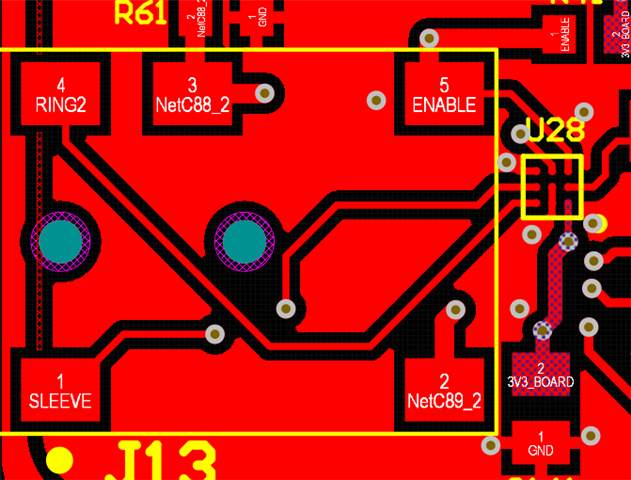
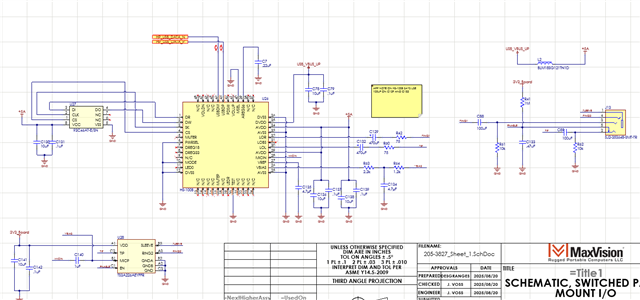
I cannot get the microphone to work reliably. If i plug and unplug the headphone jack it may work 4/10 times. Attached is the schematic. Speakers work fine, but i think something is incorrectly implemented on the TS3A226AEYFFR. Any thoughts?

Also, I have to turn up the microphone all the way up to 100% volume to get normal microphone input volume. On the OS microphone test utility in Windows once i turn up the microphone volume to 100% it registers the microphone at around 36. This is the case for the times that it is plugged in and actually works. for the other 6/10 times it doesn't register anything in the microphone test utility. 

Thanks,

Jacob
  • Hi Jacob,

    Nothing really stands out with the use of the TS3A226AE. 

    1. Ensure the VDD pin has a stable 3.3V supply.

    2. Verify the physical connectivity of the Ring2 and Sleeve pins.

    These steps will help isolate whether the problem is a board-level connection issue (ex., soldering) or a failure in the detection logic

    Thank you,

    Arya 

  • The 3.3V is stable. The issue is consistant with all 5 board assemblies. see screenshot below:

    My thought is that it has something to do with the detection logic I am using, but nothing sticks out.

  • Hi Jacob,

    First check if the jack detection is working properly, by probing the enable pin. Before insertion connect a 10k pull down resistor to the enable pin, this should hold the pins voltage to 0V. After insertion of the jack, this should cause the switch to be open and allowing the enable pin to voltage to rise to 3.3V. This test is to make sure the device is following the expected behavior.

    Thank you,
    Arya 

  • I connected a 10k pull down across C133. When the headphone jack is not plugged in i get about 15mV and when it is plugged in a get about 30mV, so this appears to be the issue. What do i need to change to get this enable back high after the insertion?

  • however when i take my schematic as is (without adding an extra pull down across C133) and instead just use what is on my board the enable pin works correctly. It uses the pull down of R62 before insertion and then uses the pull up of R41 after insertion. This results in 0V before insertion and 3.3V after insertion.

  • Hi Jacob,

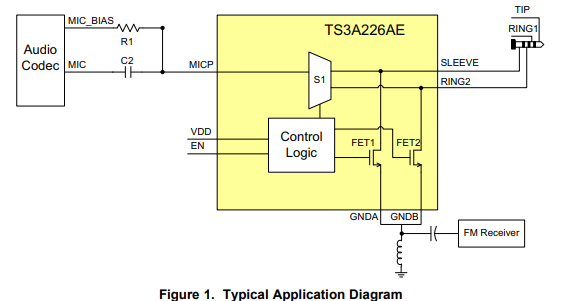
    The 15mV/30mV reading confirms the enable line is floating, meaning that it does not have a solid connection to either ground or the supply. The circuit seems not to be able to interpret these "in-between voltages" and behaves like this. As you can see in the image below, the MICBIAS voltage comes from the Audio Codec, goes through an external pull-up resistor (R_BIAS) (typically 2.2k), and connects directly to the MICP pin of the TS3A226AE. Try to see if this will fix the problem you are having.

    Thank you,

    Arya 

  • I only saw the The 15mV/30mV when i added an extra 10k pull down to the circuit i originally attached. When i don't do that and just use my pcb as it is designed the enable transitions properly between 0V and 3.3V. This seems to be working correctly. You can see that my VBISA Circuit is very close to the one your provided. I do have any extra 4.7uF cap and 1.2k resistor i could take out if you believe this to be an issue.

  • Hi Jacob,

    Yes, remove the extra 4.7µF capacitor, which could be the likely cause of the low volume. The extra resistor's value isn't a major concern, but if functionality is still an issue, then remove that as well.

    Thank you,

    Arya 

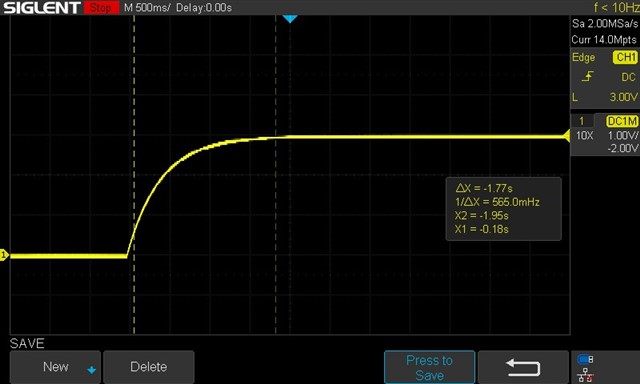
  • Removing C134 definitely helped with the low volume. I am now going back to testing the enable pin. I do get a transition when the headphone jack is inserted, but it is a long transition. See attached.

  • Hi Jacob,

    Try removing the extra resistor to see if that fixes the long transition for the headphone jack.

    Thank you,
    Arya 

  • This did not appear to help. It took 4 insertions of the headphone plug before the mic worked.

    In addition, the scope showed a transition from 0V to 3.3V over 1.58sec

  • Hi Jacob,

    Is there a capacitor in the PENABLE, that can be the reason you are seeing the ramp up like that? Try reducing the size of the capacitor if present in the PENABLE.

    Thank you,

    Arya 

  • To make the transition faster i put a 10k for R41, .047uf for C133, and a 1k for R62. This resulted in the OS recognizing the microphone 10/10 times.