Part Number: TAS6684-Q1
Other Parts Discussed in Thread: TAS6584-Q1
Hello teams,
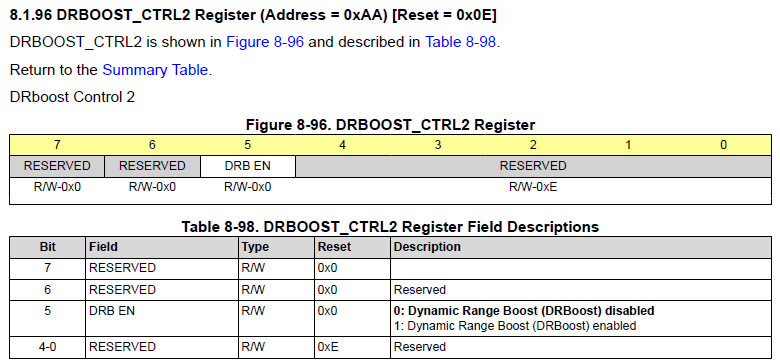
Please tell us more about DRboost.
When and under what circumstances is this feature most effective?

Best regards,
Kenji Gemma
This thread has been locked.
If you have a related question, please click the "Ask a related question" button in the top right corner. The newly created question will be automatically linked to this question.
Part Number: TAS6684-Q1
Other Parts Discussed in Thread: TAS6584-Q1
Hello teams,
Please tell us more about DRboost.
When and under what circumstances is this feature most effective?


Best regards,
Kenji Gemma
Hi Kenji
It's no suggested to use, may create some pop noise, mostly happen on low frequency audio, also sensitive speakers.
This function, is to detect the audio signal, when it is small enough, will use smaller analog gain, so the noise could be smaller. Pop is created during analog gain change.
Hello Shadow-san,
Thank you for your reply. I always appreciate your help.
I understand your answer.
Please tell me one more thing.
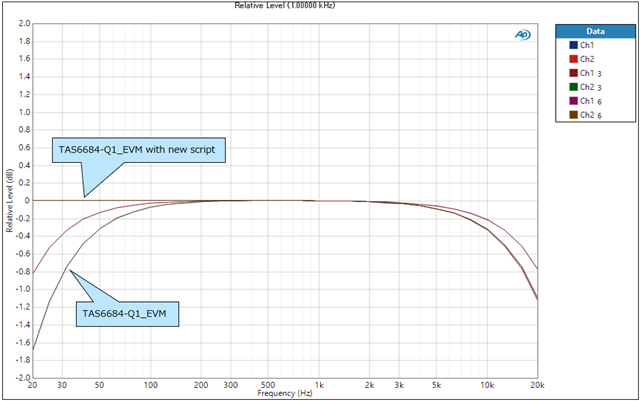
The attached diagram compares the frequency characteristics of the TAS6684-Q1_EVM and TAS6584-Q1_EVM.

As you can see, the characteristics are different.
This is especially true in the low and high frequency ranges.
Please tell me the reason for this difference.
Also, if I want to make these characteristics the same, what should I do?
Fundamentally, the register settings for both EVMs are identical.
The conditions are as follows:
1W/4ohm、DC14.4V、Sampling Frequeny:48kHz
PWM Frequency:480kHz
Modulation Scheme:1SPW Mode
Spread Spectrum:Off
DC Brocking bypass:DC Blocking enabled
Best regards,
Kenji Gemma
Hi Kenji-san
It's the internal DC block filter created such issue, the default cut off frequency is different.
Have a try to use below script for TAS6684.
w c0 00 00
w c0 7f 8c
w c0 00 04 #DC block
#48khz
w c0 b0 07 8c e6 5e f0 e6 33 44 07 8c e6 5e 0f fe dc d5 f8 01 23 17
w c0 c4 08 79 5a 00 00 00 00 00 00 00 00 00 00 00 00 00 00 00 00 00
w c0 00 00
w c0 7f 00
w c0 00 00 #Enter page0,book0.
Hello Shadow-san,
Thank you for your message. Your support is greatly appreciated.
We immediately tested the new script you provided.
The characteristics are as shown in the attachment.

The low-frequency response has significantly improved.
However, it differs from the characteristics of the TAS6584-Q1_EVM.
Our goal is to match the characteristics of the TAS6584-Q1.
We plan to apply this to a product currently under development.
We will be changing the device from the TAS6584-Q1 to the TAS6684-Q1.
We look forward to your continued support.
Thank you for your cooperation.
Kenji Gemma
Hi Kenji,
Can you confirm again the following setting is applied to the 6684 set-up?
1W/4ohm、DC14.4V、Sampling Frequeny:48kHz
PWM Frequency:480kHz
Modulation Scheme:1SPW Mode
Spread Spectrum:Off
DC Brocking bypass:DC Blocking enabled
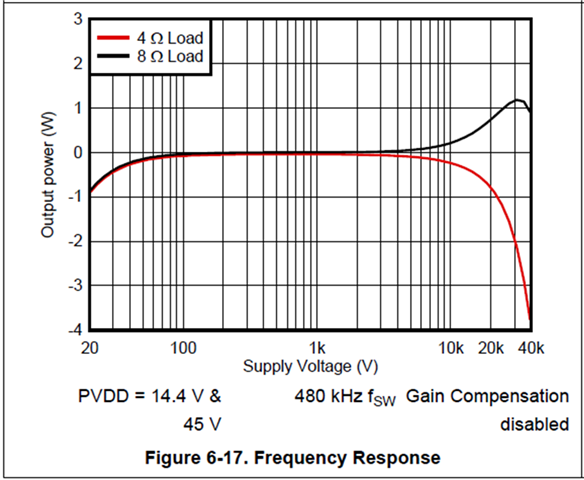
The frequency response you measured is quite different from the datasheet and I'm trying to understand why. This is what I would expect your frequency response to look like this for 6684 if the set-up is the same:

Or is there something that you know you do differently from the datasheet?
Elise
Hi Elise-san,
Thank you for your comment.
We believe the following:
The low-frequency part depends on the DC blocking bypass settings.
The high-frequency part depends on the LPF constant settings.
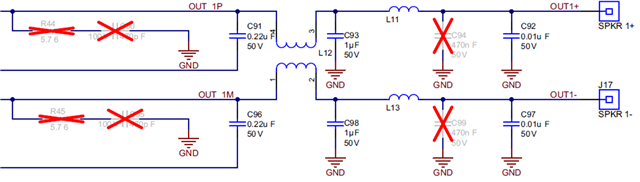
The EVM constant settings are 10uH + 1uF.


If there are no issues, could you share the register settings information from the measurement in Figure 5-26?
Sincerely yours,
Kenji Gemma
Hi Kenji,
Let me try to reproduce the frequency response on my end as well before I get back to you later today
Elise
Hi Kenji,

I got something fairly similar to you. You're right in that the EVM uses a different LC filter from the datasheet.
TAS6684 and TAS6584 will have this frequency response difference just because they're different devices with different internals (even if it's minimal). An ~0.3db difference isn't that much, though. If it's still a concern for any reason please let us know.
Elise
Hi Elise-san,
Thank you for checking the frequency response.
Please tell me:
Which of the TAS6584 or TAS6684 is the frequency response shown in the image?
Please share the register settings used at that time with us.
Best regards,
Kenji Gemma
Hi Kenji,
The screenshot was of TAS6684. I tested all 4 channels so there's 4 different colored lines.
I used the same setup as you:
1W/4ohm、DC14.4V、Sampling Frequeny:48kHz
PWM Frequency:480kHz
Modulation Scheme:1SPW Mode
I also used the TAS6684 EVM, so the same LC filter.
For register settings, I basically just ran the 9.2.1.3 Start-Up Script from the data sheet, everything else should be the device default. The start-up script does enable SS, but I double checked it with enabled/disabled and the frequency response didn't change.
If you want to discuss more detailed register settings, let's do so via email.
Elise
Hi Elise-san,
Thank you for your reply. We were able to understand the content.
Please tell us just one more thing.
How about the frequency characteristics of the TAS6584-Q1 EVM ? We know that the Start-Up Script in 9.2.1.3 does not include the DC block 3Hz description.
w c6 00 00 #DC block 3Hz
w c6 7f 8c
w c6 00 04
#48khz
w c6 b0 07 8c e6 5e f0 e6 33 44 07 8c e6 5e 0f fe dc d5 f8 01 23 17
w c6 c4 08 79 5a 00 00 00 00 00 00 00 00 00 00 00 00 00 00 00 00 00
and...

Best regards,
Kenji Gemma
Hi Kenji,
The datasheet Figure 6-17 from 6584 seems to be really close to the frequency response that you measured for 6584. Or did you want 6584 to also have a flatter response like 6684? If so, please follow this following I2C script for 6584:
Let me know if I mis-understood your question though.
Elise
Hi Elise-san,
Thank you for your reply.
Is the script for 6584 correct with the following content? We would appreciate it if you could confirm this for us.
w c6 00 00 #page 0
w c6 7f 00 #book 0
w c6 00 00 #page 0
w c6 7f 8c
w c6 00 25
#48khz
w c6 b4 7f b5 f9 b6 00 b7 00
#96khz
w c6 b8 7f b9 f9 ba 00 bb 00
w c6 00 00
w c6 7f 00
w c6 00 00
If there are no issues with the script, we'll try it out immediately.
Best regards,
Kenji Gemma
Hi Kenji
Please use it like below. The Burst write, only need to provide the first address, then followed all the data in sequence.
w c6 00 00 #page 0
w c6 7f 00 #book 0
w c6 00 00 #page 0
w c6 7f 8c
w c6 00 25
#48khz
w c6 b4 7f f9 00 00
#96khz
w c6 b8 7f f9 00 00
w c6 00 00
w c6 7f 00
w c6 00 00
Hi Shadow-san,
We confirmed that the low-frequency range exhibits a nearly flat frequency response.
Please tell us: Is the cutoff frequency for this script the same 3Hz as for 6684?
We were unable to discern any difference in characteristics between this and the DC blocking bypass state of 0x39 DSP_CTRL1.
Best regards,
Kenji Gemma
Hi
Please tell us: Is the cutoff frequency for this script the same 3Hz as for 6684?
Yes, correct.
Hi Shadow-san,
Thank you for your reply.
We have attached our measurement results.

Although we used the same cutoff frequency setting, as you can see, the characteristics differ.
Would it be possible for you to share your measurement results?
Our goal is to achieve the same frequency characteristics for both sides.
We appreciate your cooperation.
Best regards,
Kenji Gemma
Hi
Our goal is to achieve the same frequency characteristics for both sides.
Only 20Hz to 20KHz is effective frequency band for audio device. They are already totally same at 20Hz.
Hi Shadow-san,
Thank you for your reply.
We didn't expect the characteristics to differ despite having the same cutoff frequency setting.

We feel that a simple replacement from TAS6584-Q1 to TAS6684-Q1 would be difficult.
Even so, Audio and Sound Quality are not easily achieved.
Best regards,
Kenji Gemma
kenji,
There could be some slightly difference on DSP firmware about the LPF. If customer does cares about listening and want exact same configuration, would you reach to Kevin with email. So he can provide you something more about calculations and test data.
Dylan
Hi Dylan-san,
Thank you for your reply.
OK, we understand. We've also met Kevin-san.
If the difference in HPF characteristics is due to the DSP firmware, we consider it unavoidable.
The current characteristics are as shown in the figure.
(Is the new script released for the TAS6584-Q1 truly effective?)


Best regards,
Kenji Gemma
Hi Gemma-san,
I recommend contacting Kevin Lu directly via email regarding this issue.
Elise