This thread has been locked.

If you have a related question, please click the "Ask a related question" button in the top right corner. The newly created question will be automatically linked to this question.

OPA2134: PCN VCM

Part Number: OPA2134
Other Parts Discussed in Thread: OPA1678

Hi,

I would like to know the input voltage range (VCM) when the power supply voltage is ±5V.

Please tell me the Min/Typ/Max values of VCM.

If possible, I would appreciate it if you could tell me the values before and after PCN issuance (Rev. A and Rev. B).

Best Regards,

Nishie

  • Hi Nishie,

    The input common mode range can be found on the datasheet. Please refer to the table below for the latest datasheet specifications.

    The VCM for the ±5V range can be inferred by placing (5V) in for V- and V+. Therefore, the input common mode range is  -2.5V < VCM < 1.5V.

    The VCM for the pre-PCN datasheet can be found below. The positive common mode range limit is 1V closer to the rail in the pre-PCN datasheet.

    Please let me know if you have further questions.

    Best regards,
    Carrie

  • Hi Carrie-san,

    Thank you for your reply.

    The supply voltage of the OPA2134 is ±2.5V at Min. What happens to the VCM in this case?

    Best Regards,

    Nishie

  • Hi Nishie-san,

    I looked into this more, and have an update to my previous statement. The VCM for devices after the PCN issuance is shown below. This device is now capable of going to the negative rail for the input common mode range.

    (V) - 0.1 V < VCM < (V+) - 3.5 V

    The reason the minimum value was not updated in the datasheet is because it is currently possible to receive units from before or after the PCN issuance, and we wanted the datasheet to reflect the pre-PCN VCM limitation of the negative rail.

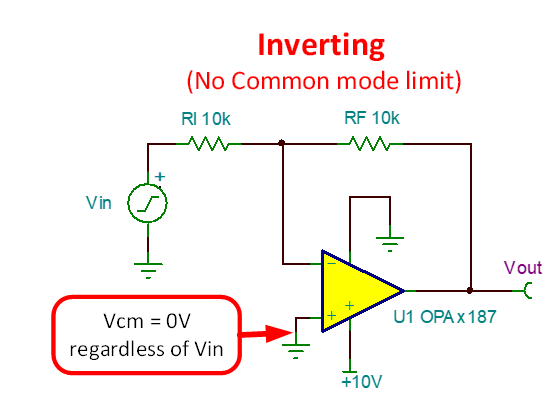
    Therefore, if you receive a pre-PCN device, the common mode range for a ±2.5V supply would be 0V. In this case, best practice would be to ground the IN+ node of the amplifier, and use the op amp in an inverting configuration (example shown below).

    If you receive a post-PCN device, the common mode range for a ±2.5V supply would be -2.6 V < VCM < -1 V. However, you also need to ensure your circuit does not violate the output swing of the op amp, so be sure to check the output voltage is within the output swing capability of the op amp.

    For more information on input common mode range and output swing, please refer to the TI Precision Labs videos found here and here. Please let me know if you have further questions.

    Best regards,
    Carrie

  • Hi Carrie,

    I'm Ryusuke Fukunaga.

    I am responding on behalf of Nishie.

    The above changes are not reflected in the PCN or data sheet.

    I would like you to revise the data sheet together with the current consumption difference discussed in the E2E below.

    OPA2134: Quiescent Current - Audio forum - Audio - TI E2E support forums

    Due to the specification change, our customer is considering the replacement of parts.

    However, there is no standard. Therefore, we have stopped shipping.

    When will it be revised?

    Best Regards,

    Ryusuke

  • Hi Ryusuke-san,

    Right now, there are still pre PCN material that is shipping, so there are no immediate plans to update the datasheet. At this time since both devices exist in market inventories, the product datasheet remains with the worst case specification. We can recommend an alternative device for the customer that has an updated datasheet. Is this an acceptable alternative?

    Best,
    Carrie

  • Hi Carrie,

    Thank you for the update and for the explanation regarding the current datasheet status.

    To proceed with selecting and evaluating an alternative device for the customer, we are considering OPA1678.

    Could you please confirm if OPA1678 is an appropriate alternative in this case?

    Also, if there are any other recommended alternative devices with an updated datasheet, we would appreciate your suggestions.

    Best regards,

    Ryusuke

  • Hi Ryusuke-san,

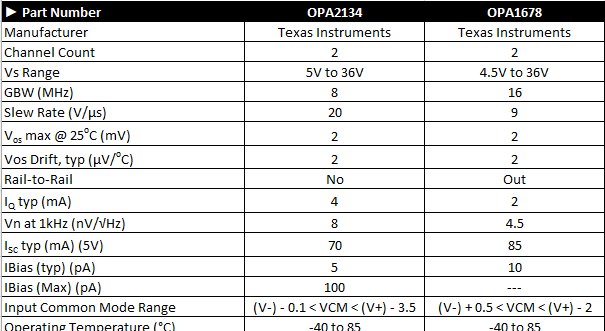
    The OPA1678 has similar specifications to the OPA2134, but it also has a higher bandwidth and lower slew rate. Below is a high level comparison of the two devices.

    From our previous discussion, we can calculate the input common mode range for the OPA1678 at a ±2.5V supply to be -2.0 V < VCM < 0.5 V. Is this range acceptable for the customer?

    Do you know how the customer is currently using the OPA2134 in their circuit? This will help to give an accurate recommendation regarding the OPA1678, as well as alternative devices.

    Best regards,
    Carrie