A related question is a question created from another question. When the related question is created, it will be automatically linked to the original question.
If you have a related question, please click the "Ask a related question" button in the top right corner. The newly created question will be automatically linked to this question.
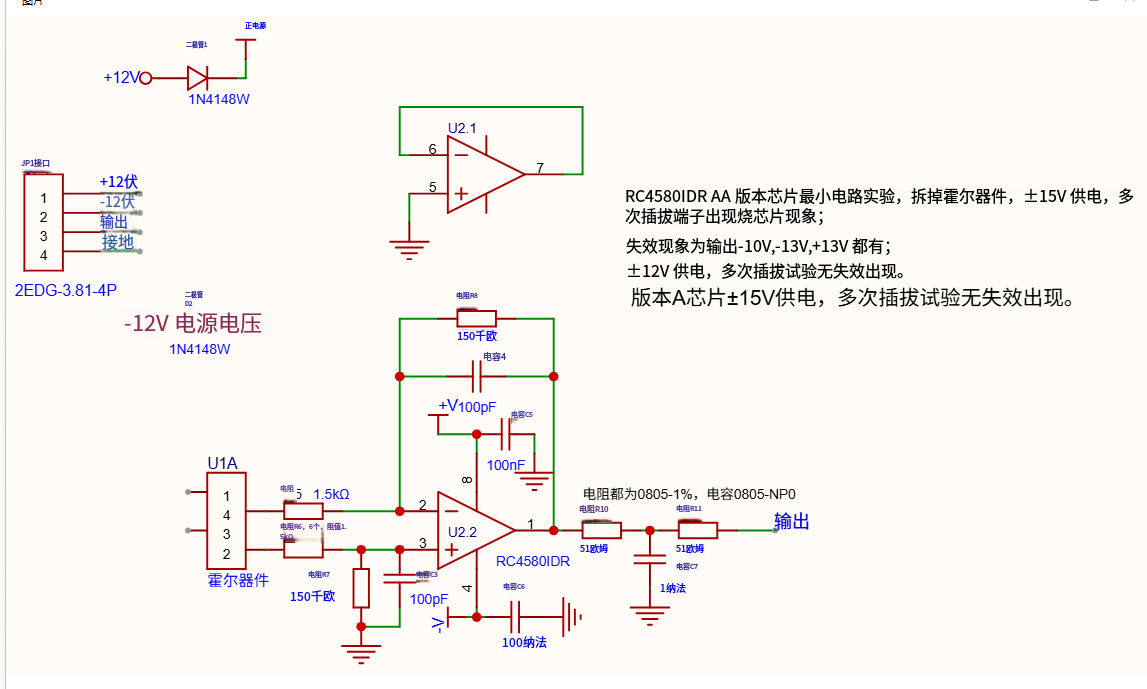
RC4580IDR We have tested this model and found that it would burn out when powered by ±15V, but there was no such issue when powered by ±12V. Could you please help us understand the cause and suggest a solution? Thanks a lot.
Have you checked for any transient electrical overstress events that may be occurring on your circuit?
The RC4580 has an absolute maximum supply voltage of ±18V and a recommended operating supply voltage of ±16V. Operating beyond the absolute maximum rating can damage the device.
Additionally, the input voltage should not exceed the supply voltage during power-up or power-down sequences. Common causes of electrical overstress (EOS) include:
Power-up/power-down transients that drive input or supply pins beyond absolute maximum ratings
Excessive input current to the input pins
To protect against overvoltage and overcurrent transient events, we recommend:
TVS (Transient Voltage Suppression) diodes for voltage clamping
Series resistors on the inputs to limit current to 10mA or less
Currently, this circuit only encountered this issue in the 25-year AA new version. The historical A version batches did not have this problem. Could you please check if it is related to the upgrade of the product wafer? And how can we avoid this situation?
The RC4580 design transitioned from SFAB (150mm) to RFAB (300mm) manufacturing, as detailed in the product change notification (linked below) from November 15, 2023. You may have received devices from either the previous or current design. The design has changed and in general the parameters in the specification table of the new device meet or exceed that of the old device.
If you are experiencing device failures, electrical overstress (EOS) is a common cause. To help diagnose the issue, please check if any of the following conditions are present in your circuit:
Power-up/power-down transients that drive input or supply pins beyond absolute maximum ratings
Excessive input current to the input pins
Understanding these potential stress conditions will help us identify appropriate protection measures for your application.
To protect against overvoltage and overcurrent transient events, we recommend:
TVS (Transient Voltage Suppression) diodesfor voltage clamping
Series resistorson the inputs to limit current to 10mA or less