TAS67524-Q1: Comparison with the TAS6424E-Q1

Part Number: TAS67524-Q1
Other Parts Discussed in Thread: TAS6424E-Q1, TAS6424E

Hello, Team,

We are considering whether to use the TAS67524-Q1 or the TAS6424E-Q1 for our new product development.
We have obtained both EVMs and are currently conducting evaluations.

We have a few questions we’d like to ask.
One of them concerns LC resonance.
As you are likely aware, LC resonance under no-load or light-load conditions is an inherent characteristic of Class D amplifiers that do not use overall feedback.
We are asking this question because we observed differences in behavior when comparing the two devices.

First, the characteristics under a 4-ohm load and an open-circuit load are as follows:
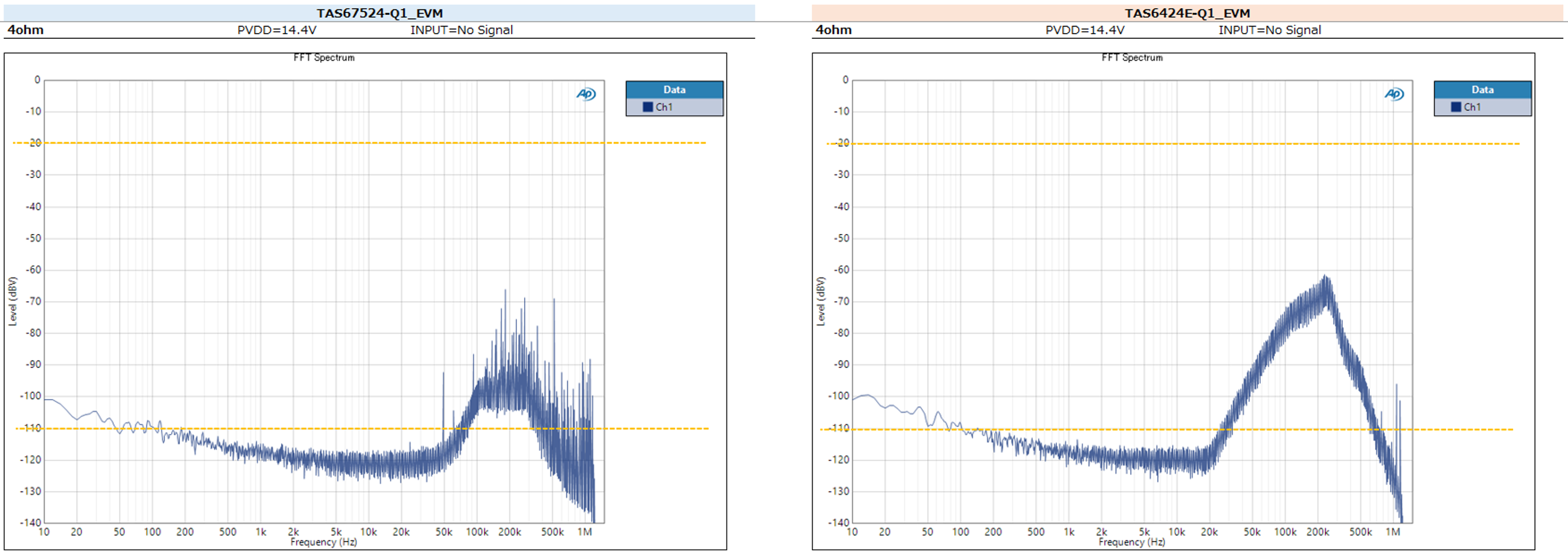
image.png

image.png


Next, when a typical speaker system is connected to the EVM, it exhibits the following characteristics.
Although a tendency toward LC resonance can be observed, there are no significant issues.
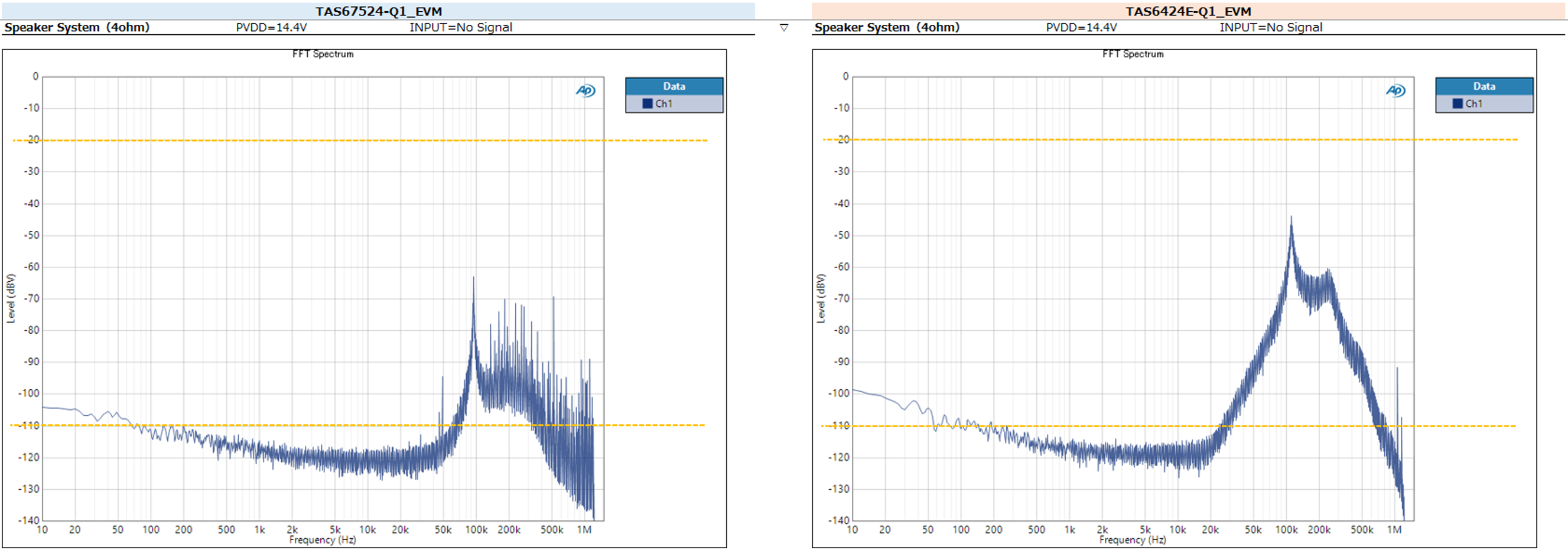
image.png


Finally, here is the characteristic in question.
The unit is powered on with a 4-ohm load connected.
Then, while in Play Mode, the load is switched from the 4-ohm load to the speaker system.
This might seem a bit tricky, but it simulates a change from the end user’s perspective.

The TAS6424E-Q1 shows no particular change.
However, the TAS67524-Q1 does show a change. It behaves almost as if the load were OPEN.
Why does this change occur?
It appears to be a change specific to 1L Modulation—what do you think?
Please let me know the cause of this.
In this case, I presented the characteristics using a Speaker System load for clarity, but the same trend is observed with a dummy resistor as well.
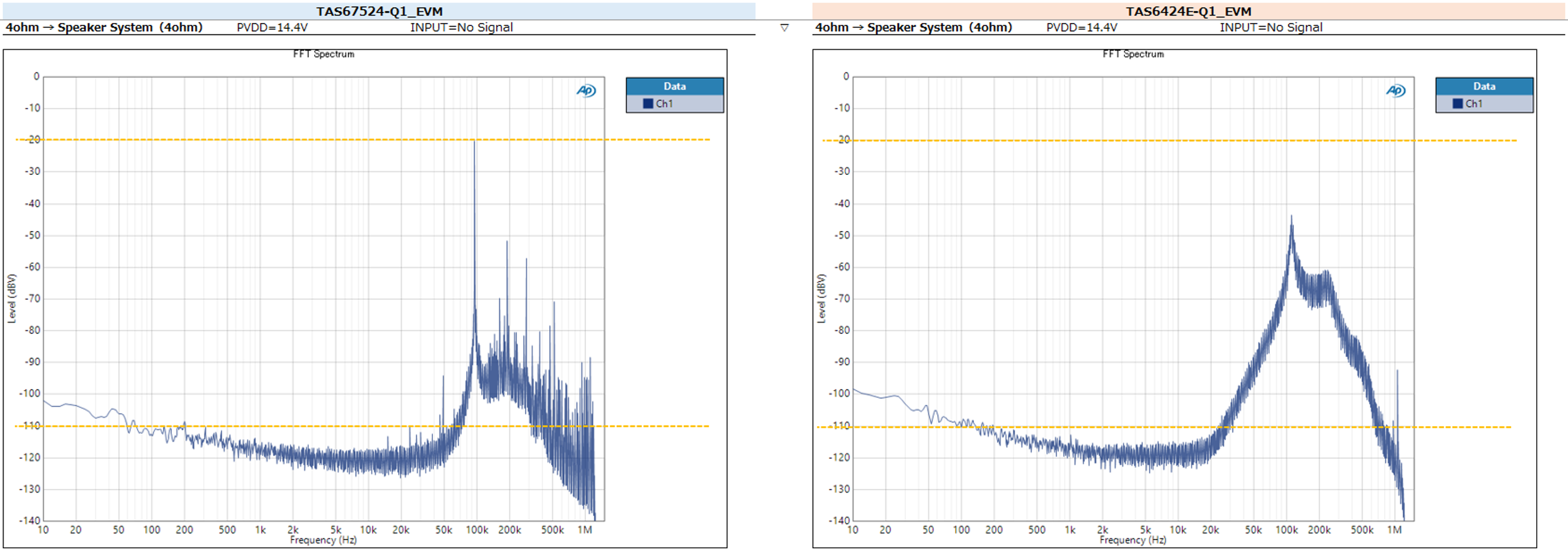
image.png


Best Regards,
Kenji Gemma

  • Hi Kenji

    The TAS6424E-Q1 shows no particular change.
    However, the TAS67524-Q1 does show a change. It behaves almost as if the load were OPEN.

    It feels like, when TAS67524 make this changes, there's likely to be more oscillation, similar with open load. Kindly use oscilloscope to confirm it.

    It's hard to tell the exactly reason. Just from the testing method, seems the oscillation would appear during the load transition moment. And after speaker connected, TAS6424E dumped better.

  • Hello, Shadow-san,

    Thank you for your reply.

    We understand that the TAS67524-Q1 is experiencing oscillation.
    We are also verifying the symptoms simultaneously using an oscilloscope.
    At this point, the TAS6424E-Q1 seems to be performing better.

    We would like to hear your opinion on the following symptoms.
    When the load is open, we apply an input signal of 1 kHz at -20 dBFS.
    In the case of the TAS67524-Q1 EVM, the peak value of the LC resonance changes significantly and decreases.
    On the other hand, in the case of the TAS6424E-Q1 EVM, the peak value of the LC resonance does not change significantly.
    We would like to know the reasons for these differences.

    Best Regards,
    Kenji Gemma

  • Hi Gemma-san

    We would like to know the reasons for these differences.

    From our side results, both of the silicon's resonance will decrease, after you keep increase the output level. There's maybe some difference between devices, this 2 parts have time span over 10 years. Won't be totally same.  

  • Hello, Shadow-san,

    Thank you for your reply.

    We have also confirmed the symptoms you reported.
    We suspect that increasing the output level raises the excitation current of the LC filter, which is affecting this characteristic.
    It appears that the output signal affects this characteristic more at higher frequencies than at lower frequencies.
    Unlike pure BTL, the 1L modulation may have slightly weaker cancellation capabilities.
    We feel that the TAS6424E-Q1 performs slightly better.

    We have another point of concern.

    It is the “Speaker load inductance” parameter.
    This parameter is listed in the TAS67524-Q1 datasheet.
    However, it is not listed in the TAS6424E-Q1 datasheet.
    What would be the recommended value for the TAS6424E-Q1?

    Best Regards,
    Kenji Gemma

  • Hi Gemma-san

    What would be the recommended value for the TAS6424E-Q1?

    TAS6424E doesn't have this limitation, no problem to use any 2ohm speaker.

  • Hello, Shadow-san,

    Thank you for your reply.
    We were relieved to hear that the TAS6424E-Q1 works fine with a 2-ohm load.

    By the way, a value of 100 uH with a 2-ohm load seems a little low to us—what do you think?
    Many 2-ohm woofer units, including their crossover networks, will likely have a higher impedance.

    What kind of behavior does it exhibit before the protection circuit activates?
    Does any related noise occur?

    Best Regards,
    Kenji Gemma

  • Hi Kenji

    For the part TAS67524, indeed lots of 2ohm speaker not suitable to use, as they may have larger inductor than 100uH.

    The major concern is the voltage and current phase shift created by this inductor. TAS67524 OUTM side is not PWM output, having period works under linearity states. If phase shift created large current during this moment, will create too much heat at OUTM, and trigger to protection.

  • Hello, Shadow-san,

    Thank you for your reply.
    We apologize for the delay in our response.

    Thank you for sharing this information. It’s very helpful and has been a great learning experience in understanding this unique AMP device.
    In particular, we understand that even if a large current is generated due to a phase shift, the protection circuit will activate, so there is no problem, and no noise is generated from the speakers.
    Therefore, we will not hear any unpleasant sounds.

    Also, the TAS67524-Q1_EVM appears to exhibit somewhat unusual behavior at a sampling rate of 44.1 kHz.
    While we do not consider this behavior to be a problem, it is peculiar.
    We're looking forward to the next new AMP device, as it appears to have been improved.

    Best Regards,
    Kenji Gemma