TAS2563: SmartAmp Excursion Protection does not appear to work on target hardware

Part Number: TAS2563

Hi Team,

We completed speaker characterization and tuning using PPC3 on the TAS2563 EVM and applied the generated tuning/bin file to our target hardware.

EQ and DRC appear to be working as expected on the target system, but we do not observe the expected SmartAmp excursion protection behavior.

Related discussions:

Could you please help us with the following questions?

  1. What are the possible causes when excursion protection does not appear to operate on the target hardware, even though the tuning data was generated successfully and other audio processing features are working?
  2.  Is there any way to directly confirm that SmartAmp excursion protection is active? For example:
  • Registers
  • Status flags
  • TDM feedback signals
  • Logs or debug information

Currently, we are evaluating the protection behavior only by observing speaker output power, frequency response, and audible output level changes. We would like to know whether there is a more direct and reliable method to verify that excursion protection is operating correctly.

Any debugging suggestions would be greatly appreciated.

Best regards,

  • Hi Hitoki Ishikawa,

    first, please confirm the excursion protection is running correct by below method:

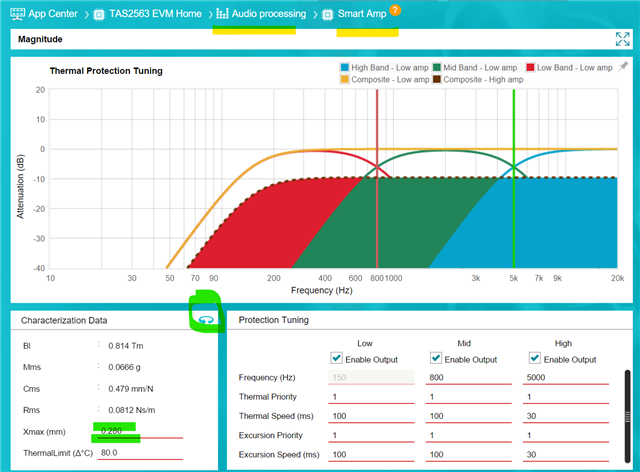
    goto below page: audio processing -> smart app, the left bottom corner, change the xmax to a very small value like 0.0001, and change the thermal value to 1000.

    if you don't see this page, click the "turn around" button in green.

    and meantime, please disable all other processing modules.

    after these setting, save the setting to SS and generate a new bin file. check the output. 

    it should output a much small signal than previous normal value.

    after confirm the excursion protection running correctly, you can change back the thermal protection, or other modules. to check which module is the bottle neck.  sometimes, the excursion is not the bottle neck, so you will not see obvious difference even there is no excursion protection, because other module limit the output to a limited level which will not trigger excursion protection.

    Br,

    Wenbin

  • Hi Wenbin,

    Thank you for your suggestion.

    We followed a similar approach to evaluate the excursion protection behavior on the TAS2563 EVM.

    After speaker characterization, we intentionally configured excursion protection to intervene aggressively under our worst-case test conditions. We then measured the speaker output power and confirmed a clear and repeatable reduction in output power when the protection became active.

    After applying the generated tuning/bin file to our target hardware, we repeated the evaluation using the same audio content and similar gain conditions. However, unlike on the EVM, the output power on the target hardware was not limited as expected under the same test conditions. We also observed noticeable audible distortion from the speaker during playback.

    Based on these results, we believe there is a clear difference in behavior between the EVM and the target hardware, and we suspect there may be a configuration or integration issue on the target platform.

    Could you please advise on the most likely causes of this behavior and any recommended checks?

    Thank you for your support.

    Best regards,
    Hitoki

  • Hi Hitoki Ishikawa,

    please share the results with my method ( change the xmax to 0.001).

    usually, the output power is not related to the excursion protectly strictly. the excursion protection only limit the max output power, but the tested power usually is the average. even the protection is running correct, the tested average doesn't change obviously.

    Br,

    Wenbin

  • Hi Wenbin,

    Thank you for your reply.

    We will ask our software team to test with the very small Xmax setting. However, due to upcoming vacations, it will take more than 10 days before we can share the results.

    In the meantime, could you please help with the following questions?

    1. Are there any common configuration or implementation issues that could prevent excursion protection from working correctly? Any recommended checkpoints would be helpful.

    2. You mentioned that output power is not a good indicator of excursion protection. However, we observed a clear and repeatable output power change when only the Excursion Priority parameter was modified. If this behavior is not related to excursion protection, could you please help us understand what causes the observed output power difference?

    For reference, the attached plots show the measured output power versus frequency on the TAS2563 EVM. All settings were identical except for the Excursion Priority parameters. Output power was calculated from the speaker voltage and current waveforms measured with an oscilloscope.

    Thank you for your support.

    Best regards,
    Hitoki

  • Hi Hitoki,

    beside the characterization, please check the priority setting of excursion, it should be 1/1/1 for init tuning. 

    regarding the output power, the significant difference can indicate the protection. but if there is only a little difference of the excursion protection, the output power is not so obvious. so that's why I say it is not a good indicator to check the excursion. but if you change excursion protection very aggressive, of course this can be a indicator.

    Br,

    Wenbin

  • Hi Wenbin,

    Thank you for your reply.

    I checked the excursion priority settings.

    Our current tuning uses excursion priorities of 0.2 / 0.3 / 0.6 because the default 1 / 1 / 1 settings allowed noticeable speaker distortion under our worst-case test conditions. For this reason, we do not consider 1 / 1 / 1 to be a suitable final setting for our target product.

    As shown in the plots I shared earlier, this tuning clearly limited the output power on the TAS2563 EVM and the behavior was repeatable.

    The same tuning/bin file was then applied to the target hardware. However, under the same test conditions, the output was not limited in the same way and noticeable audible distortion was observed from the speaker.

    Regarding your comment that the excursion priority should be 1 / 1 / 1 for initial tuning, could you please help us understand how this relates to the issue we are seeing?

    Since the same tuning produced the expected excursion protection behavior on the TAS2563 EVM, we would like to better understand what could cause the target hardware to behave differently.

    Could you please advise what the next troubleshooting step should be?

    Thank you for your support.

    Best regards,
    Hitoki

  • Hi Hitoki Ishikawa,

    usually the excursion priority less than 1 will compress the signals. it can improve the distortion, but it will reduce the output too.

    usually the noise issue for certain frequency band( usually it is around f0) could be fine tune by EQ/DRC.  add negative gain around f0 by EQ, and limit the peak output in low band by DRC could improve such issue. 

    Br,

    Wenbin

  • Hi Wenbin,

    Thank you for the explanation.

    Our intention is to maintain sound quality at normal listening levels and rely on excursion protection to reduce only the frequencies that would otherwise exceed the speaker limits at high volume.

    For this reason, we would still like to understand why the same tuning behaves differently between the TAS2563 EVM and our target hardware, and continue investigating the excursion protection issue.

    Could you please advise what we should check next regarding the difference between the EVM and the target hardware?

    Also, for this type of use case, would TI generally recommend relying primarily on SmartAmp excursion protection, or using EQ/DRC as the primary method to control speaker excursion?

    Even if EQ/DRC tuning is recommended, we would still like to understand and resolve the difference in excursion protection behavior between the EVM and the target hardware.

    Thank you for your support.

    Best regards,
    Hitoki

  • Hi Hitoki,

    usually the EVM and project will have difference audio performance because of the below reasons:

    1 power supply

     usually the EVM can have better power supply. the current limit from power will high, and the external loss is less. you can check this by measure the vbat voltage by scope.

    2 speaker box mechanical difference

     EVM may use separate speaker box which is not assembled in the big housing, there will be more acoustic loss in the project level. and sometimes there will be noise which is caused the vibration from other part but not speakers.

    3 thermal 

    EVM tuning will have better thermal environment, it will not trigger thermal protections. or later than project level tuning.

    and another thing, the noise issue is not equal to excursion protection issue. the noise issue should always covered by multi-modules as there are various reasons for it. the excursion protection only limit the excursion to under the max allowed value, this can be verified by laser measurement.

    Br,

    Wenbin

  • Hi Wenbin,

    Thank you for the information.

    Regarding the points you mentioned:

    1. We agree that the EVM likely has a better power supply than our target hardware. However, we would expect a weaker power supply to reduce the available output power rather than increase it. In our case, the target hardware produces higher output under conditions where the EVM output is already being limited.

    2. For characterization and tuning, we used the actual target speaker installed in the final product enclosure and connected it to the TAS2563 EVM through a speaker harness. Therefore, the speaker and acoustic structure were the same as the target hardware.

    3. We would also expect thermal effects to reduce output power rather than increase it.

    For these reasons, we are still struggling to understand why the same tuning behaves differently between the TAS2563 EVM and the target hardware.

    Could you please advise what other factors could cause SmartAmp excursion protection to behave differently on the target hardware? Are there any configuration, driver, or feedback-path related items that we should verify?

    Thank you for your support.

    Please note that our response may be delayed due to an upcoming holiday.

    Best regards,
    Hitoki

  • Hi Hitoki,

    in this case, I think the power supply could be the main reason for your case. you can use the device's power supply to drive EVM for evaluation. 

    Br,

    Wenbin