DIR9001: Parity Error

Part Number: DIR9001

Hi team,

Please advise on the parity error behavior of the DIR9001.
I am confused regarding the behavior of the data output (DOUT) when a parity error occurs.

Does it interpolate the data, or is it fixed to "L"?
The datasheet contains descriptions that could be interpreted as both.

One part states that if ERROR is "H", the output interpolates from the previous data. Does this mean the signal output from the DIR9001 is slightly buffered to allow for parity calculation and processing?
Does it check the 31st bit of the AES subframe?

image.png

image.png
On the other hand, the following is described regarding the ERROR pin:
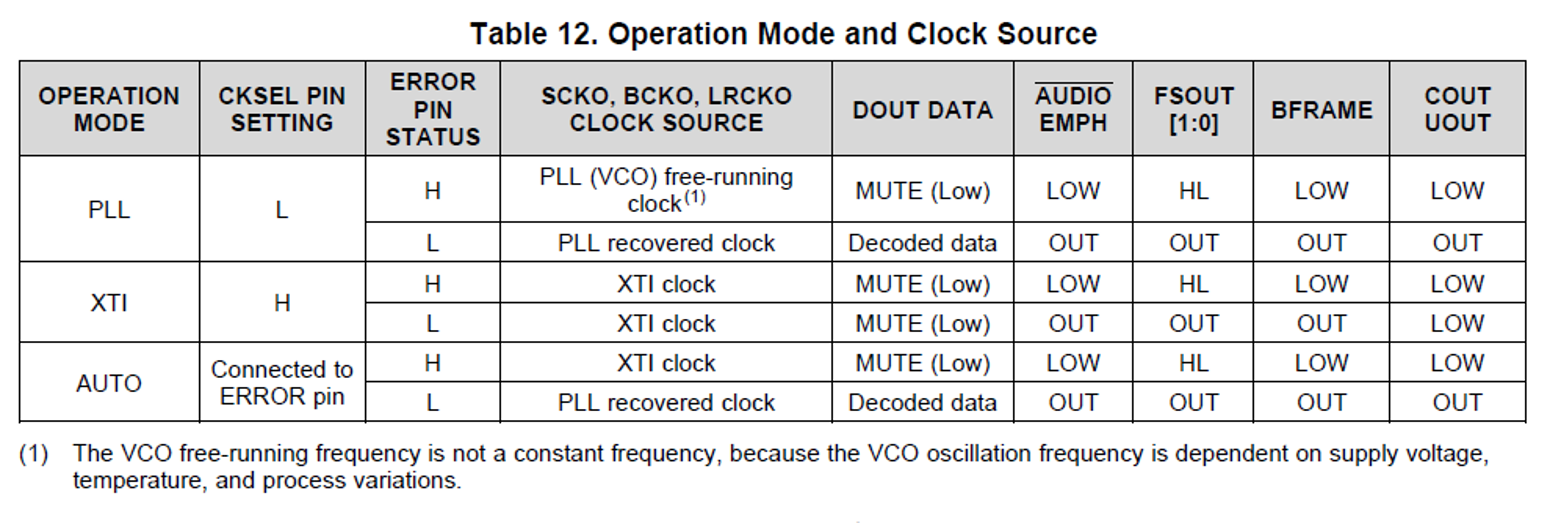
image.png

When the ERROR is "H", does it mean the DOUT DATA is Low?

I feel there is a contradiction in the behavior of DOUT when the ERROR terminal is "H".
Am I misunderstanding something?

Best regards,
Kazuki Itoh

  • Hello,

    Error  happens under 2 conditions: Unlock state of PLL or detection of parity error

    if PLL is not locked, the device cannot output meaningful audio, so DOUT is forced to mute.  Table 12 describes this scenario.

    However if PLL is locked and the Error is due to parity error, then for PCM data , the corrupted sample is replaced with the previous valid sample (interpolation), and for Non-PCM data , the data is passed through as-is with no interpolation.

    Kind Regards,

    Arash

  • Hi Arash,

    In other words, is my understanding correct that simply monitoring the "H" state of the ERROR pin is insufficient to distinguish between the two errors, and that we must also observe the state of DOUT to make a determination?

    ERROR PIN: H

    • DOUT is L PLL Unlock
    • DOUT changes Parity Error

    Just to confirm, is it correct to assume that because the data immediately preceding a parity error is used for compensation, there is a slight internal buffer link?

    Best regards,
    Kazuki Itoh

  • Hello, Yes, the Error is the OR gate of 2 different errors as shown below. 

    also there is an internal buffer as you mentioned.

    Regards,

    Arash