Part Number: TLV320AIC3204
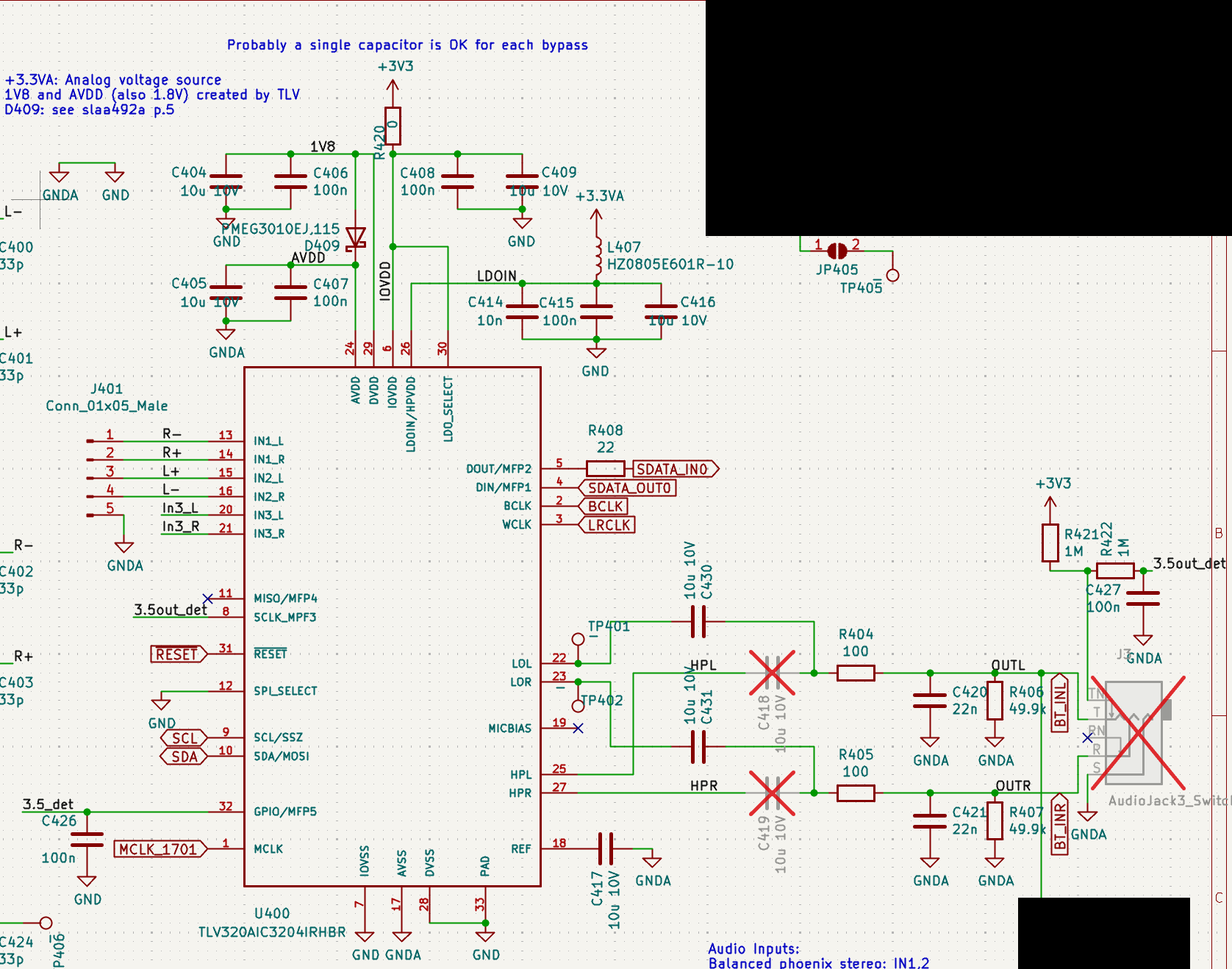
I'm having a hell of a time with pops on startup. This happens if I use the line output or headphone output. Relevant schematic:
Any ideas what's happening?
Part Number: TLV320AIC3204
I'm having a hell of a time with pops on startup. This happens if I use the line output or headphone output. Relevant schematic:

Any ideas what's happening?
Hi,
Pop is caused by some kind of sudden voltage change. These drivers are not centered at 0, they charge up to the common mode on start up. To minimize the pop created by the start up, the ramp up of the transient can be controlled on the headphone outputs. Section 2.2.3.1 of the application reference guide gives details on how to select these controls correctly.
You added the comment as I was typing this. So if this is happening because of the power supply coming on, and not the codec waking up, check section 3 of the power sequencing app note. https://www.ti.com/lit/an/slaa492a/slaa492a.pdf?ts=1790110700149 You can use a diode to make AVDD and DVDD ramp at the same time. This will mitigate pop.
I will also add, that it is generally bad practice to power things on when you are wearing headphones that are plugged in. Stopping pops is notoriously difficult if you are powering up the signal chain in reverse order (headset / speaker / etc is already on / being listened to when something up stream is powered on).
Best regards,
Jeff McPherson
Thanks! To be clear, the pop is happening before the codec is programmed, so nothing about the programming can cure this.
Do you not see the diode I have in my circuit? Is it not correct?
We can't ship a product to customers that pops this badly during powerup, this is well beyond the usual clicks or thumps. This is a >1V, 100us pop, and that's with a 1k resistor installed to ground on the headphone out.
Hi,
Diode looks fine.
Otherwise the only things to help mitigate it would be see if your power sequence is following the plots below. I agree that sounds like a violent pop, but this device is pretty limited regarding what we can do around the rails hitting the device and causing the pop.

The other thing I would recommend is to adjust the passives you have on your output, either remove one by one or swap values. The cutoff of the RC is much higher than audible (~70kHz) and slowing down the transient might help mask the pop.
Best regards,
Jeff McPherson
Thanks. I can't believe for a moment that a pop like this would be acceptable to any audio product. It's a pretty nasty sounding pulse!
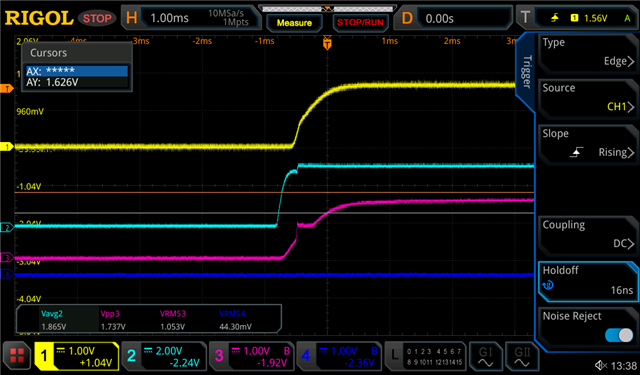
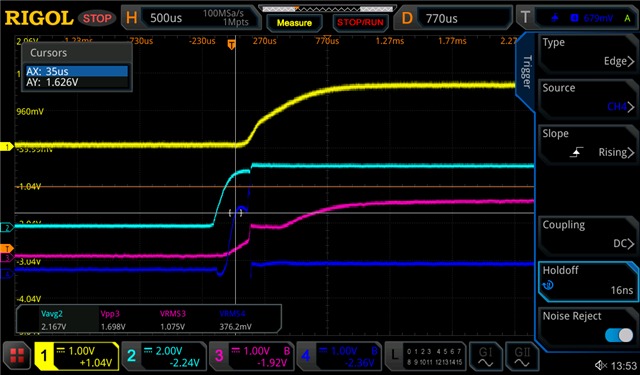
I did measure the power sequencing. IOVDD appears at least 600ms before anything else, and RESET goes high about 50ms after DVDD/AVDD/etc. Here's a plot:

Channels are: yellow=DVDD, cyan=LDOIN, magenta=AVDD.
It looks like everything is satisfied - do you see any issue?
There must be something very wrong here. This is well beyond a modest click or thump.
Going back to line output (moved the caps back), I get exactly the same poweron spike as in the headphone case.
But I also get a really nasty click when the 1.65V common mode and LDOIN supply is turned on (P1_R10 0x33 --> 0x3B) A smaller thump happens at P1_R9=0x0c (line driver power on).
How is this mitigated? I can't accept that this is how this codec is intended to behave.
Hi Joe,
Thank you for the plots. I think your power sequence looks fine. Since you are only providing LDOIN and IOVDD there's not much to do here. What you're seeing is how DVDD and AVDD are waking up, and when the diode kicks in to short the supplies together.
What I recommend is to completely float the outputs first and see what the pop looks like. Whichever outputs don't have the caps on them, you can measure on the output pads. This just removes any variables in the output filter or the layout.
The pop is also suspiciously close to the shape of LDOIN. If you have any method to slow down LDOIN (bigger coupling caps, small resistor, etc) I would be curious to see how that changes the pop profile.
Another thing I notice is that the AVDD is slower as the app note says, but it starts ramping first (could be dependent on coupling and/or the drive of the supply itself). The diode doesn't get a chance to keep the supplies together. See if flipping the diode direction makes a difference.
As a last ditch effort I would try to use a different power sequence. There a couple of other notes in the power sequences that comment on the pop of the outputs. Driving DVDD with 1.8V instead of relying on the LDO lets you keep LDOIN low until AVDD is present, which is mentioned to be a source of pop. In the single supply case, the diode should help with this, but splitting up the supply gives us more control at least for debugging. I know it's not in your schematic, but if nothing else is helping, I would try this to just to see.

Best regards,
Jeff McPherson