TAS67534-Q1: Sampling Frequency

Part Number: TAS67534-Q1
Other Parts Discussed in Thread: TAS67524-Q1

Hello, Team,

Please give us some advice.
The latest datasheet for the TAS67534-Q1 includes the following description in the “Startup Script” section:
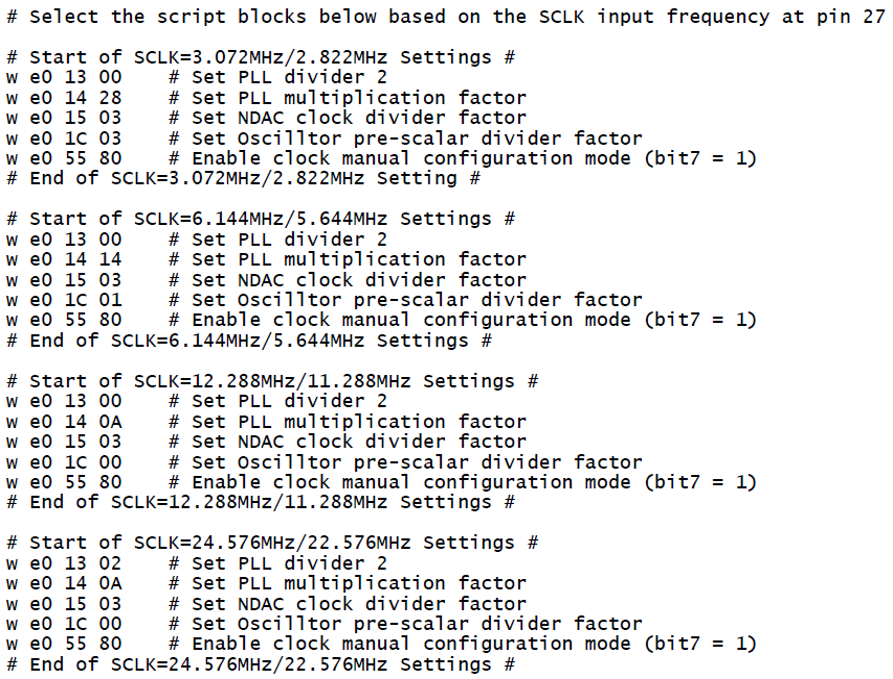
image.png

Please explain the contents of this section in more detail.
This is because we cannot understand the details based on the comments alone.

This is not mentioned in the Startup-Script for TAS67524-Q1; please also explain why.

Best Regards,
Kenji Gemma

  • Kenji,

    This configuration is for manual PLL configuration for internal clock system. This is a special requirement for TAS67534-Q1 only, and has to be followed.

    Previous TAS67524-Q1 used automatic PLL clock configuration, so not have this section. 

    Dylan

  • Hello, Dylan-san,

    Thank you for your continued support.
    We appreciate your cooperation.

    Thank you for your reply.

    Since this information wasn't included in the script for the previous prototype silicone sample either, we asked about it.
    We understand that, for some reason, it is necessary to switch from the automatic PLL clock configuration to the manual PLL clock configuration.

    As you mentioned, if it is absolutely necessary to follow this script, it would be helpful if you could include that information in the datasheet or supplementary materials.

    Perhaps we're not reading the datasheets correctly.
    As things stand, there's a high likelihood that we're missing necessary information.
    Although it's rare, there are occasional cases where the script isn't applied.

    We understand that the TAS67524-Q1 has automatic PLL clock configuration, so we believe there is no issue.
    This does not apply to this device.

    Next, we plan to evaluate Hi-Res audio.
    We plan to use a sampling rate of 96 kHz.
    The bit depth will be 24 bits.
    We will play back signals with high frequencies of 20 kHz or higher.
    If you have any points to note or advice, please let us know.

    Best Regards,
    Kenji Gemma

  • Kenji,

    I would say this changes happens before this device goes to production.  the early datasheet still support automatic clock configuration, so this could made some misleading to you. Sorry that.  While standing today, the software has to follow these steps to configuration. 

    Perhaps we're not reading the datasheets correctly.
    As things stand, there's a high likelihood that we're missing necessary information.

    About the Hi-res support, I would like to ask your pre-evaluation on some aspects.  My point is: TAS67534-Q1 has a new modulation,  even though we have tested in our test bench, still need your pre-evaluation to confirm able to support real application case.

    1. Thermal performance when playing high frequency audio.  Device will have higher loss when play >20KHz audio frequency, so please evaluate the loss versus thermal dissipate capability of heatsink, make sure there is no issue.

    2. THD performance at required output power of Hi-res. For example, Hi-res speaker requires 5W?  then measure Frequency versus THD at 1W, 5W with speaker load.  make sure there is nothing un-expected with this requirement test senario.

    Dylan

  • Hi, Dylan-san,

    Thank you for your reply.

    About the Contents of the Startup Script
    Please tell me more about this matter.

    Q:Are the hardware specifications of the prototype and mass-produced versions of the device the same?

    Q:Would it be okay to apply this script to a prototype of the device?
        We do not have any mass-produced units of the device.

    Q:We are currently conducting various evaluations using prototype devices. Are there any particular issues?

    About Hi-Res Support
    Thank you for sharing this valuable information with us.

    1.We also have concerns regarding thermal performance.
       In actual use, the power output may be only a few watts, but we plan to conduct various tests to evaluate the situation.

    2.We'll check the THD performance.
       If possible, we plan to compare it with the 6424.

    Best Regards,
    Kenji Gemma

  • Kenji,

    The pass produced silicon are the same. 

    Q:Are the hardware specifications of the prototype and mass-produced versions of the device the same?

    Yes, it can be applied to prototype device.  While please make sure the device is final version silicon, it can be confirmed by below reading method

    w e0 00 00 # Page 0

    w e0 7F 00 # Book 0

    w e0 7D 11 # Enter setup mode

    w e0 7E FF # Enter setup mode

    w e0 00 02 # Page switching to page 2

    r w0 00 0E # Read 0x0E register,  if it is 0x41, it is final silicon 

    w e0 00 00 # Page switching to page 0 (00)

    w e0 7D 00 # Exit setup mode

    w e0 7E 00 # Exit setup mode

    Q:Would it be okay to apply this script to a prototype of the device?

    Dylan