This thread has been locked.

If you have a related question, please click the "Ask a related question" button in the top right corner. The newly created question will be automatically linked to this question.

Input Capacitor simplification when driving two ICs

Other Parts Discussed in Thread: TPA3106D1

Hello,

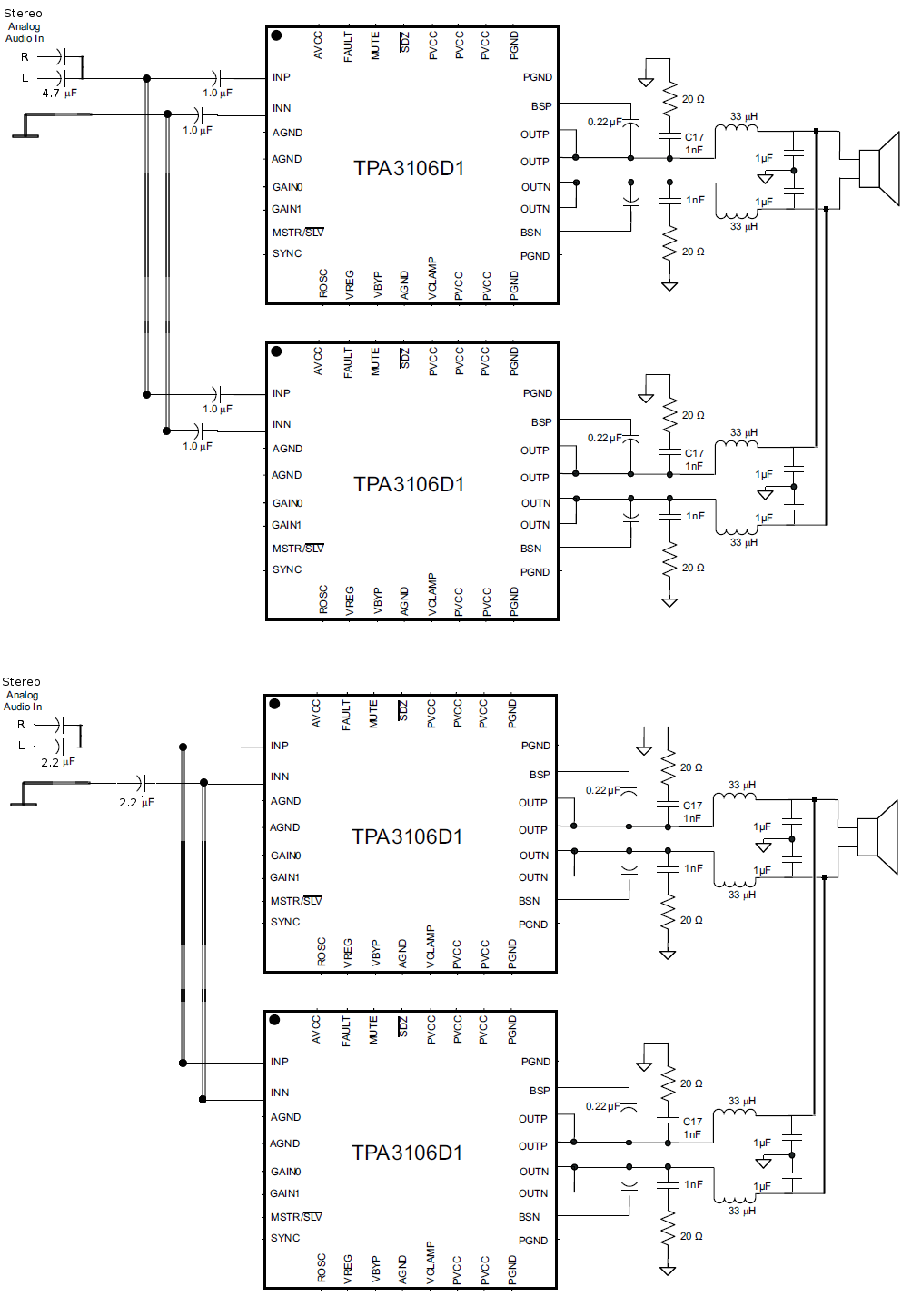
I use two TPA3106D1 in PBTL and i wanted to ask if I can simplify the input capacitors like the image shows. The upper scematic is how it works right now and I like to change it like the under schematic shows it. Does that work, beside the cutoff frequency is slightly different? (both TPA's are connected to the same supply)


Regards

Martin


  • Martin, you can try this, but make sure you don't rely on a sample of 1 or 2.  I discourage connecting the inputs of the 2 TPA3106D1 together directly.  Each could act like a DC termination for the other, and their output offsets could become large.

    I noticed a potential problem in paralleling 2 different chips.  PBTL depends on having the same gains in both amplifiers, so they share the load current.  Our stereo chips have Left and Right gains that are well matched, so there is no problem for them.  Separate TPA3106D1 gains can differ by +/-1dB, or 2dB total, so their load sharing could be off by 120% / 80%.  Also, I expect you have sync'd the chips so they follow the same switching clock.

    Best regards,

    Steve.

  • Hi Steve


    In that case i leave the input capacitors as they are now.


    I have noticed that the current draw of each amp at low output power (0...1WRMS) is very different but with high output power (10..30WRMS) the current of the amps are equal. Also i have measured the Temperature of the case while operating and it shows that they have the same temperature if working with high output power.

    Just to try i had the input of one amp adjusted until both amps drawn the same current while working in PBTL and i couldnt measure any better performance while operating with high output power.

    Because of this knowledge i assumed that  i can ignore the differences in Gain ?


    I havent sync'd them and i thougt it doesnt matter since i paralell them behind the output filter. What advantages/disadvantages would there be if i sync them ?


    Greetings

    Martin

  • Martin, when the switching outputs are sync'd, their filter inductors will tend to force sharing of the load current.  If the switching frequencies are different, it is possible to generate beats at audio frequencies that are audible.  So it is good that you have the 2 amplifiers sync'd.

    I think it is not very likely you will see an extreme gain difference of 2dB between amplifiers, so I think in most cases you will find the current sharing is good.  Generally you should not see any significant effect from differences in gain.  (This is not a great risk, which is why I called it a potential problem.  I just wanted to bring this to your attention.)

    Best regards,

    Steve.

  • Hi Steve

    I will make some tests with sync'd amps. Isnt there the downside that both amps draw peak current when switching exactly at the same time ?

    And is it better and possible to invert the input and the output of one amp to prevent that current peak ?


    Regards


    Martin

  • Martin, the goal is to keep the 2 amplifiers in phase so they share the load current.  The entire load current must be drawn from the power supply in some fashion anyway.  Placing the 2 amplifiers out of phase would go against this goal and make them circulate current between them, rather than pushing it into the load.  So please keep the 2 amplifiers sync'd and in phase.

    Best regards,

    Steve.

  • Ok,


    i will get back if i got results. Thank you for youre time!


    Regards


    Martin