A related question is a question created from another question. When the related question is created, it will be automatically linked to the original question.
If you have a related question, please click the "Ask a related question" button in the top right corner. The newly created question will be automatically linked to this question.
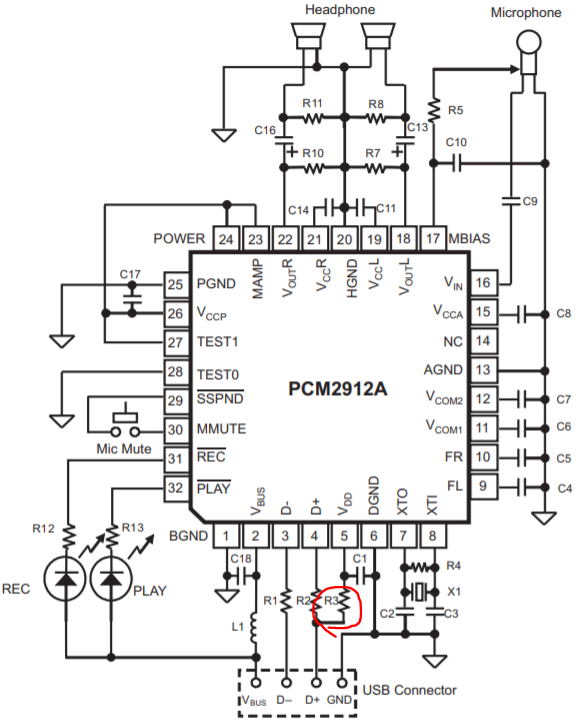
This pullup resistor is commonly used in USB protocol so that the controller can sense when a device is connected to the line. It is also used for speed sensing. Typically this resistor remains connected when you want USB to operate in low speed mode. Sometimes this resistor is integrated into a device and will be used for indicating that a device is connected, but will then be switched out so that the bus has the proper termination for high speed mode.
"Typically this resistor remains connected when you want USB to operate in low speed mode."
-> So if we want the device to operate in high speed mode, can we remove the pullup resistor?
Or do we need a switch for this? So that at first the device can be detected then we switch off the resistor so that it can operate in high speed mode?
The pullup resistor is needed for the host to detect when the device is connected, otherwise there is no way to know when a device is on the bus. Connecting a 1.5kOhm pullup to the D- line signifies a low-speed device, and connecting it to the D+ line signifies a full-speed device. The USB protocol also defines a high-speed (480Mbps) and super-speed (10Gbps) class of device which initially enumerates as a full-speed device with the mentioned pullup resistor. In that case, the resistor must be switched out. However, the PCM2912 is a full-speed device, so you should have a 1.5kOhm pullup on D+ and do not need to worry about switching it out.