This thread has been locked.

If you have a related question, please click the "Ask a related question" button in the top right corner. The newly created question will be automatically linked to this question.

LM4865: Issue with volume control

Part Number: LM4865

We have an application where we are using an LM4865 to output a 250Hz tone. We would like to amplitude modulate this tone with a 1Hz sine wave, and have set up the volume control too accept such a signal. The 1Hz sine wave varies between 1.6V and 3.0V (it is offset as required for DC volume input). We have noticed that while this works for the most part, there is a high frequency "crackle" as the volume is modulated. Is there a way to alleviate this problem by perhaps filtering the output of the bridge tied load to limit the output bandwidth to something around 500Hz or so? Is there an alternative fix? Thanks.

  • Hi, Joe,

    Welcome to E2E and thank you for your interest in our products!

    Regarding this high-frequency "crackle", have you monitored the rest of your circuit when this issue appears? Do you notice something wrong in the DC Vol pin or in the power supply? Any voltage misbehavior?

    Could you share/describe you actual LM4865 schematic?

    Thank you.

    Best regards,
    Luis Fernando Rodríguez S.

  • Hi Luis,

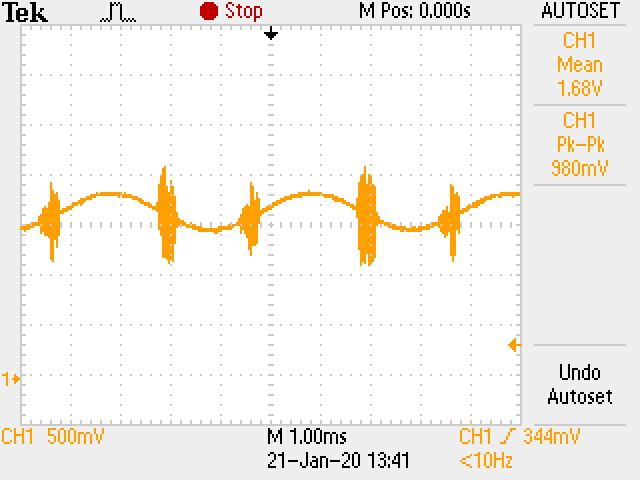
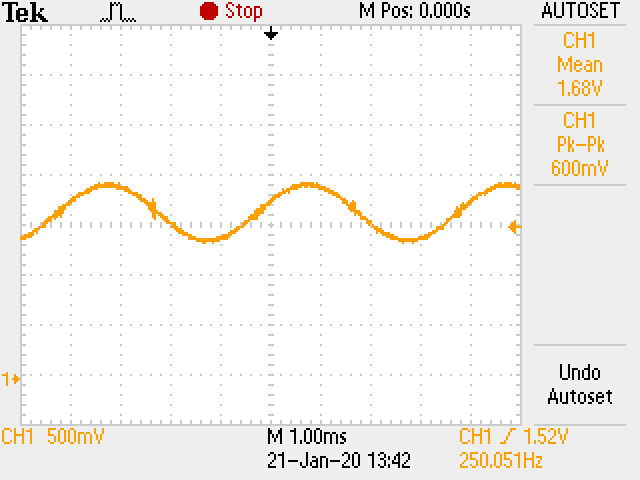
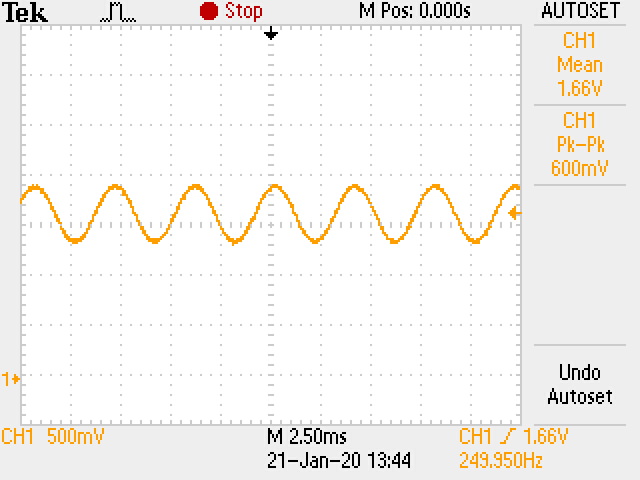
    We are essentially using the circuit shown in Fig. 3 of the LM4865 data sheet. The only modifications are that Ci is 1uF, and that the input to pin 4 (DC volume) is the 1Hz sinewave as described above. The signals going into -VIN (the carrier tone of 250Hz) and DC_VOL (the modulation tone of 1Hz, offset to be above the 1.2V DC threshold to keep the amplifier on) both look clean. Power rails look normal (we are running the part at 3.3VDC, although we have tried it a 5V and the same thing occurs). If we do not modulate the volume (by disconnecting the output of the modulation tone and and just set the volume pin to a constant value), a clean 250Hz tone is output. Whatever is happening only seems to occur during the changing DC volume. If we probe the outputs, as mentioned above, the 250Hz tone modulates as expected, however, there does appear to be some noise (int he form of ringing) at the zero crossings.

    Best,

    Joe

  • The bottom two traces are the carrier and the modulation wave, as probed at the inputs. The top two traces are speaker - and + respectively.

  • So a little more digging revealed the following. If a constant tone is sent through -VIN (pin 2) = 500p-p, and a DC voltage is applied to the volume control (pin 4), the constant tone is faithfully reproduced. If the DC volume control voltage is then increased (or decreased), the output amplitude changes in increments of 480mV (peak to peak) steps, rather than a smooth & continuous change). Every time the output "steps", a click is heard through the speaker. So it appears that the step-wise nature of the volume control introduces artifacts into the audio when it steps from one output voltage level to the next. 

  • Hi, Joe,

    Thank you for sharing the details about your application.

    What I think about the application that you are trying to achieve is that probably this device is not capable to have a soft volume change. As shown in figure 29, the gain variation from step to step is not constant (in some steps the variation is more than 5dB). This makes me think that the constant volume change couldn't be achieved. In addition, the volume control doesn't seem to be robust since the voltage variation changes from device to device.

    Just to confirm, have you tried to use a potentiometer as shown in the figure 3 and see if the problem persists?

    Best regards,
    Luis Fernando Rodríguez S.

  • Hi Luis,

    Thanks for your reply. The issue is not that the volume changes in a step-wise/non-linear fashion, but rather when the volume does change it introduces an audible "click." If the volume were to just change as a step, that would be fine (at least for this application).

    I have tested the output while varying the voltage to the volume pin using a bench supply, and an audible click can be heard at every step (even though the bench supply is continuously variable and linear). Linearity of part response aside, this would imply that once the audio is turned on and one tried to change the volume, the result would be the introduced noise at every step of volume change. It turns out, for the application I am working on, I can just filter the output to eliminate the click, since it is out of band, however, as a general volume control (unless there is something else going on with the circuit or part), it seems like the part would be marginal at best for its' intended application. 

    As far as application suitability, I understand that this is not the best way to achieve the result, since  using a VCA or equivalent would be a better approach, however, for a "quick and dirty" modulation scheme, where linearity is not critical, this works fine (excluding the introduced noise when varying the volume). 

    Best,

    Joe

  • Hi, Joe,

    Thank you for your response.

    Do you get different results when you vary the Cb capacitor? I just wanted to verify how it works in your application. Otherwise, I think the only solution would be filter the output as you mentioned in you previous post.

    Best regards,
    Luis Fernando Rodríguez S.

  • Hi Luis,

    Same result regardless of Cb value chosen. It appears that this is something inherent to dynamically switching the levels. I ended up filtering the output, and that eliminated the HF noise for our application (we were fortunate that our band of interest lies outside of the noise), however, I would say that for a part that is intended to be used with a volume control that would be varied in normal use, this issue would certainly be unacceptable. 

    At any rate, I think we can call this resolved for now, unless you have any other insight into why this happens with this part.

    Thanks for your help on this.

    Best,

    Joe