Part Number: TAS5782M
Hi
We are currently testing thermal performance of the product, and want to be sure we are operating the TAS5782 in optimal modes for minimum temperature and best performance.
I am looking specifically for information on FW control modes, and to confirm my understanding.
Question 1:
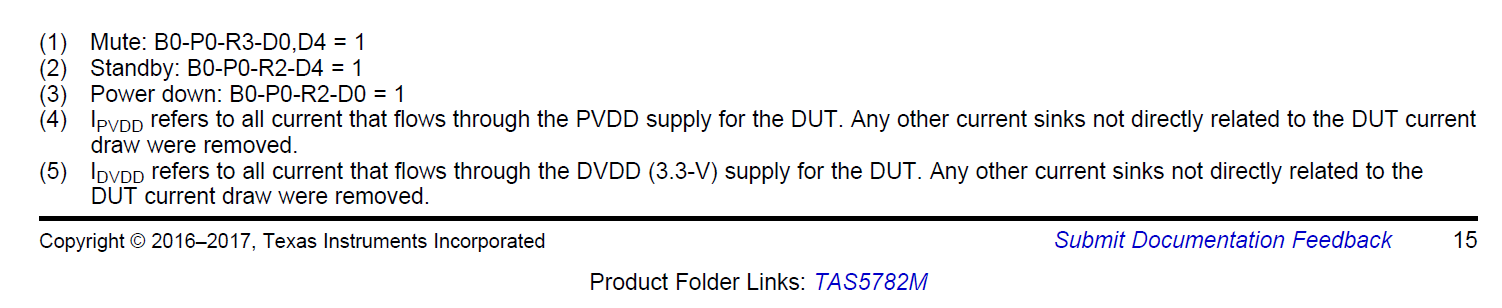
In the "Power dissipation characteristics" section of TAS5782 datasheet page 20, we can see that we do not expect `mute` mode to reduce power dissipation or temperature a lot. We can confirm using i2c commands to enable mute (P0-R03-D[0,4]) and automute (P0-R65-D[2:1]) that thermal performance is roughly the same. However if we use the *external* `SPK_MUTE` pin to do a 'soft mute', we notice a 10 degree drop in the TI amp temperature.
Is this expected behaviour? How is the external `SPK_MUTE` soft mute different from internal i2c soft mute?
Is it possible to get the same thermal performance improvement using internal 'auto-mute' function?
Question 2:
What are the recommended optimal modes to run the system for lowest
temperature:
a. While playing audio
b. While not playing audio
Is it common to use 'standby' or 'powerdown' modes (P0-R02-D[0,4]) while idle?
How quickly does the system recover from standby or powerdown (is it milliseconds, or microseconds?).
Do you have any other advice for FW configuration of the TI amp for minimal temperature?