This thread has been locked.

If you have a related question, please click the "Ask a related question" button in the top right corner. The newly created question will be automatically linked to this question.

TLV320AIC3254: TLV320AIC3254 POP

Part Number: TLV320AIC3254

Hi Sir,

Here is customer used AIC3254 EVM with default system settings code, very simple flow, input/interprocesser/filter/output that’s all. (LINE in LINE out)
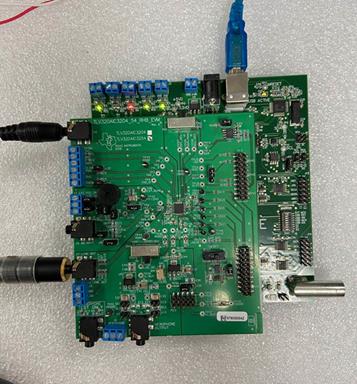
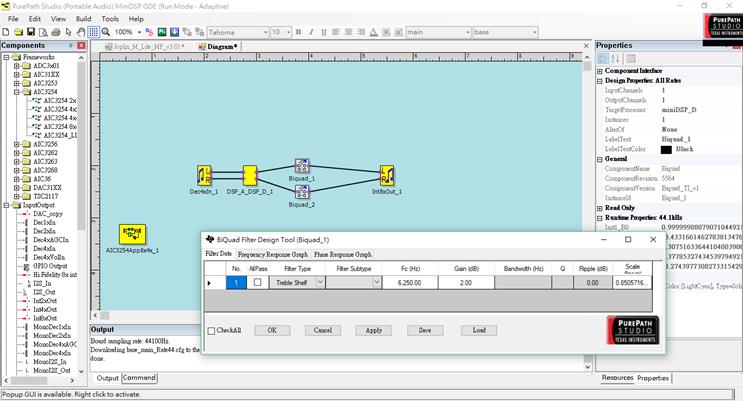
Measured line output with nothing input, as you can see in the figure, when I applied different gain level of the filter (high shelf and peak filter are tested in this case), pop signals are recorded.
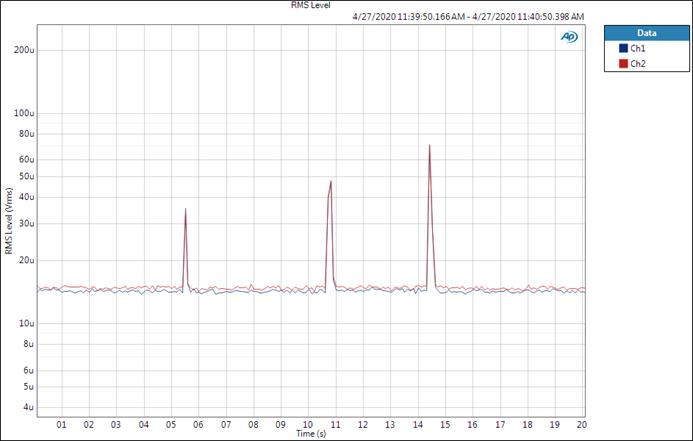
(6250Hz high shelf filter, different gains applied)
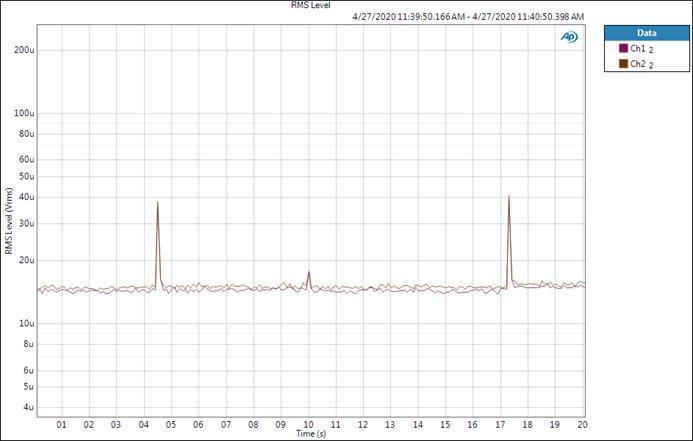
(peak EQ, 5000Hz, Q1, different gains applied)


Subjectively, this issue cannot be heard in engineer board because the output gain is too small. customer have 32dB PA gain in system so that even a tiny signal can cause a noise.

Can you check why is this happening?

Thanks, Ian.

  • Hello Ian, 

    Are you using the adaptive filtering to change the filter coefficients? That is the only way you should be changing the coefficients while the device is active.

    best regards,

    Steve Wilson

  • Hi Steve,

    Yes, we confirm today using adaptive filter.

    How to change the coefficients to avoid pop noise?

    Thanks, Ian.

  • Ian, 

    When changing the filter, it would not be unexpected to have some small artifacts,  especially if you are making a large change in the filter gain and you have 36dB of gain following the codec.  

    Some recommendations:

    1. If you are making some large changes in filter gain,  it would be helpful to break them up into smaller steps.  ie... rather than changing the gain 6 dB,  change it 1-2 dB at a time.  this would not eliminate the pop, but could significantly reduce it. 

    2. Another potential option would be to combine the soft stepping of the DAC mute, with the change in coefficients, and then unmute the DAC. if you write these registers in quick succession the DAC will never fully mute,  but may help to coverup the filter gain increase.  a variation on this option would be to change the DAC volume by a set amount rather than mute... this would give you a little more control. 

    The second option may not eliminate an artifact from taking place, but would allow for some shaping of it.  it is preferable to have a quick dip than a pop.  

    best regards,

    -Steve Wilson

  • Hi Steve,

    Thank you for helping , but we need your help to clarify as below:

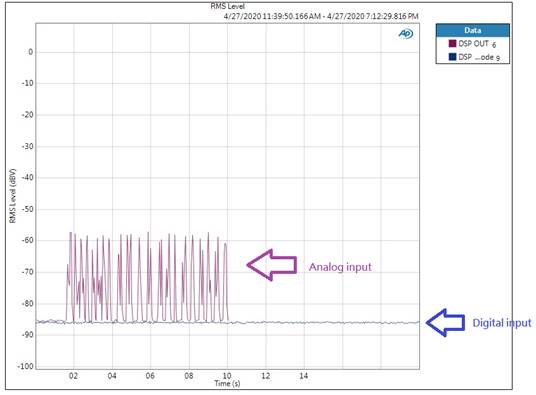
    1. We’ve test customer's PCB again & compared the result of different input mode . we are wondering why issue happened in analog mode , but digital mode doesn’t have the same issue. Can you help us clarify it?

    Thanks, Ian

  • Ian, 

    hmm,  thats interesting.  Are they using a hpf on the ADC?  there can be a small DC offset on the inputs which could contribute to this problem.

    are the biquad filters you are testing processing on the DAC or ADC? 

    -Steve Wilson