This thread has been locked.

If you have a related question, please click the "Ask a related question" button in the top right corner. The newly created question will be automatically linked to this question.

TLV320ADC5140: Why THD+N keep flat when decrease input signal level

Part Number: TLV320ADC5140
Other Parts Discussed in Thread: PCM1862

Hi Team,

I am curious about TLV320ADC5140 THD+N vs. input amplitude curve.

Generally, when decrease input signal level, the THD+N will be smaller. Just like PCM1862 curve shows.
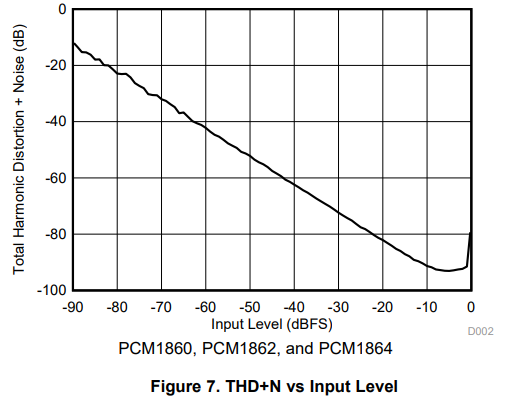
However, when disable DRE, TLV320ADC5140 curve will be flat, may I know how it works to keep such high performance? thanks. 

BR.

Wiky

  • Hi Wiky,

    There's no magic in this product and as you suspect, if Figure 6 in the ADC5140 was referenced to the input signal, then in the noise-dominated region the curve woudl have a flat upward sloping trajectory as seen in the PCM186x datasheets.  This is because the input magnitude (numerator) is getting smaller in the SNR equation while the noise magnitude (denominator) is constant.

    In the ADCx140 datasheets the figures are referenced to "dBFS" or dB to the full-scale input signal.  In this case, the numerator is always a constant level at the full-scale level (2Vrms) and therefore the noise-dominated region is flat.  

    So, in short, both curves have the same information and it's a difference between using dBFS as the y-axis (ADCx140) and using "dB-Input", sometimes called "dBc" for dB-Carrier