This thread has been locked.

If you have a related question, please click the "Ask a related question" button in the top right corner. The newly created question will be automatically linked to this question.

TPA1517: Crackling noises when moving the mouse on PC

Part Number: TPA1517
Other Parts Discussed in Thread: LM1117

Hi,

We designed a little audioboard based on TPA1517, installed on the front panel header of an Intel motherboard. We can hear audible crackling noises when moving the mouse. When using amplified speakers on the same motherboard header, there is no noise. Any ideas on what to do? I got the suggestion of adding 4 transistors to reduce pop, but on our board the chip is always enabled so it should apply. 

Thanks

  • Hi Martin,

    Could you upload the schematic and a simplified block diagram (just around the TPA1517). I need to get a better understanding of your system before I can start making suggestions!

    Thanks,

    Robert Clifton

  • How do I upload? I tried to paste a snagit and it didn't work.

    I have both schematics for the audioboard and for the motherboard codec output

    We also have a video that captures the crackling

  • I don't know how to upload files. Help please

  • Can someone tell me how to upload files to this forum?

  • Hi Martin,

    I'm not sure how you've been trying to upload but have you tried inserting the file by clicking on this button (seen in image below):

    Also if that doesn't work, try putting the files in a zip folder and uploading the zip instead. 

    Regards,

    Robert Clifton

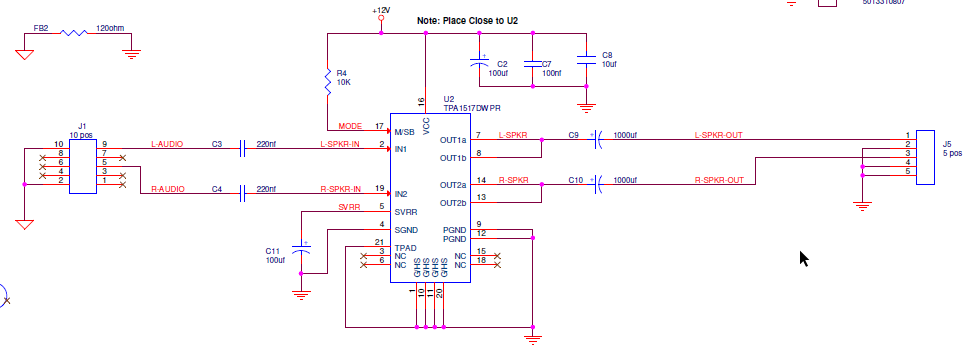
  • Parts marked N/C are not populated. The first schematic is for our audioboard, the second is our motherboard CODEC and front audio header.

    Thanks!

  • We will be trying replacing all caps with the same parts used on the development board, and also ordered a development board for comparison. This is a time critical project, so I would appreciate any feed-back as soon as possible.

    Thanks!

  • New information:

    When the audioboard is powered by the same power supply as the motherboard, we get the noise. If we power the audioboard from a separate 12V power supply, the noise is gone.

  • Hi Martin,

    Thanks for sharing your schematic. From what I'm seeing there doesn't seem to be any "red flags". This leads me to believe that the issue might be from the layout of the board however you said that you don't have that issue with different speakers. So what are the difference between the regular speakers and the amplified one? 

    Can you upload the video? 

    Best Regards,

    Robert Clifton

  • Some additional information:

    We purchased the TPA1517 development board, and it is worse than our board.

    When powering our board directly form the PC power supply, we get the noises on video

    When powering our board from a 12V pin from the power supply, the noise is greatly reduced

    When powering our board with an external 12V supply, the noise is gone.

    Any recommendations would be greatly appreciated

  • Hi Martin,

    This sounds like you've got a "dirty" power supply. I recommend adding some filtering to VCC. An LC or pi filter should likely help if it's truly from a noisy power supply.

    Best Regards,

    Robert Clifton 

  • How do you explain the TPA1517 development board being worse than ours. I didn't find any app note relating to power supply noise sensibility. where can i find it? It is also surprising to me that different types of power supplies and vendors cause the same issues.

  • Hi Martin,

    Power supply rejection ratio (PSRR) is the key specification for knowing how susceptible a device is to noise from the power supply. This device being as old as it is means it's PSRR isn't as robust as some of our newer devices. I'm not sure we have any application notes directly for class-AB devices here but I'm still checking. 

    Setup differences and board layout could play a factor between the development board's and your board's performance. 

    Best Regards,

    Robert Clifton 

  • Hi,

    As an additional test, we added an LDO LM1117, set to drop the voltage to 9V, with a 10uF on the ADJ pin. No improvement. Any suggestions for filtering circuits would be appreciated

    Thanks!

  • Hi Martin,

    Can you specify which system you tested using the LDO under? You have talked about 3 different tests you have run so I don't want to assume it's the end equipment system with the onboard 12V.

    It's interesting that the LDO didn't show any changes. As you know LDO's are great at rejecting outside noise. So unless the noise being generated by the LDO is similar to the power supply's noise there could also be a layout issue. Before we go down that route let's try to rule out the noise from the power supplies as it still seems very likely. 

    Best Regards,

    Robert Clifton