How can I test the 3.4A typical overcurrent trip point on the device for an over current fault? I have tried an OUTNx short to GND and a short across OUTNL/R (load) without being able to create a FAULTZ low. Please advise how to test this.
This thread has been locked.
If you have a related question, please click the "Ask a related question" button in the top right corner. The newly created question will be automatically linked to this question.
How can I test the 3.4A typical overcurrent trip point on the device for an over current fault? I have tried an OUTNx short to GND and a short across OUTNL/R (load) without being able to create a FAULTZ low. Please advise how to test this.
Hi David,
I'd recommend testing with a 0.5ohm or 1ohm load rather than just shorting the outputs to ground or across the load. The lower the PVDD voltage you use the smaller the impedance will need to be to reach the overcurrent trip point.
Best Regards,
Robert Clifton
Hi Robert;
In this application, the output filter inductors are 0.22 DCR and are in the path before the short. Is it possible for you to try this on the EVM board and provide some confirmation and instruction on how to get the FAULTZ to occur.
Hi David,
I'll try to get to it sometime tomorrow (dallas time).
Best Regards,
Robert Clifton
Hi David,
To keep you updated, I haven't been able to get to this today. Tomorrow should be easier though.
Best Regards,
Robert Clifton
Hi David,
Did you test it on idle status or play power? You can set device to play and output some power.
For short to power and ground, please short directly and using cable or wire. Do not series big resistor on cable or wire.
Regards,
Derek
This was tested in play mode, with a full scale signal being output at loud volume. The short was direct with a wire to GND, and seperately cross the speaker load directly. The FAULTZ signal did not trigger, and the Pvcc was current limited to 5A (above the 3.4A trip point). Can you test this on the EVM board and then advise on how to get the FAULTZ to trigger?
Hi,
Did you monitor current with oscilloscope? And how did you short GND and load short?
Did you check the cable impedance?
The current was monitored on the PVcc supply (not an oscilloscope) and was constant when the short was applied on one output to GND at a 1.7A increase. With both outputs tied to ground, there was a 2.4A increase, but the trip point was not reached, as the increased current was being continuiously drawn. FAULTZ was not indicated. The short was a 22AWG wire, about 2" in length, so the impedance to GND was minimal. A direct short across the output filter inductors (0.22 ohm DCR) was not able to create sufficient fault current to trigger the FAULTZ either.
Again, can you reproduce this on the EVM board and then let me know how you are getting the FAULTZ to occur and what your current is on the 7.5Vin. Please set Pvcc to 7.5V with an 8 ohm speaker load.
Hi David,
I do not have TPA3131 EVM in my hand, but I have TPA3132 EVM(OC threshold is higher). I checked on TPA3132 EVM board.
OC current should be monitored on output, not PVCC power current, since OC protection is for speaker. And when you short to GND or Power, you should monitor the current through output to GND or Power to output.
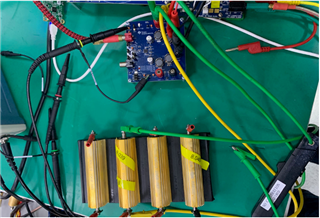
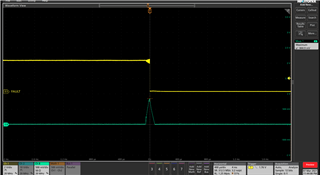
The EVM test result is correlated to datasheet. I pasted my test setup picture and test result waveform.
Can you send me a more readeable scope shot of the short current and an explanation of the waveforms?