This thread has been locked.

If you have a related question, please click the "Ask a related question" button in the top right corner. The newly created question will be automatically linked to this question.

ADS131M06: Impedance clarification

Part Number: ADS131M06

Hi Team,

May I ask for help? Our customer have a concern: Would you tell me please if I must match the impedance of the ADC input which can be ( 1M or 330KOhms ) to the voltage divider impedance?
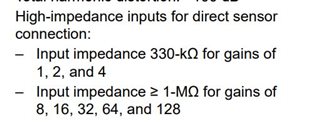

I hope you can help as clarify the customer concern. Thank you so much in advance.

Kind regards,
Gerald

  • Hello Gerald,

    Typically, knowing the input impedance helps with filter design on the input stage after voltage divider (as you do not want the filter resistance to be similarly sized to the input impedance which would result unwanted signal attenuation). While you are correct that it is best practice to match impedances, whenever possible, its clear that this matching is not a concern given how low frequency our band of interest is.

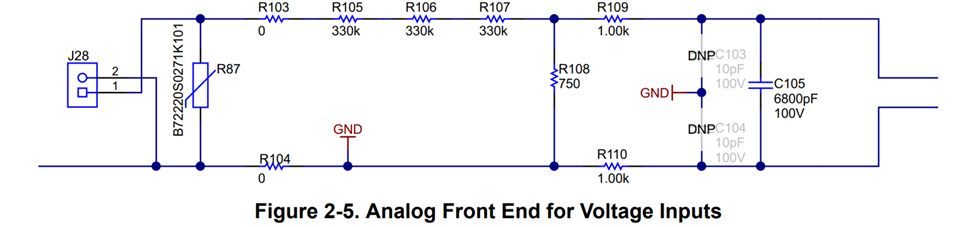
    Check out this excerpt from the TI Design to see how others create the divider:

    See 2.3.1.4.1 Voltage Measurement Analog Front End for more info in the design guide: https://www.ti.com/lit/ug/tiduem8b/tiduem8b.pdf 

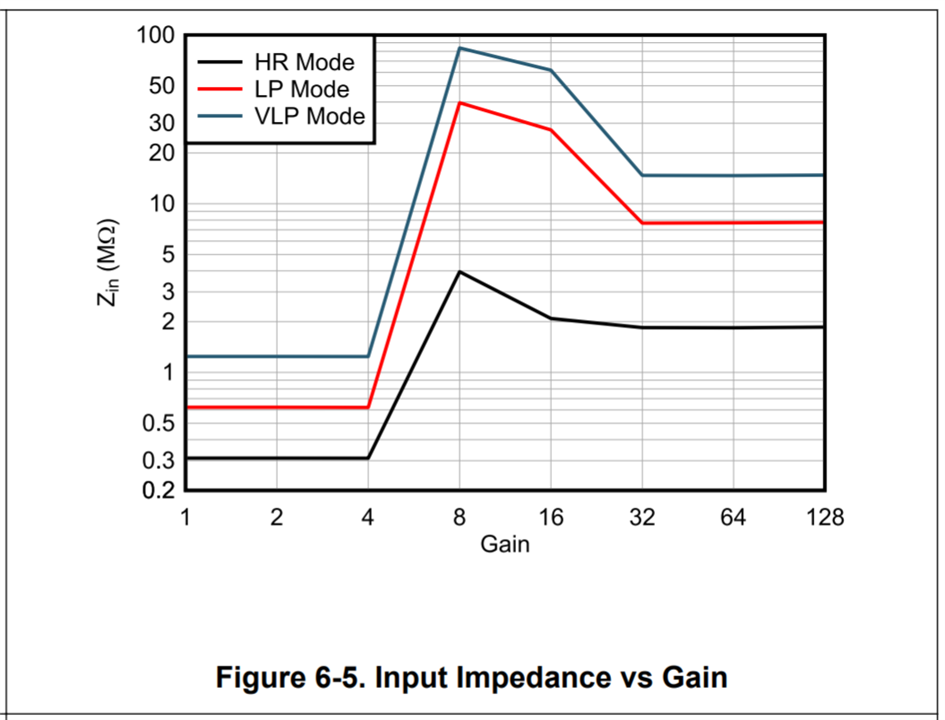
    Edit: also note the more accurate input impedances for your settings as shown in this graph from the datasheet:

    Best,

    -Cole

  • Hi Cole,

    Thank you so much for your previous response. In addition to this, we received a reply from our customer regarding with your last response. Please see below: 

    "The advices and the app note were really helpful, thanks for sharing it with us.

    I realized that in your schematic, you are measuring the voltage from the mains (100-240V) which frequency is within the range of 50 - 60 Hz. However, the designed RC filter from the schematic (R109=1K; C105=6.8nF) forms a cut off frequency at about several KHz (much more than the frequency of interest).

    In our design, the signal we are measuring, is in the range of 2-15V with 50Hz frequency and have designed a Low pass filter with cut off at 70 Hz, trying to avoid entering of noises, since everything above 70Hz we do consider as a noise.

    What is the purpose to design an RC filter with so high cut off in your schematic, compared to the frequency of the input signal. If so, what kind of considerations you have taken while designing the filter."

    Kind regards,
    Gerald

  • Hello Gerald,

    The TI design is in context of the e-metering and the industry is pushing to comprehensively understand how much power is consumed. As such, the fundamental signal (i.e. 50-60Hz) and some of the harmonics of the fundamental is needed to accurately understand the power profile. I'm not well versed in it, but I think there are a couple of European and American industry standards in e-metering that describe how many harmonics need to be captured and what frequency they usually fall in. 

    So, this is why the cut-off is high in frequency, the sample rate and other filtering is meant to capture those harmonics. You may not want to measure some of these harmonics in your system but my gut says that 70Hz is pretty low in frequency. If you've already done the math of what the amplitude of the signal will be at 50Hz, feel free to ignore. But, the cut-off frequency is the -3dB point which means the filter needs to start rolling off from 0dB to reach the -3dB point. If the math doesn't work out, then you'll be intentionally attenuating the fundamental, which I have not heard of before.

    I will also say, that the digital filtering within the ADS is going to be doing most of the work as a low pass filter for your frequency of interest (i.e. the roll off and shape of the filter is more aggressive than 20dB/dec of the input RC) and the input RC filter works mostly as an anti-aliasing filter for the modulator (which also passes any frequency of interest). There's some more info in the applications section of the datasheet if you'd like to learn more (Section 9.1.2 Antialiasing).

    Does that make sense?

    Best,

    -Cole