This thread has been locked.

If you have a related question, please click the "Ask a related question" button in the top right corner. The newly created question will be automatically linked to this question.

Generic Question: IC Output vs Temperature

Other Parts Discussed in Thread: DAC11001B

Hi,

This is a generic question that applies to all TI ICs.

My customer says that the end product will be used between -40 and +120C. They want me to show proof that the ICs I use will be guaranteed to output a stable value over that temperature range.

For example, take a digital pot. They want to make sure that its resistor will be not drift over that range.

Or as another example, suppose there is a DAC. They want to make sure that the analog output voltage will not drift over that range.

How can I do this? My thought was to show them max operating temperature range on the datasheet, but I am not sure if the IC is guaranteed to not drift over this range.

Please advice.

Thank you in advance.

Best regards,
Lu Tan

  • Hello Lu, 

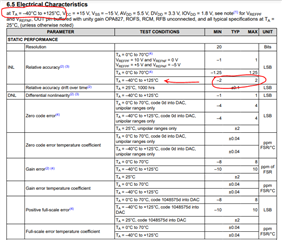
      The datasheet is the guiding document for these parameters.  The specifications are guaranteed over the temperature range specified, and there is generally variation with temperature.  You will notice for almost all specifications, there is a +/- value stated, this is directly related to variables such as temperature and Vcc.  

    For example, selecting the DAC11001B: https://www.ti.com/lit/ds/symlink/dac11001b.pdf , notice the variation specified for each characteristic:


    Here is an AppNote for this DAC that discusses in detail the sources of variation: https://www.ti.com/lit/an/slaae47/slaae47.pdf  .

    Here's a section on Drift over Temp:


    And here is an article on DRIFT for DACs: e2e.ti.com/blogs_/b/analogwire/posts/dac-as-programmable-voltage-reference .  

      In summary, you will have to go through each datasheet to obtain these characteristics for each device used in the design.  There is no generic answer that applies to all ICs the same way, except that all will have variation over temperature. 

    Regards,

    ~Leonard