This thread has been locked.

If you have a related question, please click the "Ask a related question" button in the top right corner. The newly created question will be automatically linked to this question.

ADS8688: ADC loading issue and cannot read

Part Number: ADS8688


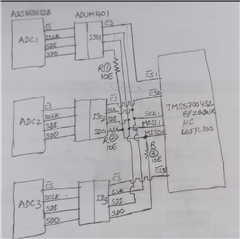
Hi, My customer is using ADS8688 in the below configuration. when they remove R2, R3 (ADC2, ADC3) in the below. ADC1 could able to send the data nicely to TMS570. when they populate all the three resistors meaning all three ADCs are in active (based on Chip select). they could not get any data. seems some loading issue. Could you please help me understand anything wrong with the configuration they are using. 

ADC to Digital isolator to TMS570. (below diagram)
  • Hello Sandeep,

    Thank you for your post. 

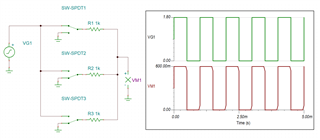
    With R2 and R3 resistors installed, the customer has effectively created a resistor divider, which will attenuate the SDO signal from the one active ADC. This is likely causing the high/low levels to be insufficient to ensure proper decoding by the controller.

    When CSn is high, the DOUT pin on ADS8688 is tri-stated. Has the customer installed a pull-up or pull-down resistor on the ADC side to define the voltage on DOUT when it is tri-stated? Assuming the SDO is pulled low, the output of the isolation channel should also be driven low. R1, R2, and R3 will effectively attenuate the SDO from the active ADC by a factor of 3 (600 mVpp vs. 1.8 Vpp).

    Regards,

    Ryan

  • Ryan, Thanks for the response. 

    R1,R2,R3 values are 0E only, for bypassing the path they gave these resisors. No Divider network.

    For ADC side they are provided Pull ups. Still same issue.

  • Ah ok. In that case, I imagine there is still some contention between the isolator outputs. When the unused SDO pins are pulled high, are the isolated outputs also driven high? If all three SDOs are driving MISO at once, there will always be some bus contention. The only solution is to use an isolator which can tri-state the outputs based on a separate enable input.

    Regards,

    Ryan