Other Parts Discussed in Thread: THS4521, , OPA2350, INA851, INA149, INA821, INA826, PGA855, THS4551, ADS1274
Hello,
I am facing a severe issue in one of my product designs with an ADS1278 and THS4521 buffers. It might very well be that I have misunderstood how to use both parts, but it would be important for me to verify if I can solve the problem or I have to rethink the concept from scratch.
In my application I have to measure several voltage drops from devices that are place in series. The issue that I face is, that when connecting more than one differential input to one of those components in series, the voltages read in the others change. The voltage change can not be explained solely by the input impedance of the single differential channels, as this influence should be marginal in my setup.
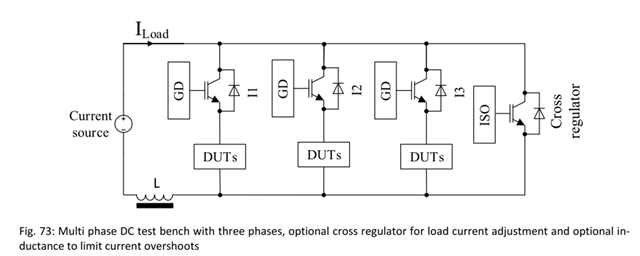
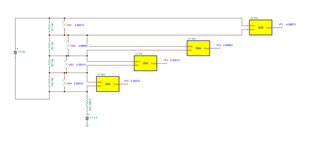
For debugging the issue I have build a very simple setup shown below:
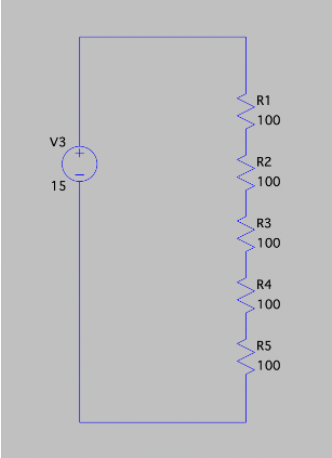
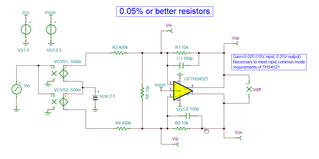
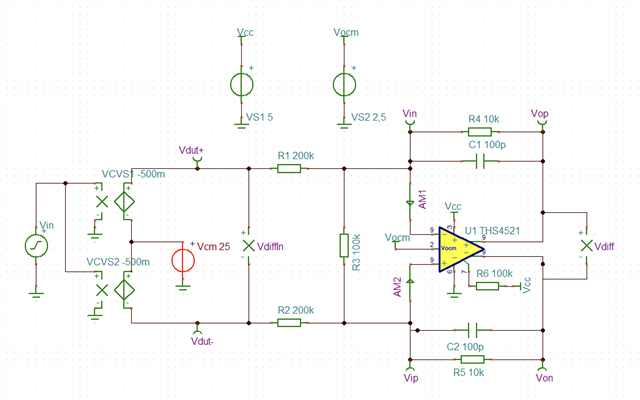
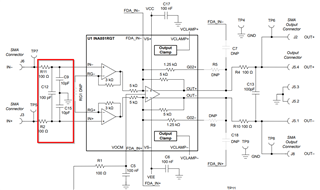
Simply 5 resistors in series, each one 100ohm and a voltage source of 15V. In this case the current flowing would be 30mA and the voltage drop in each resistor 3V. The THS4521 buffers are configured in a way that they attenuate the input signal, as they should be capable of reading up to 20Vpp. Below you can find the basis design for my schematic:
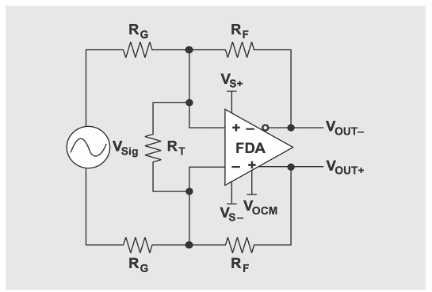
Rg is 20KOhm, Rf is 4.99KOhm and Rt for this specific test is not present, I have however a different setup with Rt of 12.9KOhm which presents the same issue. My ADS1278 follow the same schematic concept as in the reference board with an OPA2350 for the VCOM output to the THS4521. The ADS1278 acquires 8 differential signals, each one buffered by a THS4521 and it is configured in High-Speed mode and acquiring in this specific case 100KSPS. The voltages fit and the channels, if its negative input is connected to the ground, are very accurate. The ADS1278 is interfacing with a Microcontroller in an isolated way and has its own isolated supply. All values are transferred to a computer via ethernet and read in a Labview application.
Now to the test, if I connect just one differential channel to the setup above, for instance to R1, the voltage measured is very accurate (compared to a Keysight 34470 multimeter). If I connect one channel to R1 and another channel to R3 for instance then problems happen. The Vr1 increases in up to 60mV, which is a killer for my application. Due to the input impedance of the THS4521 (in my setup arround 60KOhm), an increase of 1mV could be reasonable when connecting 2 channels, but not up to 60mV. See a table below with a part of the measurements that I have performed:
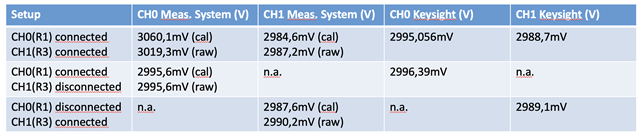
It might very well be, that I have not well understood the principle of differential measurements, but this is really a killer for my application. I would really appreciate inputs to solve this or to get to the root cause. Worst case I would have to change the whole concept, but I hope I can solve this issue somehow.
Thanks and Best Regards,
Javier