Part Number: ADS8598H
Other Parts Discussed in Thread: ISO7763, TCA9534, ISO1640, ISO1641, ISO7762
Tool/software:
Dear technical support,
in our custom data acquisition project, we are designing an isolated interface between a microcontroller (STM32) and the ADS8598H ADC.
In order to limit the number of signals crossing the isolation barrier, serial communication between ADC and uC is preferrable.
Therefore, we thought about isolating the main signal for the communication with an ISO7763, i.e. the DOUTA, DOUTB, FRSTDATA, CSn, SCLK and, eventually RESET signals.
From my understandings, also the two CONVST signals and the BUSY must be monitored, while the other configuration pins can be implemented via hardware.
Now, in the event of changing the oversampling ration and the range dinamically without acting on hardware, we want to have access on these pins too.
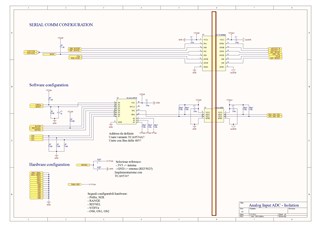
For clarification, this is the (unfinished) schematic:

Now my question: is there any advantage of using a supportive microcontroller (e.g. MSP430) over an I2C expander (e.g. TCA9534) to control the eight signals that are now disconnected in the schematic? To optimize PCB space, we want to minimize the isolation ICs, hence we discourage the direct connections of STM32 pins to a total of 14 pins of the ADS8598H.
Could I find any issue by controlling CONVSTA, CONVSTB and BUSY through a GPIO expander?
Thanks in advance for your support,
Andrea