This thread has been locked.

If you have a related question, please click the "Ask a related question" button in the top right corner. The newly created question will be automatically linked to this question.

ADC3542: External Clock Generation

Part Number: ADC3542
Other Parts Discussed in Thread: CDCE6214, LMK3H0102, LMX2571

Hello,

I am considering using the ADC3542 with an FPGA to acquire data from a thermal sensor. The datasheet states that, to maximize ADC SNR performance, the external sampling clock should have low jitter and use differential signaling with a high slew rate.

After consulting with the FPGA vendor, they advised against using the FPGA’s internal PLL to generate the ADC clocks due to concerns regarding jitter and precision. Could you recommend an external IC suitable for generating the required clock signals for the ADC?

The sensor provides the input clock, and the required outputs are:

  • A clock signal at the same frequency as the input, with a 90° phase shift, for the CLK signal.

  • A second clock signal, 8 times the input frequency, for the DCLK signal.

Screenshot 2025-12-23 074222.png

Additionally, is it possible to use the 1-wire serial interface in 16-bit mode? If so, do I need to change the register address from 0x07 to 0x6C and set registers 0x1B to 0x88?

Thank you for your support.

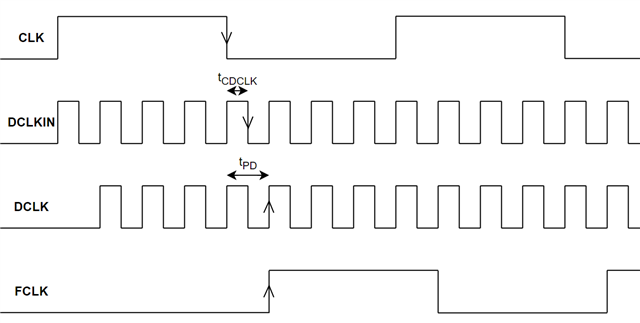
EDIT: The tPD is defined as the time from the sampling clock falling edge to the DCLK rising edge; however, for the 1-wire serial interface, this is not reflected in the timing diagram. Should the reference edge be the falling edge only for this interface? Also, is the tPD value still defined as 2 + tDCLK + tCDCLK for tCDCLK < 2.5 ns, and 3 + tCDCLK for tCDCLK ≥ 2.5 ns?

  • Hello,

    Apologies for the delay due to te holiday break. Please see my responses below:

    1. The recommended clocking device really depends on what your requirements are: what frequency are you clocking the ADC, what mode you're using the ADC in (which determines the required DCLK frequency), what performance do you need, what are your SWAP-C requirements, etc. Here are some reccomendations:

    • CDCE6214: cheapest, small, and lowest power but can only output up to 328MHz and not the best performance
    • LMK3H0102: smallest, newer part with good perfomance but requires higher power
    • LMX2571: best performance and lower power but bigger and not as versatile

    You can also see this application note for more information on clocking part selection.

    2. Yes, it is possible to use the ADC in 1-wire, 16-bit mode. Please follow table 8-11 in the ADC3542 datasheet to determine the correct configuration sequence for this mode.

    3. No, this is an error in the datasheet. The DCLK waveform should be inverted, similar to the other timing diagrams. Apologies for the confusion, we are aware of this error and are correcting it in the next revision of the datasheet. The correct Tpd value is still as it is listed in the datasheet spec table.

    Best,

    Luke Allen

  • Hello,

    1. Thank you for the parts recommendations. However, I am currently considering using a part from a different supplier.

    2. I will follow the table as well as the next page step-by-step programming example (1-wire serial).

    3. So, for the datasheet next revision, the timings will be like the image below?

    Thank you.

    Best regards,

    João Rego

  • Hi João,

    Yes, that is correct. If you have any additional questions or run into any issues while configuring, please feel free to start a new thread.

    Best,

    Luke Allen