This thread has been locked.

If you have a related question, please click the "Ask a related question" button in the top right corner. The newly created question will be automatically linked to this question.

ADS1282-SP: Gain Error and Aging

Part Number: ADS1282-SP

Dear TI Support Team,

I have a question with regards to the Gain Error parameter of the ADS1282-SP.
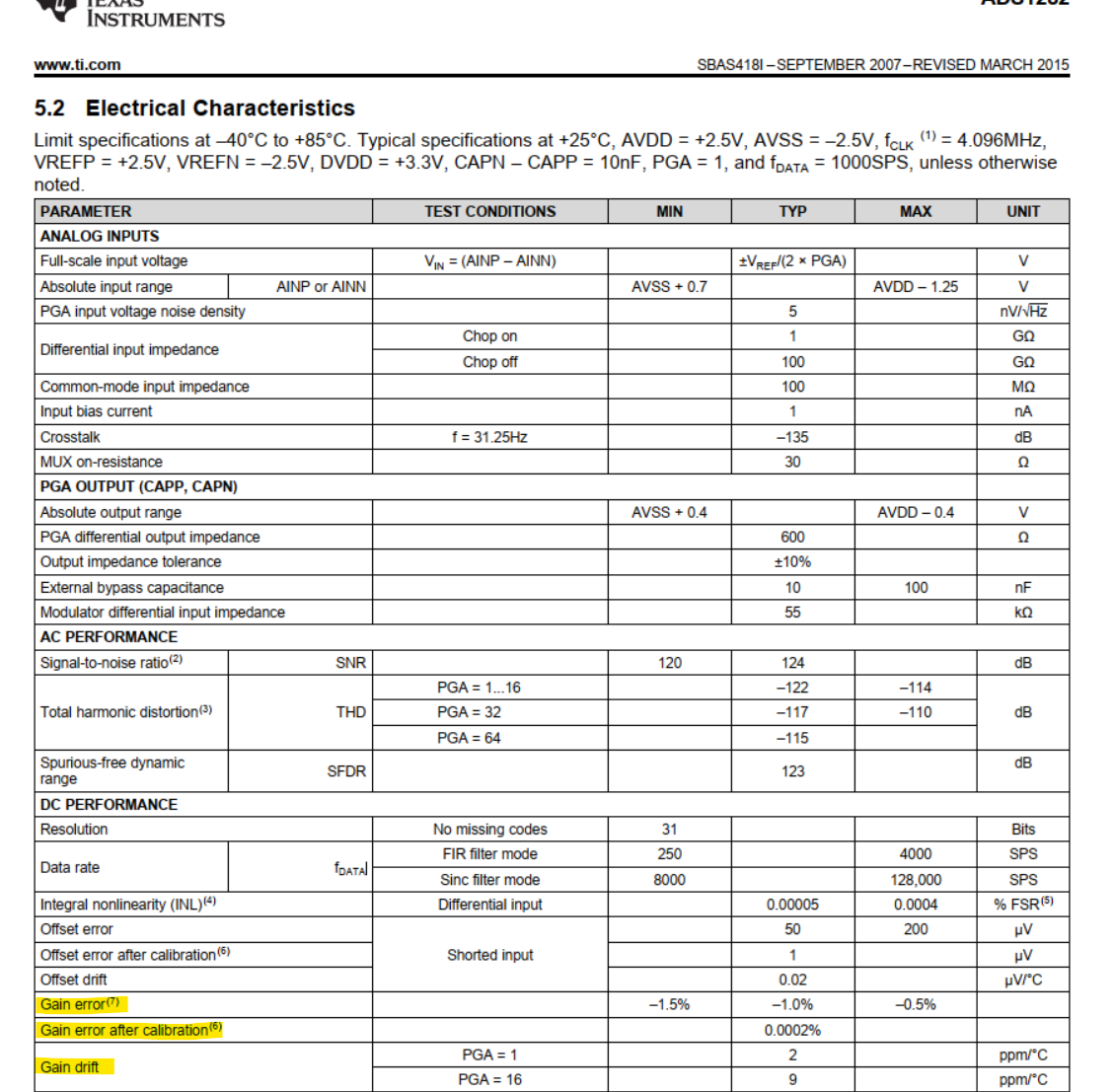
According to the datasheet, the (typical) systematical gain error is about -1% which is consistent with my acquired values. The range (min./max.) of the gain error is specified from -0.5% to -1.5% (table in §5.2 of  SBAS418I). Can this specified error be considered as an initial tolerance?

For my worst-case analysis, I'm taking the specified temperature drift into account (e.g. 2 ppm/°C for PGA of 1). Additionally, the TID report of the devices gives some post radiation figures of the gain error for different PGA settings and total dose which are far below the -0.5% to -1.5% range given in the datasheet (e.g. -1.03% to -1.122% for PGA G1 Error, 50 KRad, p. 8 of  SLAK016A). Do you expect any other type of aging apart from radiation?


Many thanks in advance,

Tobias
 

ADS1282_Datasheet_1.pngTID_Test_Report_1.png


  • Hello Tobias,

    Welcome to the TI E2E community.

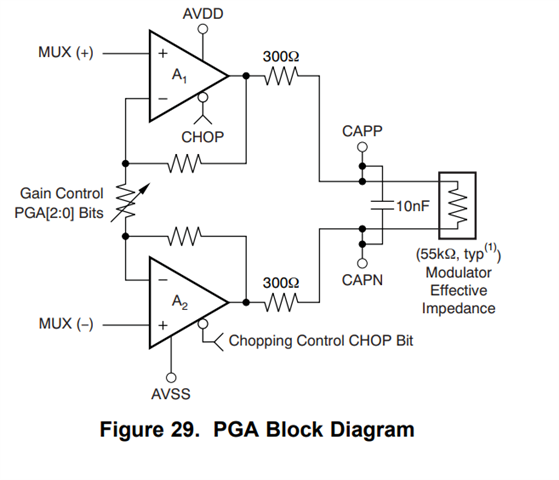
    Yes, the gain error variation is primarily due to initial tolerance.  This gain error is a systemic error created  by the internal PGA output filter resistors (300Ohm + 300Ohm) and the equivalent 55kOhm input resistance of the ADC modulator.  The variation from -0.5% to -1.5% is primarily due to part-to-part resistor and capacitor variations inside the device.  If these initial gain errors are calibrated, then the remaining errors will be much smaller.

    Gerror=100%*(1-55k/(55k+0.3k+0.3K))=1.08%.

    In addition to this initial gain error, there is gain drift over temperature, time, and radiation exposure.  We specify the typical gain drift of 2ppm/C and 9ppm/C for gain=1 and gain=16.  There are no specifications for drift over time, but a good estimation for 10year drift is equal to gain drift over a 100C change in temperature.  In other words, you can expect over a 10year operation, the gain to shift by 200ppm (0.02%) using gain=1 and 900ppm (0.09%) using gain=16.  If the gain drift error is too high due to temperature, radiation, or time, then some type of external self-calibration using a stable reference voltage can be used to correct for this drift.

    Regards,
    Keith Nicholas
    Precision ADC Applications

  • Dear Keith,
    Many thanks for the detailed and helpful information!

    Regards,
    Tobias