This thread has been locked.

If you have a related question, please click the "Ask a related question" button in the top right corner. The newly created question will be automatically linked to this question.

ADC128S102QML-SP: ADC128S102QML-SP thermal issue?

Part Number: ADC128S102QML-SP

Hello,

I am using four of your ADC128S102QML-SP for taking housekeeping data in our flight electronics. They are situated on different PCBs, but they are used all in the same way.

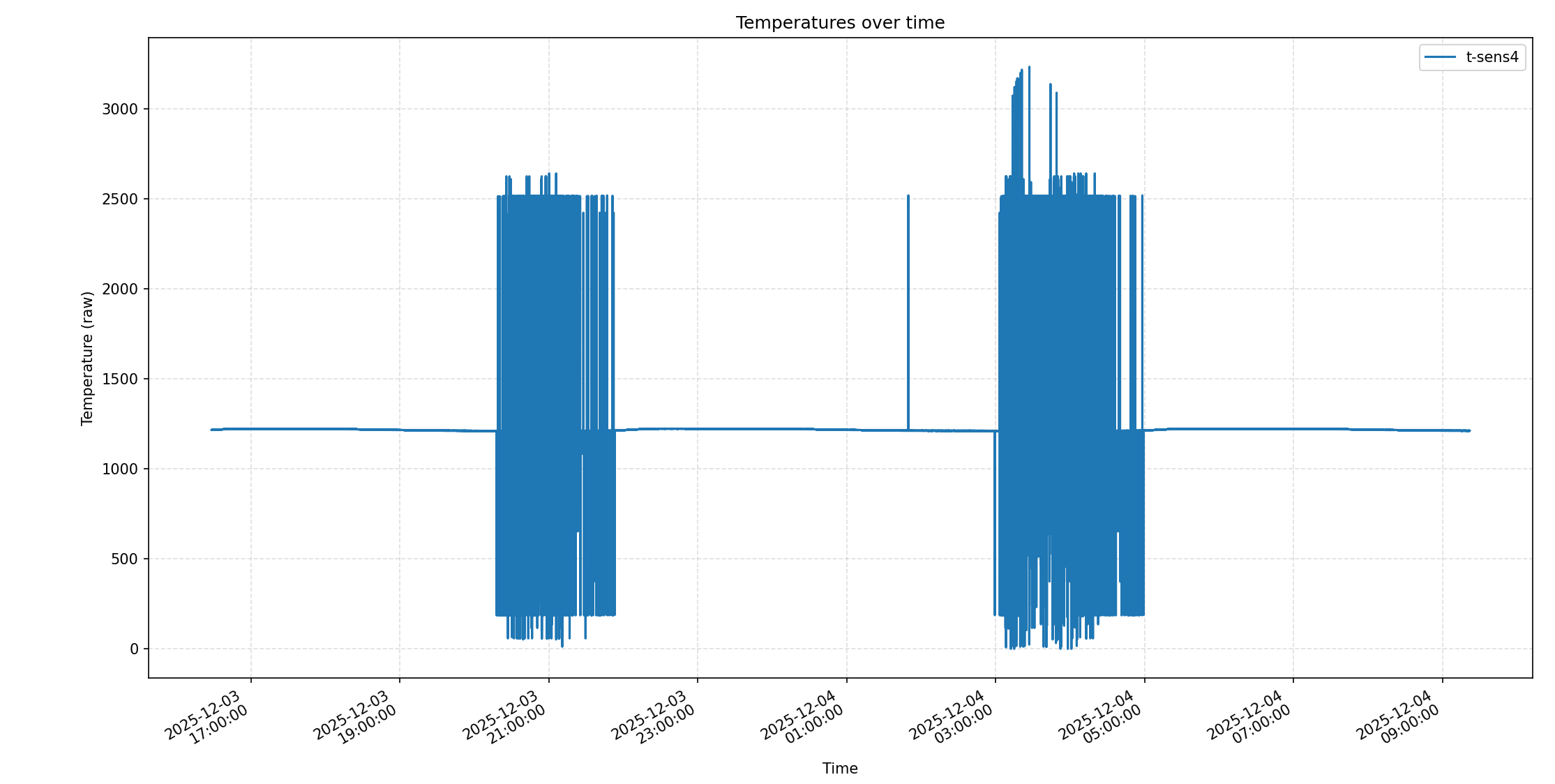
During TV testing the unit was cycled between -35°C and +55°C. All HK values showed nominal values, with one exception. One ADC128S102QML-SP is used to read temperatures from external and internal temperature sensors. Therfore euch channel has an own analog chain to amplify the signals from the temparature sensors. For the TV tests the external sensors were fixed values resistors outside the vacuum chamber at room temperature. So normally you would expect a constant value to be read, maybe with little variations due to temperature dependecies from the analog circuitry.

But look at the figure below. What you see is three warm phases and two cold. At the cold phases, the ADC delivers corrupt data. This is approximately at box temperatures below -25°C. A closer look into the first cold phase is shown in the second figure. This looks like a digital issue to me. HK refresh rate is 1Hz. All eight channels of the device show similar data. The three other ADC128S102QML-SP do not show this. They always deliver proper data.

We are currently checking the analog input signals and powersupplies of the device, but therefore the unit has to be disassembled.

Could this be an part failure? Or do you have any other thoughts on this?

Thank you very much for your answer!

Best Regards

Carsten


adc-problem.png

adc-problem-zoom.png

  • Hi Carsten,

    This device does have an application advisory, but this seems to be much more significant than that would account for. To confirm, this only happens on one unit at cold temp?

    If the device begins at cold temp, and is then brought up to room temp, does the issue persist, or do the conversion seem correct afterwards?

    Regards,
    Joel

  • Dear Joel,

    thank you for your answer. Yes, it only happens to one unit. The other three units are connected to the same bus and they work properly. When the device gets out of the cold range, it comes back to normal operation. I have read about the sparkle codes, but I think they appear much less frequently.

    Best Regards

    Carsten

  • Hi Carsten,

    Apologies for the big delay in my response. The next step would be to perform an A->B->A test to verify that the issue follows the device. If the bad device is swapped with a known good device, does the issue happen on the good device? Now, if the bad device is mounted on another board, does the issue follow the device?

    If that is the case, I think we would want to proceed with the return process and failure analysis.

    Regards,
    Joel

  • Dear Joel,

    please excuse my very late answer. In the meantime we found the problem, it was a simple timing issue. The SPI bus, connecting the four ADCs, is routed through the whole instrument, and therefore the signal integrity is not so good. Signal slopes are too slow for 10MHz SPI Clock operation. We now reduced the clockspeed, and the problem is gone. Thank you very much for your cooperation!

    Best Regards

    Carsten