This thread has been locked.

If you have a related question, please click the "Ask a related question" button in the top right corner. The newly created question will be automatically linked to this question.

DAC8760: Spontaneous Burnout

Part Number: DAC8760

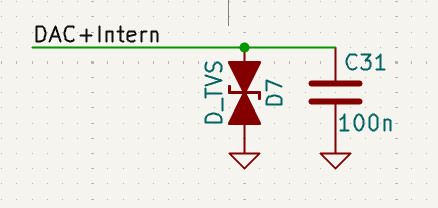
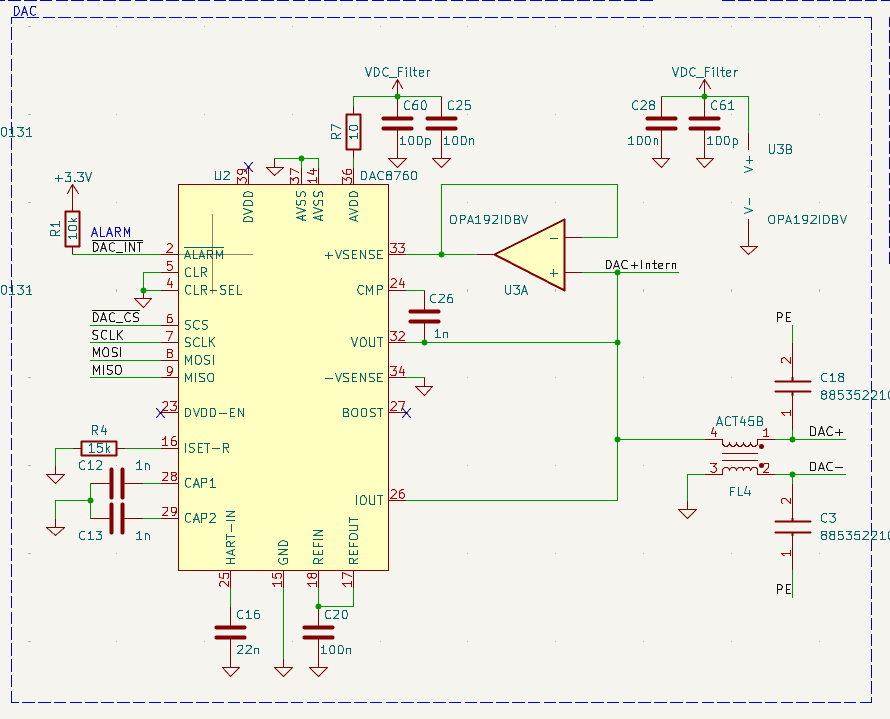
Sometimes when switching the load of the DAC via a switch the DAC burnsout and the IOUT output ist destroyed. After the burnout the internal Resistor between BOOST-Pin and AVDD-Pin is highly resistive. When I try to replicate this event I am unable to do this and it does not matter how fast I toggle the switch, the IOUT-Output stays functional. Is it possible that inductive loads are the problem or maybe ESD. Even with protection circuits the device gets destroyed sometimesDACProtection.pngDACESD.png
 

Thank you for your help

  • Hi,

    Can you give more details in what loads you are switching between?

    Also, can you describe the register configuration of the device?

    Thank you,
    Lucas

  • Hi,

    We are switching between open-ended and Multimeter(Almost 0Ohm). We already placed a 100 Ohm resistor in series with the Multimeter and still sometimes the DAC burnsout. We are using the 4-20mA configuration. Thank yout for your fast reply

    kind regards,

    Lennart

  • Hi Lennart,

    What is the inductance of the inductor on IOUT?

    Can you describe the protection circuits have you already tested?
    The datasheet recommends a few unipolar and bipolar diodes, with a series resistor:


    Also, when using a capacitor greater than 470 pF on the CMP pin, it is recommended to add a 100 pF capacitor to GND at the CMP pin.


    Thank you,
    Lucas

  • Hi Lucas,

    Thank you for your reply. The inductance is hard to quantify. It comes from the relatively long cables in our switching box. We have the TVS Diode implemented. What is the purpose of the two unipolar diode. We can not implement them in that way because we drive the DAC8760 with GND and 24V volts. Does the 15Ohm resistor make such a difference because we already have pretty big load in the output. What does the additional 100pF at the CMP Pin do to protect us from our current burnout? Do you have an idea what happens in our circuit to result in this burnout?

    kind regards,

    Lennart

  • Hi Lennart,

    The unipolar diodes provide protection directly at the pin. It is recommended to choose a diode with a lower forward voltage, such as the BAT54, as they will trigger before any internal diodes of the DAC.

    The 15 ohm resistor was specifically tested during the development of the part, but I am not sure how much it will affect in your circuit. It could be worth trying if it is easy to include.

    The additional capacitor on CMP shouldn't have any affect on the burnout issue.

    From what I understand, IOUT has some inductance where sometimes an instantaneous change in load that makes the current cause a transient that can damage the device. Having protection circuitry such as the 15 ohm resistor and unipolar/bipolar diodes closer to the pin may help prevent this.

    Thank you,
    Lucas

  • Hi Lucas,

    My Main Problem is that I can not really recreate the destruction of the DAC. It is just that sometimes the DAC just dies. Do you have any idea what it could be. ESD maybe? Thanks for your help

    kind regards,
    Lennart

  • Lennart,

    One possibility is that the device is experiencing a large overvoltage because of the input inductance. You have a large 100uH inductor on the input of your circuit. If the board is outputting 20mA, and the leads are immediately disconnected you may see large voltage spikes. This comes from V=L(di/dt), and it can be very large spikes of voltage seen at the output leads. 

    I would imagine that you might see the same spiking at the output if it starts as an open circuit and the output is then connected to a load. You could see this as a voltage output, and once connected to the load, any ceramic capacitance on the load will instantaneously pull a large current.

    Just to check, you could look at the output with an oscilloscope to see if there's spiking or ringing on the output.

    Joseph Wu