This thread has been locked.

If you have a related question, please click the "Ask a related question" button in the top right corner. The newly created question will be automatically linked to this question.

ADS1232: Pull-up-Pull-down Resistor

Part Number: ADS1232
Other Parts Discussed in Thread: , TPS7A20

Hi
The pin description for the digital pins doesn’t specify whether pull-up or pull-down resistors are required. Do I really not need any resistors here, and can I connect the pins directly to the MCU?

best regards

john

  • Hello John,

    In general, you can connect these pins directly to the MCU.  The DRDY/DOUT pin is push-pull and always driven high or low.  All of the digital input pins should be driven high or low and not left floating.  If the MCU pins can be hi-z for longer than power-up initialization, then you should pull the ADC digital input pins high or low. 

    The /PWDN pin should be held low during power-up for proper device reset.  I recommend using a pull-down on this pin to make sure it is low before the processor configures the IO pin connected to the /PWDN as an output.

    Regards,
    Keith Nicholas
    Precision ADC Applications

  • Hi Keith

    thx for the support. 

    I still have the following questions:

    • Can you tell me what the advantages and disadvantages are of using an internal clock source versus an external crystal? What are the advantages of using a crystal?
    • What should I pay attention when selecting components and dimensioning the filter for the analog inputs? Is one even required?
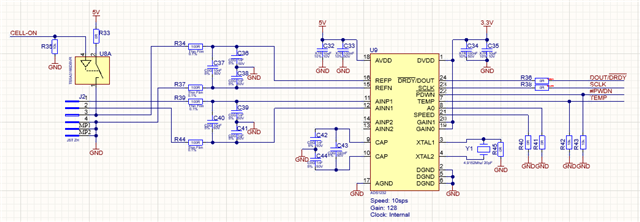
    • Could you review the circuit diagram for the section around the ADC?

    I’m really looking forward to your replies

    best regards

    John

  • Hello John,

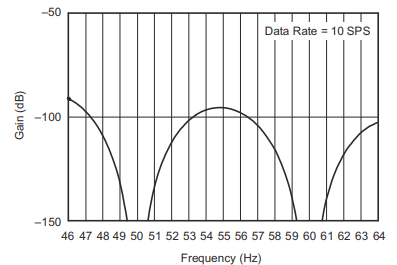
    1.  The internal clock oscillator is very low power and being integrated into the ADC, reduces the board area needed for the entire circuit.  The accuracy is +/-3%, which provides for 100dB of 50/60Hz power line rejection over this range (Figure 7-6 in the datasheet). 

    The main advantage of an external crystal is the tighter tolerance, typically 0.01% or better.  This provides some additional margin since power line frequency is not exactly 50/60Hz.  I think most customers use the internal oscillator, since the performance for power-line rejection is good enough in most cases.

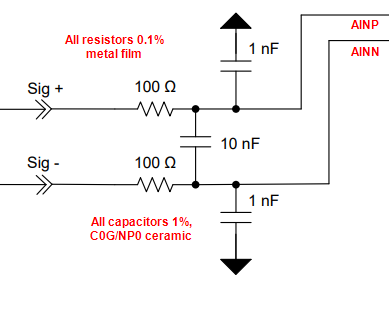
    2.  Yes, you should include filters for both the reference inputs and the analog inputs.  There is always the chance of external noise pickup between the bridge sensor and the ADC, and the filter can help with this.  In addition, the filters provide ESD protection for the ADS1232.  Recommended input filter for both the reference and ADC input:

    3.  I do not see any attachments.  Please try uploading again using the Insert -> Image/video/file option.

    You can also refer to the ADS1232REF evaluation board user's guide, as well as the application note A Basic Guide to Bridge Measurements (Rev. A)

    Regards,
    Keith

  • Hi Keith

    very helpful. thx for it.

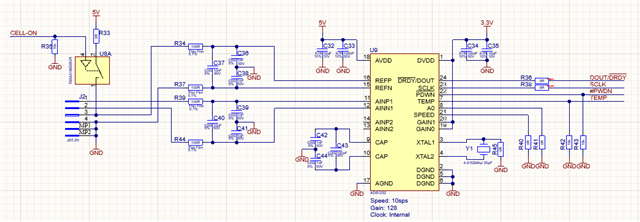
    I have added filters to the schematic and attached it.
    When I look at the schematic of the ADS1232REF evaluation board user’s guide, different capacitor and resistor values are listed. I’m not sure which ones to use now? I prefer yout values (100R+10nF+1nF)

    The load cell should to be switchable; where is the best place for the switcher? High side oder low side of?


    The ADC is to be used in a commercial kitchen scale with a capacity of up to 2 kg and is battery-powered (3.7V LiPo).
    What would you recommend to generate 5V from the 3.7V battery? ( 5V boost or 5.5V boost + 5V LDO or 5V charge pump or something else)

    best regards
    john

  • Hello John,

    The schematic looks good.  Depending on the external noise environment, you could use a 10uF X7R in addition to C37 for the reference input.  I do not think this will make much difference in overall noise performance, but it is hard to predict.  

    Either charge pump or boost can be used to generate 5.5V, followed with a good 5V LDO, such as TPS7A20.  Depending on the noise of the boost or charge pump, you may not need to follow with an LDO, but the TPS7A20 is very low cost and will provide a very good low noise supply for the system.

    Regarding the boost or charge pump, I would use either the lower-cost option or if power consumption is a key factor, the more efficient solution.

    Regards,
    Keith