This thread has been locked.

If you have a related question, please click the "Ask a related question" button in the top right corner. The newly created question will be automatically linked to this question.

ADS1220: multiplex multiple RTD channels

Part Number: ADS1220
Other Parts Discussed in Thread: MUX36S16, , ADS124S18, ADS122S14, MUX36S08

Hi TI team, 

I am seeking some advices.

I am developing a high accuracy and high-speed multi-channel RTD temperature measurement system with a target sampling rate of more than 1000 Hz, as shown in the diagram below. The plan is to use an ADS1220 together with 4 MUX36S16 to multiplex 16 RTD channels.

Would this be a reasonable architecture for achieving the required performance? Are there any potential concerns, limitations, or risks that I should consider?

 Any recommendations or alternative approaches would be greatly appreciated.
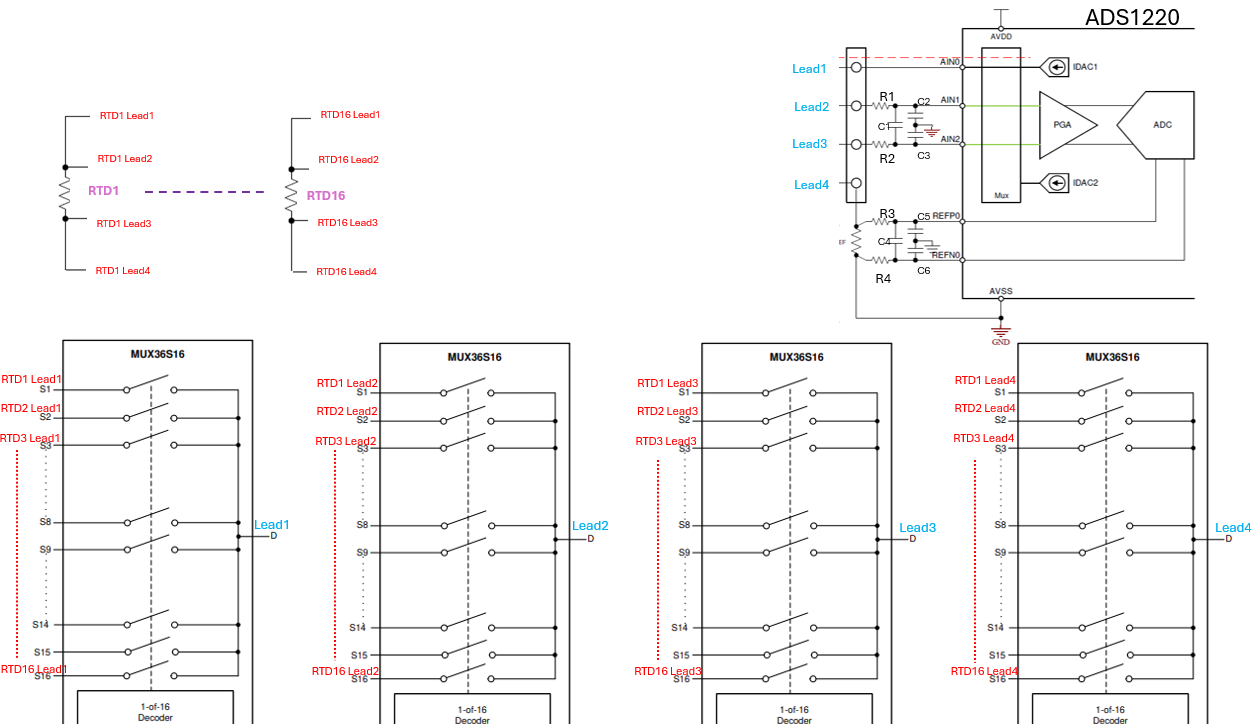
image.png

  • I overlooked the channel switching overhead between channels. With the ADS1220, each conversion requires approximately 0.5 ms, so scanning 16 channels would take: 
    0.5 ms × 16 = 8 ms
     This means the maximum sampling rate per channel is only: 
    1 / 8 ms = 125 Hz

    My target is 1000 Hz per channel, so it appears that this approach will not meet the performance requirement. I may need to consider a different architecture or a faster ADC solution.

  • Hello AD,

    You are correct that that solution would not work for the speeds you are trying to achieve. The newer version of the ADS1220, the ADS122S14, could support up to 8 RTD readings at its highest speed in 1ms. This speed would have the worst noise performance, and still less than your desired 16 readings you wanted. A multi-ADC solution may be needed. You could run multiple ADS122S14s in parallel or daisy chain them together. If more ADCs are used, the speeds can be reduced, and the noise performance will improve. The ADS124S18 is another possible solution. This ADC could gather about 10 RTD readings with comparable settings to the ADS122S14 calculation mentioned earlier.

    What performance are you hoping to achieve when you say "high accuracy"? This might help narrow down the architecture and ADC to use.

    Regards,
    Mason

  • Hi Mason,

    Thanks for your reply.

    Our target is to achieve an RTD measurement accuracy and noise level of less than ±0.1°C. We plan to use 4-wire RTD sensors, and using multiple ADC devices is acceptable. The complete system is expected to support approximately 100 RTD channels.

    For each 4-wire RTD, the ADC configuration requires:

    • 1 pin for IDAC excitation
    • 2 pins for RTD differential voltage measurement (VRTD+ / VRTD−)
    • 2 pins for reference voltage measurement (VREF+ / VREF−)

    The VREF pins can be shared among multiple RTD channels.

    Based on this, my understanding is:

    • ADS122S14 can support approximately 2 × 4-wire RTDs
    • ADS124S18 can support approximately 5 × 4-wire RTDs

    I am currently considering the following architectures:

    Option A

    • 1 × ADS122S14
    • 8 × MUX36S08

    This configuration can support up to 16 RTDs. Additional identical groups can be added to support more RTD channels.

    Option B

    • ADS124S18 without external multiplexers

    Each ADS124S18 can directly support up to 5 RTDs. Additional ADS124S18 devices can be added as needed to increase the channel count.

    Option C

    • 1 × ADS122S14 
    • 17 × MUX36S08  = 17*5 =75 RTDs

    Given the requirements of approximately 100 RTD channels, a per-channel update rate above 1000 Hz, and a target accuracy of better than ±0.1°C, could you please advise which architecture is preferable and whether there are any concerns regarding settling time/conversion latency, noise performance, or overall system complexity?

    Thank you very much for your advice.

  • Hello AD,

    Option A and C will not give you the target accuracies at the speed you desire. Option B will be your best option. 

    Please keep in mind that as your speed increases, the noise will increase as well. This noise will lead to a decrease in the effective resolution, and decrease your accuracy. The datasheet for the ADS124S18 provides the following equations:

    Option B will be your best option. It will allow for higher speeds with higher accuracies. The ADS124S18 also has a sequencer to reduce the amount of communications to the ADC. 

    Regards,
    Mason