This thread has been locked.

If you have a related question, please click the "Ask a related question" button in the top right corner. The newly created question will be automatically linked to this question.

ADS1259 Gain Error Confusion

Other Parts Discussed in Thread: ADS1259

Hi there,

I'm just reading through the datasheet of the ADS1259 and the given values for the typical and maximal gain error keep confusing me.

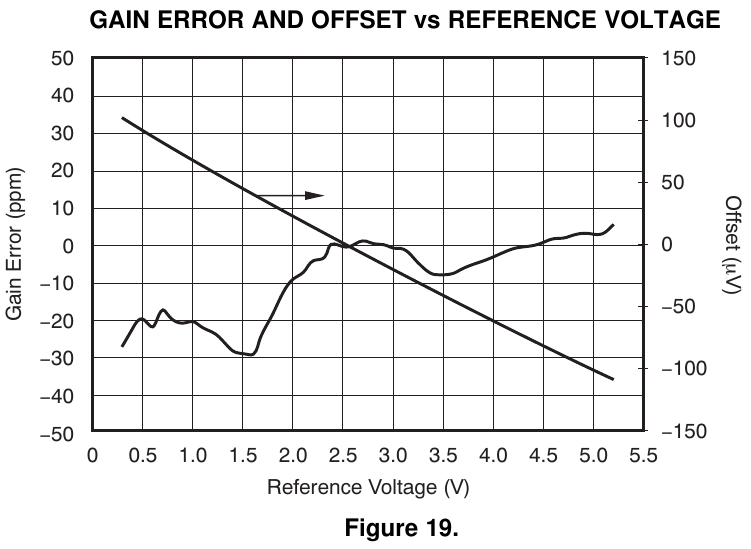
According to the electrical characteristics section, the typical (uncalibrated) gain error is 500ppm@25°C and the maximal gain error is 5000ppm@-40 to +105°C. But according to the plots in the typical characteristics section, none of five units even reaches the typical value (which is sort of contrary to the meaning of the word "typical"). The range of the gain errors in the "gain error and offset vs reference voltage" figure is even ten times lower than 500ppm and almost zero at 2.5V Vref. I know that this device can be calibrated, but from my understanding, these plots should not show any calibrated measurements. Why do the values for the gain error differ so much Could somebody please clear those things up? Thanks in advance!



  • Hi Martin,

    Welcome to the forum!  Sometimes we try to give as much information as we can because of questions from the past, and sometimes that information can become confusing.  I think that is what is happening in this case.

    5 devices is a pretty small sample size.  Basically the first graph you reference is to show the kind of variation you might see across temperature.  But over a large number of devices tested, or from simulation data, you might expect to see a broader range of error with respect to worse case.  The typical numbers can include lot variation.

    Maximum specifications are guaranteed numbers related to final device testing after manufacturing.

    When we add other things that can effect or compound an error, then these errors will become worse.  The reference is designed for a normalized value of 2.5V.  You may see differing gain error between devices depending on possible differences of the internal reference value.  If you use an external reference, then depending on the voltage it may introduce additional error.

    It does become rather complex, I agree.  With respect to the typical number, you would typically not expect to see a gain error worse than the typical value.  It might be better, it might be worse, but not worse than the maximum.  You should always do an offset calibration as this will match the 0 point of the gain slope.  The difference of the ideal gain slope as compared to the actual will always be more pronounced the closer you get to full-scale.  Here is where there is a trade off.  If you sacrifice dynamic range you will reduce the effects of gain error.  In other words, you reduce or restrict the input range to reduce the effect of gain error.

    Best regards,

    Bob B

  • Hi Bob,

    thank you for your fast reply. Your explanations are what I would have guessed - but guessing is something that I like to avoid :)