This thread has been locked.

If you have a related question, please click the "Ask a related question" button in the top right corner. The newly created question will be automatically linked to this question.

ADS131E08: SFDR&THD&Dynamic Range

Other Parts Discussed in Thread: ADCPRO

Q1:  snipped from datasheet 
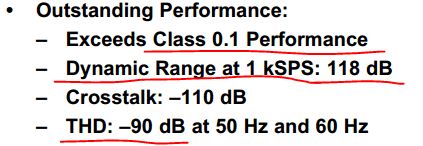
what's the Class 0.1 performance?

what's the exact definition of Dynamic Range?

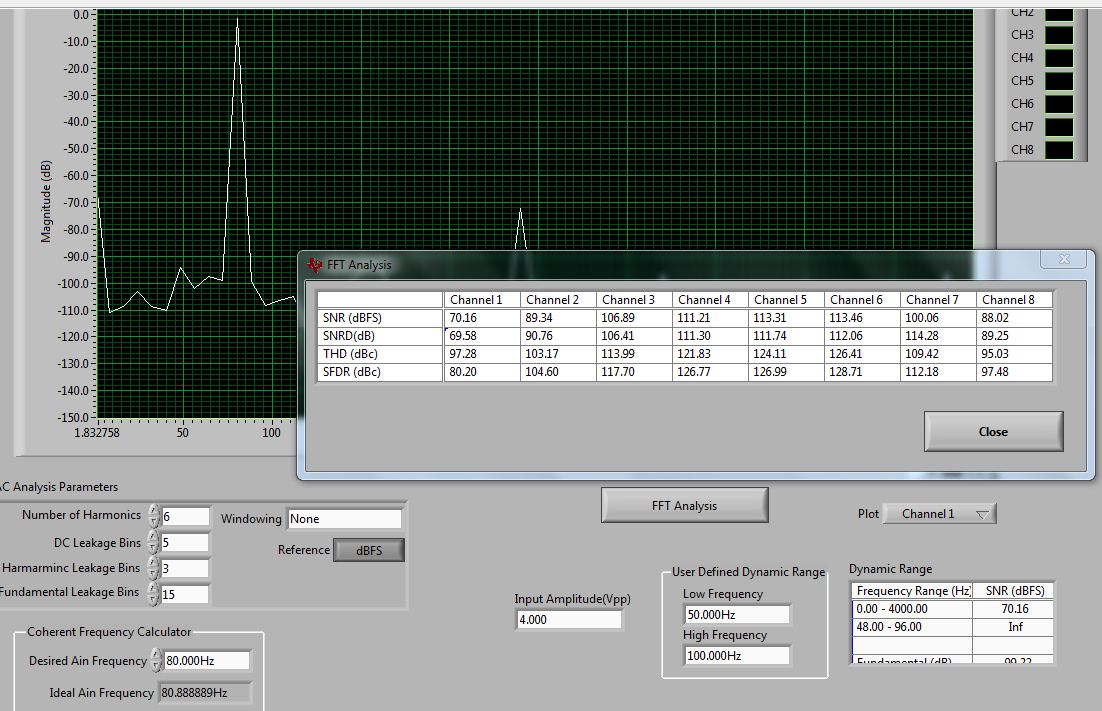
Q2: Why THD is larger than SFDR?

Test Condition: 80 Hz, 4 Vpp, Sine -- 8000 SPS 
Look forward to your reply, thanks a million!

  • The class rating is the electric meter class spec defined by ANSI standards; it references the accuracy requirements for the measurements.  If you are working on or researching power meters, you definitely want to review the specs and understand their significance.

    Dynamic range is the ratio between the largest and smallest input values that are discernable by the device over a given bandwidth.  The smallest level (limiting factor) will be the noise floor of the device in most cases.

    In regarding to SFDR and THD, THD takes into account only the harmonics for the distortion content while SFDR is the largest signal (should be fundamental) to next largest spike, which may or may not be a harmonic frequency.

    For reference, although the EVM tools are different, the user guide for ADCPro found at http://www.ti.com/tool/adcpro?DCMP=hpa_tools&HQS=adcpro has a section (Appendix A) that shows the basics of the measurements for ADCs.

  • Hi Greg, thanks a lot for your answer. There are still some other questions.

    1. according to your explanation of DR (Dynamic Range), the SNR should approach DR when the amplitude of input signal is near full scale. SO, why they are quite different during my test? Or, is my comprehension of SNR and DR correct? 

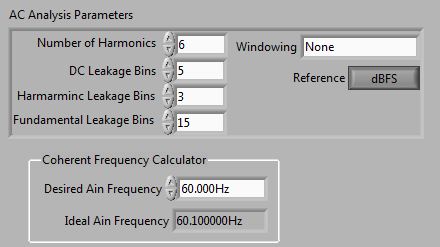
    2. in the following graph, what are the DC leakage, Harmonic leakage & fundamental leakage and their differences?

    Thank you so much!

  • Hi Bill -

    For accurate measurements, you must have a precise input signal. Any noise of the input signal can skew the results of the measurement.  Most signal generators don't generate the quality of signal required; you may have to run the signal through filtering, either passive or active, to achieve the results that you are expecting (the performance of the device).


    Regarding the software, please reference the user guide for ADCPro for an explanation of the measurements and controls that are available.