A related question is a question created from another question. When the related question is created, it will be automatically linked to the original question.
If you have a related question, please click the "Ask a related question" button in the top right corner. The newly created question will be automatically linked to this question.
You can use SSI interface module, but I suggest you to select SPI frame format by configuring the SSI module because of following reasons (TI Synchronous Serial Interface as an example):
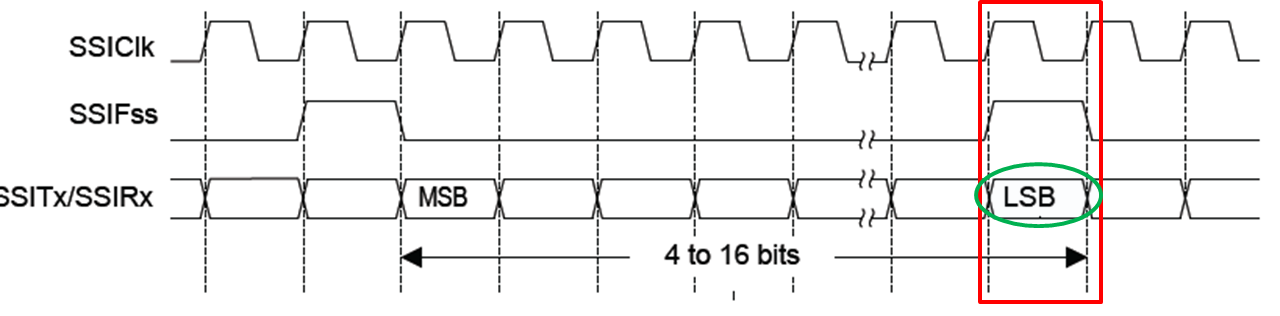
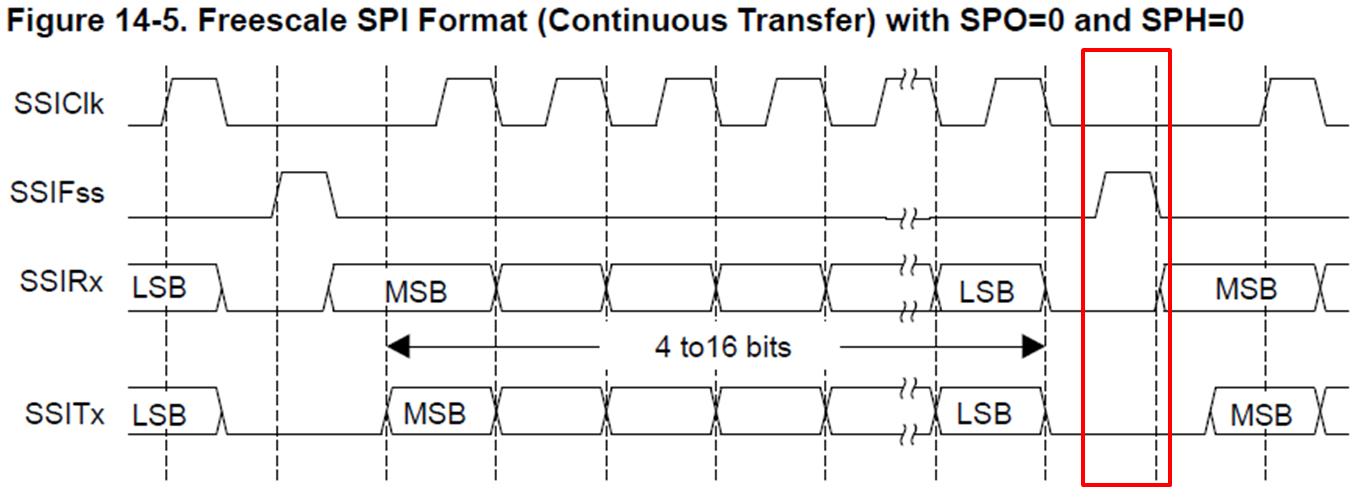
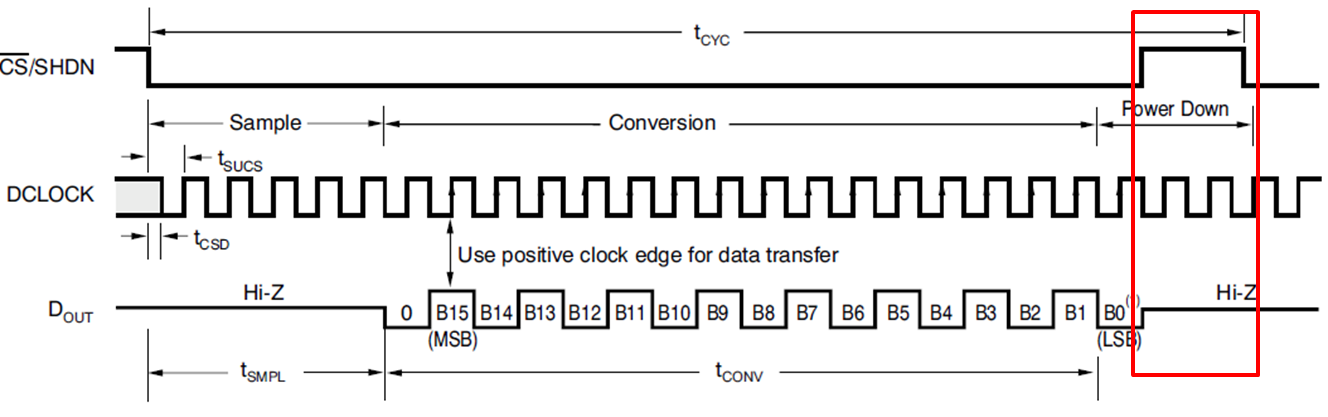
1. When the data frames are transmitted continuously, the SSI format's SSIFss signal is pulsed High for one SSICLK period while the last bit(LSB) on the SSITx/SSIRx data line is being transmitted(refer to Figure 1 as below). But for standard SPI timing, the SSIFss signal is pulsed to High after the last bit(LSB) on the SSITx/SSIRx data line is transmitted(refer to Figure 2). ADS8326 has the same timing requirement as standard SPI in Figure 3.
2. The SSI format drives the data on the rising edge of SSICLK and latches the data on the falling edge. But ADS8326's SPI timing is opposite and transmits the data on the falling edge of DCLOCK and the mater/system can capture the each bit on the rising edge DCLOCK clock.(Figure 1 vs Figure 3)
The ADS8326 requires all three digital pins to be used. The CS pin is what starts the conversion process in this design. DCLOCK is both for the interface and for the internal operation of the ADC, and is used for the actual conversion. And, of course, your data shows up on Dout. Therefore, the ADC does not function without any one of these signals. You do need a 3-wire configuration.
One might be tempted to tie CS low, thinking that we could get away with never going into shutdown mode, but according to Page 8 of the datasheet, that would only result in the same data repeatedly clocked out.
If you absolutely need an ADC with a 2-wire interface, TI has several to choose from that are also 16-bits and around this speed.
Take a look at these, from the Selection Tool on TI.com. It looks like the Serial I2C interface (2-wire) is what you are looking for.
In the case of the ADS7924, for example, a conversion is initiated by writing a command word to the ADC via the 2-wire interface, and no Convert Start pin is used. The data is read from all four channels using the same interface. This device also has some interesting automatic measurement modes, where an interrupt signal is toggled if the measured results are out of range of values that you set.
many thank but this is not the right component for me. I don't want to use a bi-direcional communication like I2C because I need do have a full duplex RS485 transceiver that send clock and receive the data: that's why I need an SSI communication and not SPI or I2C