This thread has been locked.

If you have a related question, please click the "Ask a related question" button in the top right corner. The newly created question will be automatically linked to this question.

ADS1258 step settling time

Other Parts Discussed in Thread: ADS1258

The ADS1258 datasheet has the following information on page 20, under section SETTLING TIME

When applying asynchronous step inputs, the settlingg time is somewhat different. The step-input settling time diagrams (Figure 45 and Figure 46) show the the converter step response with an asynchronous step input. For most modes of operation, the analog input must be stable for one complete conversion cycle to provide settled data. In Fixed-Channel mode, the input must be stable for five complete conversion cycles.

I'm attaching the section to this post as well.
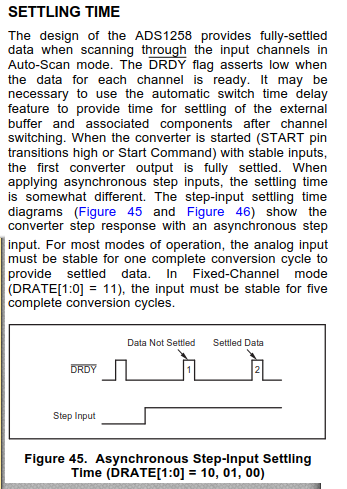
What does "Step input" mean in this context? What is the amplitude change with which we can not see fully settled data in the output? If my input is changing between 0.1V to 0.2V continuously, does that count as "step input"? Can't we sample continuously changing signals with this ADC?

  • Hi Hakan,

    The ADS1258 has a SINC5 digital filter. You can think of the filter as a moving average filter that collects 5 samples and takes the average. Therefore, the calculated average will be "unsettled" until 5 conversions have completed.

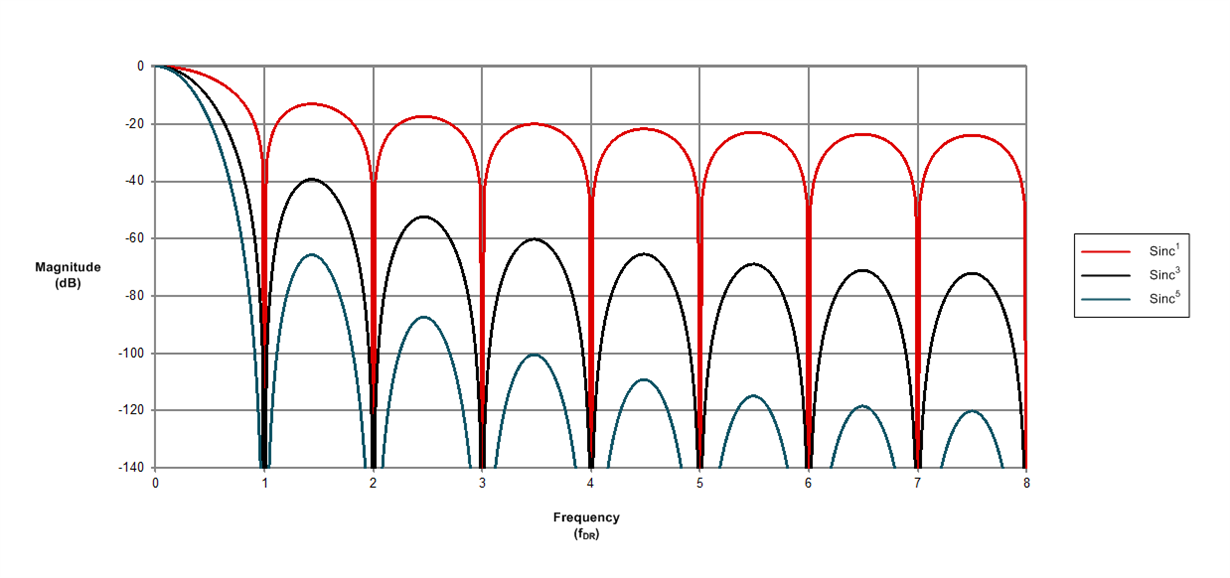
    The settling time after a step input, is not so much related to the change in amplitude of the input signal, so much as the frequency of the input signal. A true "step" signal contains a lot of high frequency harmonics.The higher frequencies will be attenuated by the SINC's LPF frequency response, shown below:

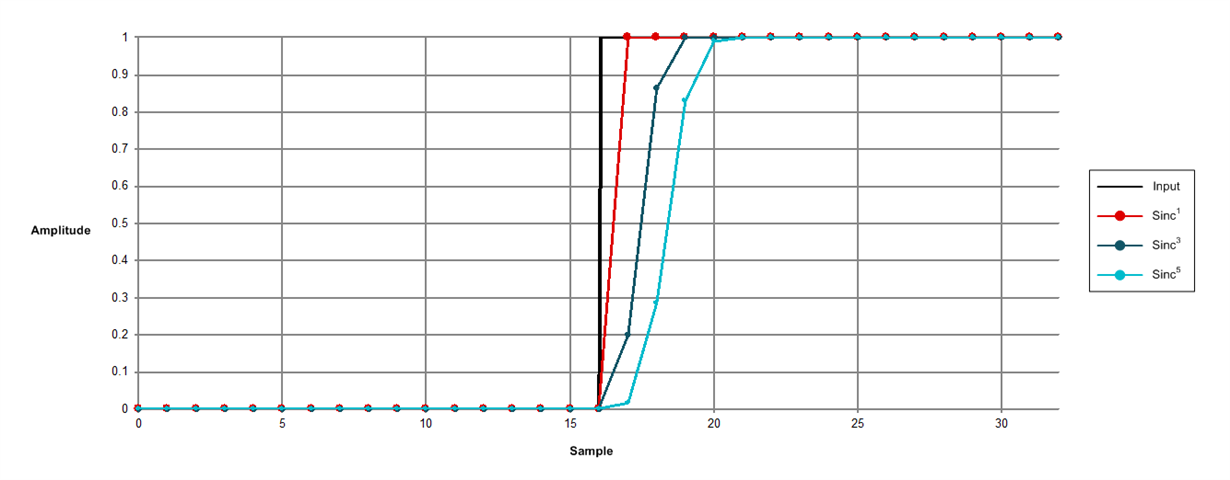
    When the "step" is passed through the digital LPF, it will have a time-domain step response like the following:

    Notice that the higher the order of the SINC filter, the more conversions are required for the filter to settle.

    Reference:

    So yes, you can continuously sample an input signal but keep in mind that the signal is going through the SINC LPF and will be attenuated as such... If you need to capture the higher-frequency content in the input-signal, then either you'll need to run the Delta-Sigma ADC at a much higher data rate (where the SINC filter provides the bandwidth needed), or in many cases a SAR ADC may be better suited for capturing a wide-band signal. Delta-Sigma ADC's are generally used for capturing "slow" signals.

    You will also see a "step" input when switching MUX channels, even though the input signals are DC. Therefore, the settling time of the SINC filter will have a big impact on how quickly you can MUX through all of the channels on the ADS1258. Note that in Auto-scan mode, the ADS1258 will not output data until the filter has "settled". Therefore, the effective data rate will appear to be about 1/5th of the nominal data rate, and the effective data rate per channel will decrease as you use more channels.

    Best Regards,
    Chris 

  • Thank you for the detailed answer. I have other questions about the ADS1258 for which I will create a new post momentarily.