This thread has been locked.

If you have a related question, please click the "Ask a related question" button in the top right corner. The newly created question will be automatically linked to this question.

ADS1282: Conversion rate ADS1282 (2 INPUT)

Part Number: ADS1282
Other Parts Discussed in Thread: ADS1262, DAC1282

Hi !

For my application (geophysics) we need to convert 4 differents data from 4 sensors with only 2 adc 32bits at 1kHz. Basically we need to convert data of 4 sensors every 1ms.

So we've used 2 ads1282 but when we want to change the input (by writing in config1 register), the ads1282 take 63 DRDY period to be ready and output the data).

So with 64ms between 2 conversion for one adc is pretty big...

So my question is, is it possible to use two ads1282 with 4 sensors at 1KSPS rate or we have to take 4 adc or maybe take the ads1262/63 ?

Thanks a lot for you help ! i'll be waiting your answer. Have a good day :) .

Regards, Quentin.

  • Hi Quentin,

    The settling time of wide-band digital filters is not really intended for achieving high data throughput when multiplexing between channels. The second channel of the ADS1282 is typically used for testing with the DAC1282, but during normal operation the inputs are not usually multiplexed.

    If you need to sample 2 channels every 1 ms, you could configure the ADS1282 with the SINC5 filter and a data rate of 16kSPS. This results in a settling time of 0.41 ms (with a 4.096 MHz clock). However, you would not have the flat-passband of the FIR filter and you would have more noise from the higher data rate.

    What type of performance are you trying to achieve?
    For best SNR and THD, you'll probably be best using 4x ADS1282.
    If you only need good DC or low-frequency performance, the ADS1262 would be a good option.

    Best Regards,
    Chris
  • Hi, Chris.

    First, thanks a lot for your relply !
    Yes, actually we need a good SNR to be able of getting small signals but like all embedded systems we need an energy consumption as little as possible that's why we want to use only 2 ADC. Anyway we'll use 4ADS1282 as you suggest.

    I'm just wondering ADS1282 can be pushed up at 16kSPS ? On the datasheet, CONFIG0 register can only set between 250 and 4kSPS

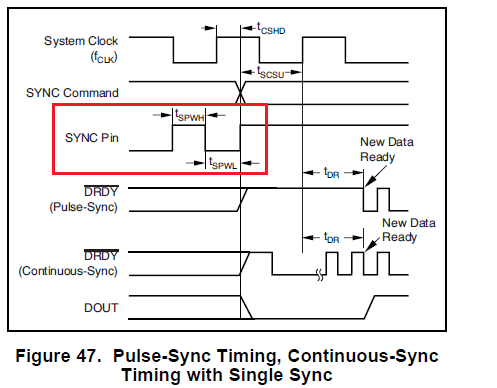
    Finally i've another question. When i apply a toggle on a sinc pin (0 to 1 and 1 to 0 with the impulsion duration is like 1µs), i've the same timing issue between two conversion (on the same input). Is it the regular operating ? Or maybe there is something that i do not correctly ?

    Thank you in advance, and have a nice day.

    Regards,
    Quentin.
  • Hi Quentin,

    The 250 SPS to 4 kSPS data rates apply to the FIR filter mode; however, if you use the ADS1282 with the SINC filter then you get data rates between 8 kSPS and 128 kSPS. Refer to table 6 in the data sheet for the SINC filter data rates.

    ...I'm not sure why the "Register Map" section of the datasheet  only shows the FIR filter data rates. That could certainly be made clearer in the documentation!


    For the SYNC issue, I think you just need to provide one more rising edge to the SYNC signal. Figure 47 in the datasheet shows the SYNC pin go low-high-low-high, like so:

    Best Regards,
    Chris

  • Hi Chirs, 

    I just want to let you know that we have upgrade our solution with 4 ADC 1282 and it's working ! So i wanted to thank you for your advice :)

    I have another question about the noise conversion. In the datasheet, the SNR is given in function of the frequency table 1 p.12

    For exemple at 4KSPS with PGA a 8, SNR = 116dB, if we convert this dB level in Vrms and V(peak-peak) we have : 1.585µVrms and 4.483Vpp

     Does this mean that the smallest measurable signal is 4.483Vpp ? Or it's totally different ? 

    Thanks a lot ! 

    Regards,

    Quentin.

  • Hi Quentin,

    What value were you using for Vref?

    For a 5V reference, PGA = 8 V/V @ 4 kSPS:

    • FSRrms = 5Vpp / (2 * sqrt(2) * 8 V/V) =0.221 Vrms and
    • Nrms =  FSRrms / 10^(116 dB / 20) = 350 nVrms

    So the smallest measurable signal is 350 nVrms.
    Or you could convert this to a peak-to-peak value, then smallest measurable signal would be 350 nVrms * 6 c.f. = 2.1 uVpp (assuming a crest factor of 6).

    Best Regards,
    Chris

  • Hello Chris, 

    Actually i'm using Bipolar Vref (-2.5/+2.5) but i gess it's not change the value of Nrms, does it ?

    Thanks again, you helped me a lot with my issues :) 

    Regards, 

    Quentin.

  • Hi Quentin,

    That's correct, for a +/-2.5V bipolar reference you would still use the 5V differential reference voltage for the calculation.

    Glad to help, let me know if you have any additional questions!

    Best regards,
    Chris