This thread has been locked.

If you have a related question, please click the "Ask a related question" button in the top right corner. The newly created question will be automatically linked to this question.

ADS1120-Q1: About the Bridge Measurement

Part Number: ADS1120-Q1

Hello,


Regarding to Bridge Measurement with ADS1120-Q1, my customer is asking a question.

They will refer Figure 82( Bridge Measurement ) on datasheet(page 95) for their application.

・Analog input : Magnetic(Hall) Sensor

・AVDD = Magnetic Sensor power: 5V

・Data rate: 2k SPS


(Question)

(1)They will place a current limit resistor between power line and power input,

because magnetic Sensor can’t input many current to power input.(Please refer below.)

In this case, is there any problem or concern?

(For example, the impact on ratiometric operation)
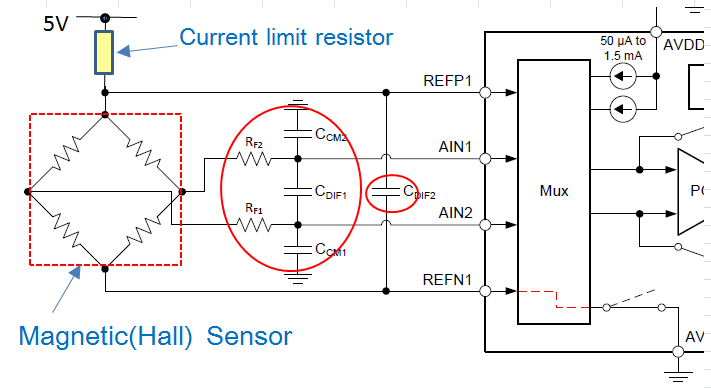


(2) A first-order differential and common-mode RC filter(RF1, RF2, CDIF1, CCM1, and CCM2)

How much resistance value and capacitance value should they estimate?

Can they refer Thermocouple Measurement section on datasheet(page48)?

(RF1 = RF2 = 1 kΩ, CDIF = 100 nF, and CCM1 = CCM2 = 10 nF.)


Regards,

Tao2199

  • Hi Tao2199,

    The customer can limit the current with a resistor, but they can also use current excitation for the bridge instead of voltage excitation.   Current excitation can be accomplished by using the IDAC current sources of the ADS1120-Q1 and routing the current out REFP1.  The required minimum voltage reference is 0.75V, and if using the IDAC current sources, the maximum is AVDD-0.9V, which is the compliance voltage of the IDACs.  Another consideration is the common-mode voltage for the input.  In most cases the desired gain will be 128, but if the reference voltage is at the minimum of 0.75, the maximum gain that can be applied is 1 due to common-mode input restrictions of the PGA.  So to achieve maximum gain with the lowest noise result, the common-mode of the input must be within the correct input range with the use of the series resistor or with the current excitation, which simply means you cannot use a large series resistance or a very small current.

    As to the values of the filtering components, the values given are a good starting point.  If you need to use the low-side switch, then you must also take into account analog settling of the filter components, which will also include the resistance of the bridge.

    Best regards,

    Bob B