This thread has been locked.

If you have a related question, please click the "Ask a related question" button in the top right corner. The newly created question will be automatically linked to this question.

IC LMP91000

Other Parts Discussed in Thread: LMP91000, ADS1115, LM4120

Is there any possibilities to use raspberry pi to read ADC(ADS1115) converted analog output voltage of LMP91000 IC ?

  • Hi Dhanalakshmi,

    Welcome to our e2e forum! The analog output of the LMP91000 is either temperature data of sensor data - you could certainly use the ADS1115 to read the output and as long as your controller has an i2c interface, there should not be any issue.
  • I am using LMP91000 IC, the analog out of the ic given to ADS1115 and to read voltage by using raspberry pi.

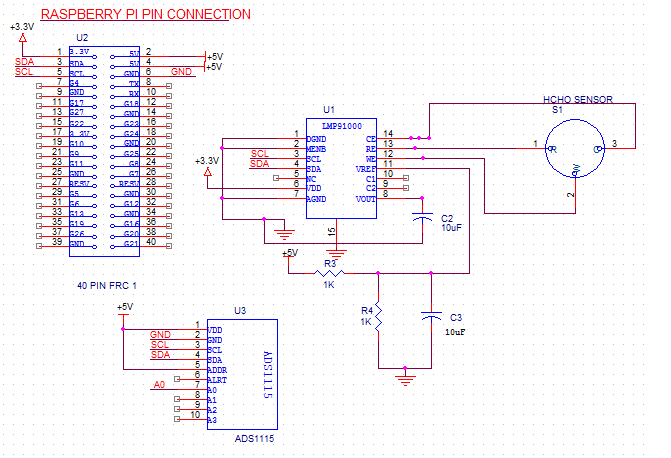
    LMP91000 IC and ADC address are visible.

    The current wiring is as follows:

    LMP91000 Raspberry pi

    DGND GND

    MENB GND

    SCL SCL

    SDA SDA

    NC        Not connected

    VDD 3.3V from raspberry pi

    AGND AGND

    CE        Out to CE

    RE        Out to RE

    WE        Out to WE

    VREF External 2.5V        

    VOUT A0 (Analog Read) to ADC

    DAP        GND

    My problem is the instrument continuously gives false readings that do not change according to the chemical environment.

    And I've attached the code.

    import Adafruit_ADS1x15
    import math
    import time
    #from kivy.core.window import Window
    from time import sleep
    import smbus
    
    class Main:
        #calculate average
        total_sum = 0.0
        average_counter = 0
        average = 0.0
    
        #led = LED(17)
        adc = Adafruit_ADS1x15.ADS1115(address=0x4b)
        GAIN = 1
        adc.start_adc(0, gain=GAIN)
        formaldehyde_error_counter = 0
        error_msg = ""
        def config_lmp91000(self):
                    bus = smbus.SMBus(1)
                    device_addr = 0x48
                    ready_reg_addr = 0x00
                    lock_reg_addr = 0x01
                    tiacn_reg_addr = 0x10
                    refcn_reg_addr = 0x11
                    modecn_reg_addr = 0x12
                    while(not bus.read_byte_data(device_addr,ready_reg_addr)):
                            pass
                    bus.write_byte_data(device_addr,lock_reg_addr,0x00)
                    if not bus.read_byte_data(device_addr,lock_reg_addr):
                            bus.write_byte_data(device_addr,tiacn_reg_addr,0x0c)
                            bus.write_byte_data(device_addr,refcn_reg_addr,0xc0)
                            bus.write_byte_data(device_addr,modecn_reg_addr,0x03)
                    print("Read Reg vales")
                    print hex(bus.read_byte_data(device_addr,refcn_reg_addr))
                    print hex(bus.read_byte_data(device_addr,tiacn_reg_addr))
                    print hex(bus.read_byte_data(device_addr,modecn_reg_addr))
    
        def formaldehyde_thread(self):
            start = time.time()
            adc_avg = 0.0
            adc_sum = 0
            counter = 0
            while 1:
                try:
                    adc_value = self.adc.get_last_result()
                except IOError as e:
                    adc_value = None
                    print 'IO Error in formaldehyde thread'
                    sleep(1)
                except:
                    print 'Not IO Error'
    
                if adc_value is not None:
                    counter += 1
                    adc_sum += adc_value
                    adc_avg = adc_sum/counter
                    #print 'start', start
                    #print 'diff', time.time()-start
                    if((time.time() - start) >= 2):
                        voltage = round((adc_avg * (0.000125)), 7) * 1000
                        print 'voltage :', voltage
                        #base voltage:1.230
                        if (voltage <= 1614):
                            ppm_value = 0
                        else:
                            ppm_value =round((((voltage - 1614.0))/6),2)
                            print 'PPM :',ppm_value
                        #self.update_formaldehyde(ppm_value)
                        self.total_sum += ppm_value
                        self.average_counter += 1
                        self.average = self.total_sum/self.average_counter
                        adc_avg = adc_sum = 0.0
                        counter = 0
                        start = time.time()
                    if self.formaldehyde_error_counter > 0:
                        self.formaldehyde_error_counter = 0
                        self.error_msg = ""
                        #sleep(.1)
                else:
                    self.formaldehyde_error_counter += 1
                    if( self.formaldehyde_error_counter == 3):
                        if not self.error_msg:
                            self.error_msg = "Error: "
                        self.error_msg = self.error_msg + "check adc, formaldehyde sensor "
    
    if __name__ == '__main__':
            obj = Main()
            obj.config_lmp91000()
            obj.formaldehyde_thread()
    

    Please check and give solution for this problem.

  • Dhanalakshmi,


    First, I'd like to see if the error is with the ADS1115 or if it is a problem with the LMP91000. Depending on the device, the question may be answered by different people.

    I need to know what the ADS1115 is measuring, is it measuring the temp sensor? or is it measuring the electrochemical cell. Are you able to measure the VOUT of the LMP91000 directly with a multimeter? I need to confirm that the voltage coming out of the LMP91000 is the voltage you expect.

    If you're having problems ADS1115, I would try measuring a known voltage, from a low-noise adjustable lab supply. This would ensure that you can write to and read from the ADS1115 correctly. If ADS1115 output is incorrect, I'll need to know the ADC input voltage and the configuration settings for the device. After that, I'd like to see the I2C communications, showing the SDA and SCL either from a scope shot or logic analyzer.

    If the problem is from the LMP91000, then I'll need to find another expert on this device to help with questions.


    Joseph Wu
  •  Hi Joseph,

    ADS1115 used to measure LMP91000 vout voltage that is for measuring HCHO 3 pin electrochemical cell.

    I've attached schematic diagram here.

    Let me know, If there any problem in that code which i've attached in previous message.

  • Dhanalakshmi,


    I don't see anything wrong in the schematic, but I do have a few questions.

    Can you measure the output voltage of the LMP91000 with a multimeter? What is the voltage, and is it stable? I'm not an expert with the LMP91000 but the load capacitance of the transimpedance amplifier seems high. If the output of the LMP91000 is not correct, you may want to start lowering that value.

    Then what is the output data from the ADS1115 and what do you have written into the configuration register?

    If there is any question to the output data of the ADS1115, I'd still like to see the I2C communications with either a scope shot or logic analyzer.


    Joseph Wu

  • Hi joseph,

    Yes, i can measure the output votage with a multimeter that vout pin of LMP91000. Output voltage is 1.625 it's not stable. It varies from 1.600 to 1.700.

    how to reduce the load capacitance value?

    ADS1115 used to read the analog output that vout pin of LMP1000, and then this voltage converted into PPM. (Note: see the code i have attached in the previous message)

    In the configuaration register:

    LOCK register 00: Registers in write mode.

    TIA control registor 0C: Choosed TIA feedback resistance: 7K, RLOAD: 10ohm

    REF control registor C0: REF_SOURCE: External, INT_Z: 67%, BIAS_SIGN: Negative, Bias selection: 0%

    MODE control registor 03: FET_SHORT: Disabled, OP_MODE: 3-lead amperometric cell

    Sorry, I don't have scope or logic analyzer.


    Regards,

    Dhanalakshmi


  • Dhanalakshmi,


    As I mentioned earlier, I'd like to know if you're having problems with the LMP91000 or if the problems are with the ADS1115. At this point, I'm more focused with the ADS1115 because I know this device well. If the problem is with the LMP91000, then I'll ask someone else to help.

    Most of my previous questions, I was asking about the ADS1115. For the ADS1115, what is the configuration register set to? What is the gain, data rate, and the multiplexer setting?  If the output of the LMP91000 is 1.6V to 1.7V, what are you getting for the output of the ADS1115? I'd prefer that you change your code to also report the ADC output code and not automatically do the conversion. Have you tried measuring a known voltage to see if the ADS1115? Use a lab supply or even a voltage divider to set known input and see what the ADC reports.

    Again, I'm not very familiar with the LMP91000 but I did mention the load capacitance on Vout. In your schematic, you have C2 set to 10uF. I thought this might be high. I don't know if there are limitations on the load capacitance on the LMP91000. I would start by removing this capacitor and measuring the output with a multimeter again.


    Joseph Wu

  • Dhanalakshmi,


    I haven't heard from you for a few days, so I thought I'd check in with you.

    In my last post, I mentioned that it is important to determine which device you are having problems with. Hopefully, you were able to follow my last post and make a few measurements. I'll close this post out for now, but if you continue to have problems, please post back with more details.


    Joseph Wu
  • Sorry for the delay.

    I don't know about the exact problem and configuaration registor set of ADS1115.

    We are using ADS1115 in another project, there is no problem in sensor reading value.

    So we will planned to purchase LM4120 for testing of  lmp91000.

    So that i will raise question if there any problem arised after using that LM4120.

  • Dhanalakshmi,


    Ok, thanks for letting me know. If you have any further questions or have any problems with the LM4120, feel free to post back or start a new thread.


    Joseph Wu