This thread has been locked.

If you have a related question, please click the "Ask a related question" button in the top right corner. The newly created question will be automatically linked to this question.

ADS1256: How to understand data rate and channel cycling throughput

Other Parts Discussed in Thread: ADS1256, ADS1248

Matt,

Thanks.

May I also ask about ADS1256?

I am confused how to understand table 14 in the datasheet.

What is the difference of data rate and cycling throughput?

And, how should I understand the settling time using the input multiplexer? It seems that we don't have to take care about the settling time using multiplexer, because ADS1256 output become stable before the data is read by the host.  

Regards,

Noriyuki Takahashi

  • Hi Noriyiki-san,

    I can help with with this question...

    As with many of our delta-sigma ADCs with SINC filters, the first conversion result is often delayed and does not appear at the expected data rate. This is due to the fact that higher order SINC filters require multiple conversion results in order to compute the moving average. Once the moving average has been computed; however, then data will start to appear at the expected output data rate interval.

    In general, the first conversion result out of a SINCx filter will require about "x" cycles before the averaged result has been calculated. More information about this behavior can be found here: 

    Other Parts Discussed in Post: ADS1248 In my last post , I talked about the different types of digital filters commonly used in delta-sigma analog-to-digital converters (ADCs). In this post, let’s focus…
    By in Archives > Precision Hub
     

    Now the ADS1256's digital filter is also a multi-stage filter. The first stage is a SINC5 filter and the second stage is an averager (this is the same as a SINC1 filter), as shown below.

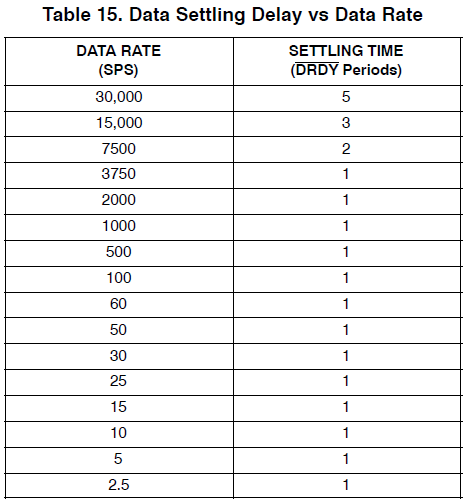
    Because of this architecture and the fact that data enters the first stage must faster than it enters the second stage (since the input is oversampled and each stages decimates the data rate) the overall settling time of this filter depends on the number of averages set by DRATE. When the number of averages is large (i.e. the data rate is slow), there is plenty of time for the SINC5 filter to settle within one data rate cycle. However, at the fastest data rate (where the averager is bypassed), there is not enough time for the SINC5 filter to settle within one cycle and so the effective data rate appears to take 5 cycles to settle (due to the SINC5 filter), as shown in table 15:

    The ADS1256 is designed to mask this settling time; therefore, you do not need to ignore the first conversion results. Instead the ADS1256 will automatically delay the /DRDY signal until the digital filter has had time to settle.

    When multiplexing through channels you will always reset the digital filter and your effective data rate will never be as fast as the continuous output data rate. Therefore, the purpose of table 14 in the datasheet is to give you an idea of the fastest effective data rates you can expect to achieve when you use the ADS1256 in a multiplexing application.

    I hope that helps!

    Best regards,
    Chris