This thread has been locked.

If you have a related question, please click the "Ask a related question" button in the top right corner. The newly created question will be automatically linked to this question.

ADS1278: Data conversion question

Part Number: ADS1278
Other Parts Discussed in Thread: THS4524

Hello, i have a design very similar to the picture below using both the THS4524 and the ADS1278.
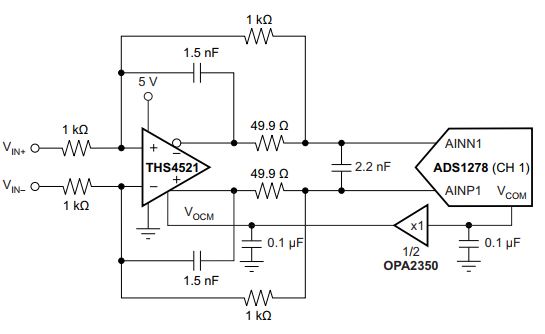
The output of the THS4524 is set to 0V to 5V full scale. When I probe the pos and neg input pins of the ADS1278 (with respect to each other, not to the return), take that value and apply my gain setting, I get what the expected differential input voltage value. When I take the data coming out of the ADS1278 the values are always half of what the input is. I don't want to just apply a 2x gain factor to the output data, but I have been unsuccessful in finding why the data value coming out of the ADS1278 is half the value of the input voltage. 

Thank you for your time,

David

  • Hi David,

    Thanks for your post.

    Do you mean your differential input signal is 5 V peak-to-peak? In that case, the maximum differential amplitude seen at the ADC inputs would be +2.5 V and -2.5 V. I assume that's what you meant because the maximum reference voltage for the ADS1278 is 3.1 V, so the absolute voltage between AINP and AINN can never be 5 V.

    Also keep in mind that the ADS1278 is using binary two's complement to represent the data, so positive inputs are represented by 0x000000 to 0x7FFFFF (positive full-scale) and negative inputs are represented by 0x800000 (negative full-scale) to 0xFFFFFF.

    Best Regards,

  • Yes, the current differential input signal is 0 to 5V with a 2.5Vocm. If the maximum input is only 2.5V, then to get a the bi-polar signal output from the ADS1278 I am looking for, I need to rescale the output of the THS4524 and use a Vocm of 1.25V. Would you agree?

    Thanks!
    David
  • Hi David,

    Perhaps I'm still not completely sure how your inputs are configured. Could you share a diagram showing how your input signal is connected to the inputs of the THS4524?

    I don't believe the Vocm pin has to change - in fact, if both the ADS1278 and the THS4524 are using the same supplies (+5V and GND, for example), you can simply leave the Vocm floating to mid-supply. Internally there is already a resistor divider. Each output pin of the THS4524 can achieve the maximum swing (between the supplies) if Vocm is set to mid-supply. Differentially, you will still be limited such that AINP - AINN never exceeds VREF.

    Best Regards,
  • Ryan, I believe the confusion is on my end. I have gone back to both datasheets and I did misunderstand the FSR of the ADS1278. I thought the FSR of +/-Vref was midscale plus/minus Vref, which in my case would have been a 0V to 5V input. My gain setting of the THS4524 gives me that range and with 0V input to the THS4524, the output is 2.5V on AINP and AINN of the ADC. I am going to rescale the output of the THS4524 so that Vout+/- is centered at 1.25V.

    David

  • Hi David,

    Please understand that the ADC does not care about where the input common-mode voltage lies with respect the reference voltage. You can have a differential voltage of 1 V (AINP - AINN) centered around a common-mode of 1.25 V (1.75 V - 750 mV), 2.5 V (3 V - 2 V), even 3 V (3.5 V - 2.5 V). The ADC will output the same code for a given VREF. The important thing is that the voltage on each input pin of the ADC stays within the supplies.

    The code range for the ADS1278 is symmetrical about 0x000000 using binary two's complement. Positive differential input voltages from 0 V to +VREF are represented by 0x000000 to 0x7FFFFF. Negative differential input voltages are represented by the remaining codes, where -VREF = 0x800000 and 0 V minus one code is 0xFFFFFF. Please refer to Table 5 on page 24.

    It may also be help for you to review the Excel tool we have for the ADS1278. There is a useful "ADC Code Conversions" tab which calculates the expected output code for a given ADC resolution, reference voltage, and input voltage.


    Regards,