This thread has been locked.

If you have a related question, please click the "Ask a related question" button in the top right corner. The newly created question will be automatically linked to this question.

ADS8588H: Low frequency conversion

Part Number: ADS8588H

Hello,

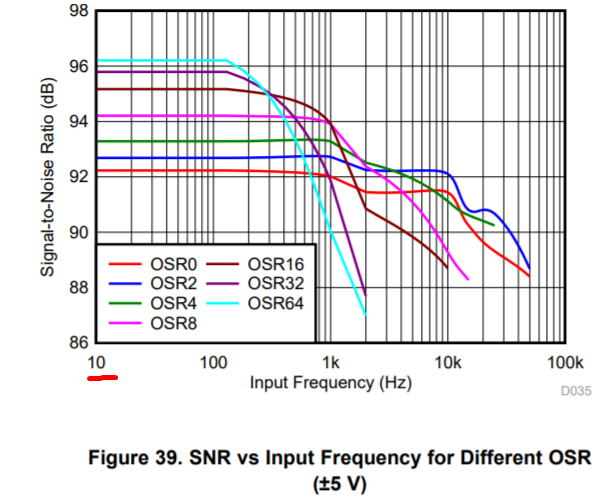
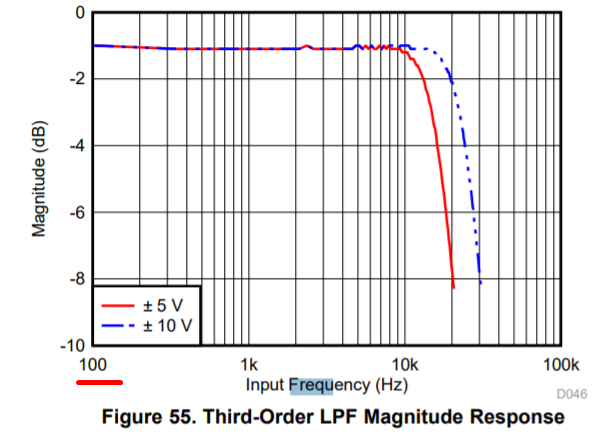
I am developing a low frequency acquisition system, [0.5 - 40] Hz bandwidth and I am thinking to use the ADS8588H as my ADC, but reading the datasheet I found some graphs that concern me because at low frequencies they seem problematic. Additionally, most graphics in the datasheet, including the filters, show the frequency response from 10 Hz and beyond, never below 10 Hz.

Could someone tell me if this is really a problem? why those graphics are that way at low frequency? and why some others don't show frequencies below 10 Hz?

Thanks.
  • Hello Mateo,

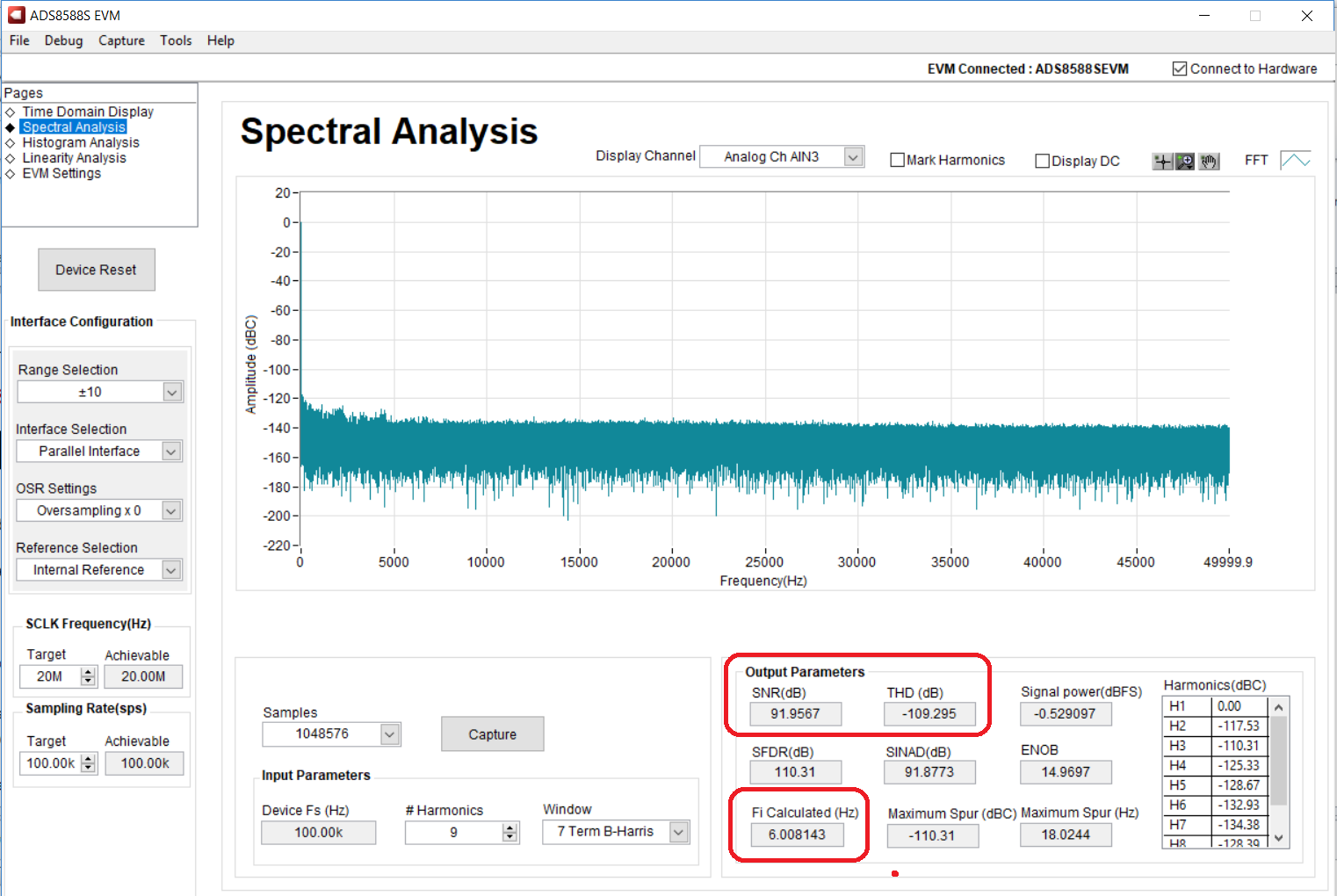
    Usually the ADC's AC performance(SNR and THD) is considered for AC input signal and its harmonics, your input signal frequency is really low (0.5Hz) and it's close to a DC signal, hence this requires huge samples to calculate AC performance especially if your ADC's sampling rate is high. I did the test with lower frequency(6Hz) input sinusoidal wave signal on ADS8588SEVM, please refer to the screenshot with the detailed information as below, the SNR and THD are close to the specifications in ADC's datasheet:

    Regards,

    Dale

  • Thank you very much for your response,

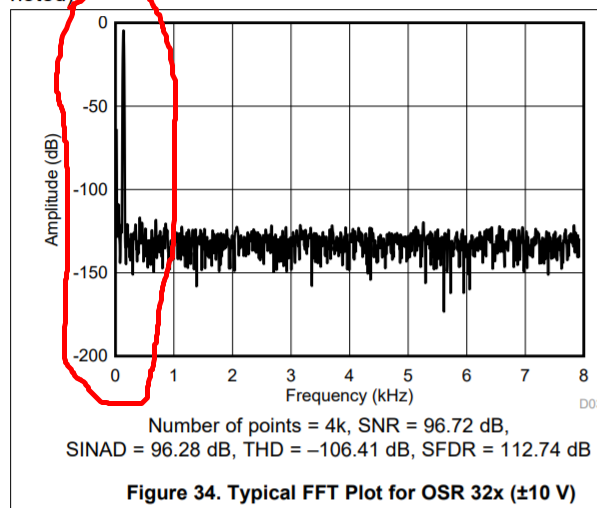
    So you think that there is not any problem with the device at low frequency (0.5Hz)? , just because of the bins, huge samples are needed to calculate AC performance, so that's why they don't show low frequency (<10Hz)? and why is there a graph with so many peaks at low frequency (Fig 34)?
    (I'll use [-5,5]V range and OS[2:0] (110) what means 7.8125 KSPS).

    Thanks again
  • Hi Mateo,

    Except these, I also believe the calculation of fundamental power may be impacted since the signal frequency is too low. Following screenshots show the AC performance for low frequency(0.5Hz) input signal which were measured on ADS8588SEVM:

    Figure 1:  no OSR.  Figure 2:  OSR=64

    The SNR is improved around 3dB to 94.4dB with OSR configuration.

    Regards,

    Dale