This thread has been locked.

If you have a related question, please click the "Ask a related question" button in the top right corner. The newly created question will be automatically linked to this question.

ADC Multiplier and Data Converter

Hello, 

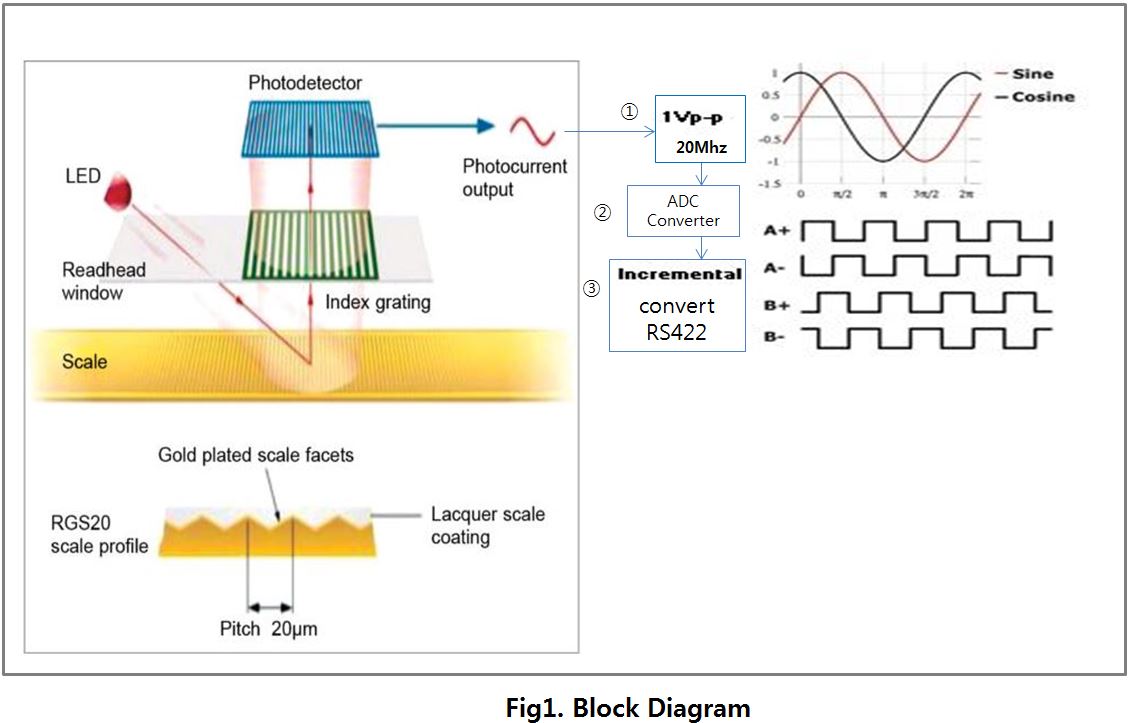
I want to sample the output of a Renishaw company's linear analog encoder into an ADC and convert it to RS422.

Advising experts.  ( e.g,  1Vpp 20Mhz/s (Analog)   ->   A+,A- / B+,B- / Z+,Z-   3 differential polarization)

Q1> How to select ADC analog device selection?

       i.e) I think I need ADC Resolution 16bit, 4Msps. ( Need ADC Conversion Clock 80Mhz ?)

Q2> How to convert ADC to RS422.

Q3> Easily consult how to configure.

Best Regards,
Jame, Shin

  • Hi Jame Shin,

    Sounds like an interesting application!  Can you tell us which encoder part number you are using?  If you are really sampling a 20MHz sine wave, you would want to sample that signal at 40MHz at least.  Once the conversion process is completed, you may be able to output RS422 through the same processor that you are driving the ADC with.  We do not have a stand alone ADC in our portfolio that can do all of this for you in one step. 

  • Hello Tom,

    I do not know the encoder part number.  and This is an application for laser equipment.

    Some companies say that they use 20Mhz as an analog linear encoder.

    I know it must be doubled or quadrupled to sample the ADC's input frequency you talked about.

    Q1> Is there any device that can convert 20Mhz to ADC on Ti?

    As a benchmark, other companies used it as an FPGA.

    I am looking for an easier way.

    Q2> Please advise us on the design configuration.

    Best Regards,
    Jame, Shin

  • Hi Jame Shin,

    Linear encoders are usually specified in meters/second and provide a resolution normally expressed in microns.  If you do need to sample 20MHz SIN/COS signals, there should be something in the high speed data converter portfolio to get the signals processed. 

    Here is a link to a TI design that gives you the basics of dealing with the analog outputs of an encoder: TIDUA05 In this particular case, its a rotary encoder, but the electronics behind the data capture are the same.