This thread has been locked.

If you have a related question, please click the "Ask a related question" button in the top right corner. The newly created question will be automatically linked to this question.

ADS131M04: Effective Resolution

Part Number: ADS131M04

Hi,

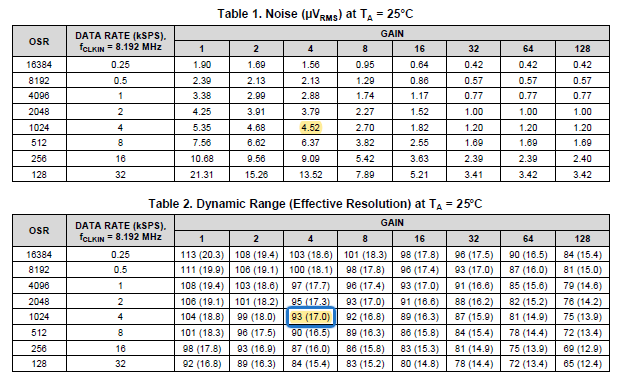
Effective Resolution is written on the datasheet as below.

For instance, the bottom 7bit is not valid when OSR:1024 and GAIN:4 because effective resolution is 17.0bit.

Is it correct?

Best Regards,

Kuramochi

  • Kuramochi-san,


    I would not say that the bottom 7 bits are not valid. I would say that noise makes it harder to determine the last 7 bits. The measurement is correct with the presence of noise. The equation is given as equation 2 in the ADS131M04 datasheet:

    The Effective Resolution gives a relation between the amount of noise and the size of the full scale range. For example, I have an ADS131M04EVM and I can make a measurement of the offset (inputs tied together) to show the noise. I can use the same setting you describe with OSR at 1024 with PGA=4. At this setting, values are highlighted in Table 1 and Table 2:

    When I take the measurement with the EVM, I need to set Channel 0 to PGA gain=4 and set the EVM GUI in histogram mode, I get the following:


    Here, the standard deviation in the signal is shown as 126.10 codes. This is the standard deviation in the signal. Calculating this out, this number of codes is:

    Noise Vrms = [126.1 codes/ (4 * 2^23 codes)] * 1.2V = 4.51 uVrms

    This is a similar to what is shown in Table 1, but it is very close. Again using equation 2, you can calculate the effective resolution, which comes out to be 17.0 bits. Again, this is a measure of the noise compared to the full scale. I would note that this is a measurement of the RMS noise, so it's not as simple as throwing away the bottom 7 bits. The peak-to-peak noise will be certainly larger, and is about 6x higher.


    Joseph Wu