This thread has been locked.

If you have a related question, please click the "Ask a related question" button in the top right corner. The newly created question will be automatically linked to this question.

TSC2007: entering an unknown state and can not control the interrupt

Part Number: TSC2007

Dear Sir,

     My customer recently encountered a problem with TSC2007.

     It works normally in the beginning but somehow it cannot control the nPENIRQ to the host processor and stay in an unknown state.

     When the issue occurs, we observe that the voltage at each pin is different to the normal one.

     (1) The voltage at I2C clk data/bus is around 2.6V

      (2)  ,X+Y+ is around 2.6V while X-Y- is 0.8V

       (3) VDD is still at 3.3V

        (4) INT is either kept at 0V or 2.6V.

Would you kindly give us some direcrions?

Thanks

Sincerely,

Edward

  • Dear Sir,

          Update more observations on this issue.

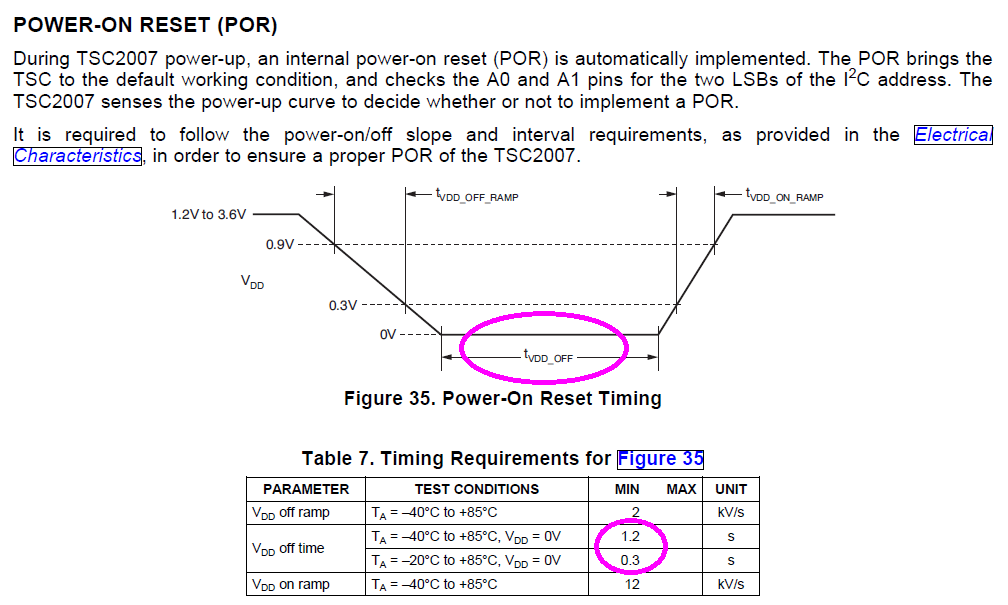
          The customer found there is chance to duplicate the issue once the period between turning off the system and powering on is less than 1sec.

          Just found the description in the segment of POR in datasheet. Does that mean the customer should extend the tvdd_off longer than 1.2 sec?

          What would happen if the vdd off time is less than 1 sec or less? Or what should they do to make it to the default working condition? 

    Thanks

    Sincerely,

    Edward

  • Hello Edward,

    Thanks for reaching out. 

    Can you share some of the following information to us? This will help us better understand what is going on. 

    - Can you share the schematic?

    - Can you provide any scope shots of the I2C communication, PENIRQ, VDD, and x/y lines?

    - Does the device enter the unknown state after a write?

    - Has customer tried switching the internal PENIRQ pull up resistor Rirq?

    I2C lines should be pulled up to VDD. It is mentioned that they are at a level below VDD. Can we confirm they are getting pulled up to VDD? A look at their schematic will also help answer this. 

    Regards,

    Aaron