This thread has been locked.

If you have a related question, please click the "Ask a related question" button in the top right corner. The newly created question will be automatically linked to this question.

ADS7828: Less than 100KHZ bus frequency sampling?

Part Number: ADS7828
Other Parts Discussed in Thread: TLA2528, ADS7138, ADS7924,

Hi,

I would like to know how sampling behaves if a bus frequency of less than 100Khz is available, i.e. 50Khz or less.

Would there be sampling problems or would it still run slower?

BR,

Antonio

  • Hello,

    We cannot state outside the specified ranges in the datasheet how the device will perform.

    This is an I2C device. I2C busses have standard bus rates, it is very unusual to drive an I2C bus at other different rates.

    I predict the device will still be functional but I do not know if it will still operate correctly.

    Regards

    Cynthia

  • Hello,

    I have problems at the level of datasheet to understand the relationship between frequency of I2C (100KHz, 400KHz, 3.5MHz) and sample rate (2Khz, 8Khz, 50Khz) because when evaluating the 5 bytes of a channel query, the bit timing is not correct. Perhaps the calculation should not be done this way.
    Otherwise even going to 100Khz of I2C bus comes out a very long time to monitor 8 channels on there are 8 signals at 50Hz.
    BR,

    Antonio

  • Hello,

    In I2C, the sampling rate is not always the same as the throughput rate. I suggest looking into how an I2C bus can function, TI has a document on this, but there is plenty of material on the web. Once with that understanding, then understanding how the ADC functions will follow.

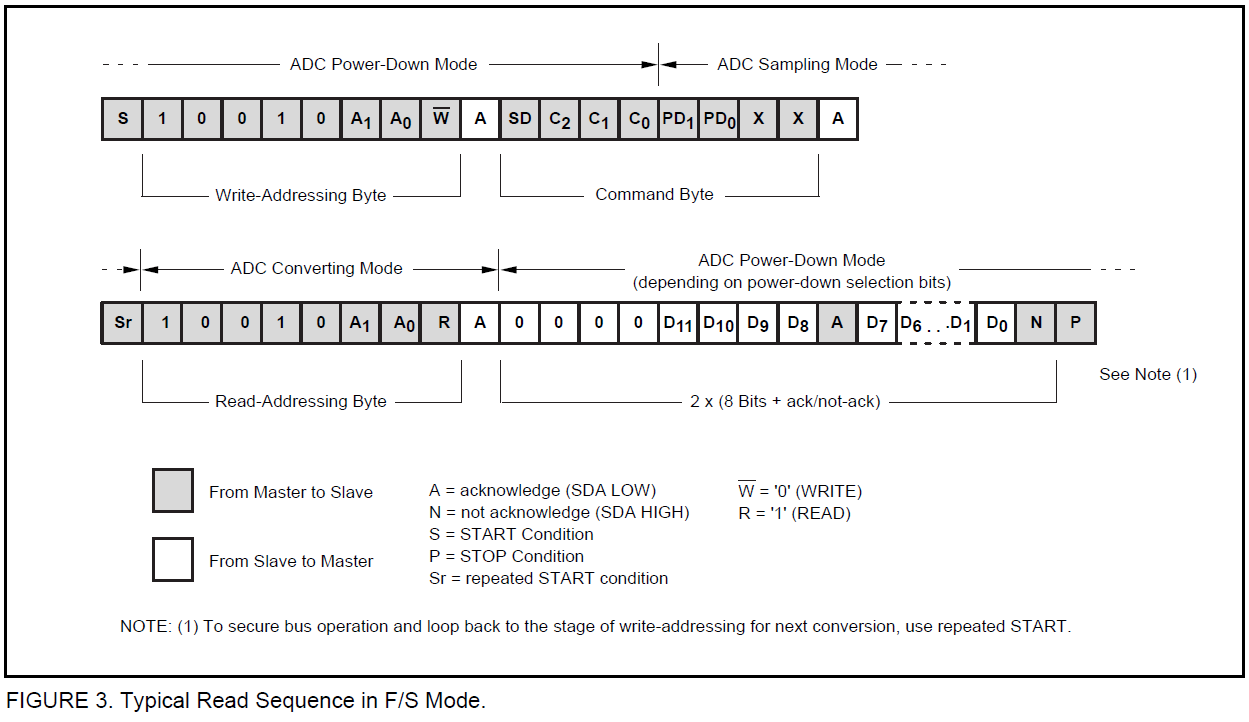
    Notice that the conversion cycle for the device is as below. the sampling phase/mode begins in the middle of the command byte and does not end until a read address byte, then is when the conversion mode/phase is started. These two modes is one conversion cycle.

    Regards

    Cynthia

  • Hi,

    Ok thanks.

    in order to limit the access timing, (which we are evaluating), would there possibly be a device which, by consulting it, transmits the AD values of all the 8 channels?

    That is, they multiplex automatically instead of one channel at a time on demand.

    Thank you.

    Antonio

  • Antonio,

    With I2C protocol, there is the TLA2528, which has an auto sequence mode. This mode would automatically sequence through the desired channels.

    The ADS7138 also has an auto sequence mode, as well as a window comparator, this would allow for the customer to be notified when the input is within or outside a desired threshold and then read data. Thus only reading data when necessary. Would this be helpful to the customer?

    The ADS7924 also offers multiple modes of operation including auto sequence with sleep if this is something that is useful for the customer.

    Please let me know if the customer finds any of these are interesting

    Regards

    Cynthia

  • Hi All,

    The TLA2528 is very interesting and fitting.

    ADS7138 has additional services which however are not required for our application; certainly if for reasons of circulation the cost was lower than the first there would be no problems.
    ADS7924 is only 4 channels so it should be doubled.

    However, we have not forgotten the ADS7828 (the first) as we are trying to speed up the I2C Bus.
    For ADS7828, from datasheet, it is declared to be for insulation applications but this feature is slightly mentioned without declaring the value of this insulation parameter (the TSSOP-16 case is very small) which could lead to a circuit reduction. I would ask you if it was possible to have this data and also to know that possibly of the TLA2528.

    Many Thanks,

    Antonio

  • Antonio,

    I do not fully understand what your question is when referring to insulation.

    If you mean isolation applications, then I can provide some detail. The ADS7828 is well suited for these type of applications because of the COM pin. Usually ADCs use the device ground to measure the analog input, which may cause issues when deciding where to place the ADC, on what side of the isolation barrier. When in single ended mode, the COM pin is used the ground for measurements of the analog input, while the device has its own ground. This allows the user to make a measurement on the other side of the isolation barrier without worrying of different ground potentials affecting the measurement. 

    There is no isolation parameters that ADCs are characterized for. 

    Regards

    Cynthia