This thread has been locked.

If you have a related question, please click the "Ask a related question" button in the top right corner. The newly created question will be automatically linked to this question.

ADS8900B: ADS8900B

Part Number: ADS8900B
Other Parts Discussed in Thread: ADS8860, OPA320, THS4551, ADS8881, THS4541

Hi Friends, 

I'm designing a DAC using ADS8900B. 
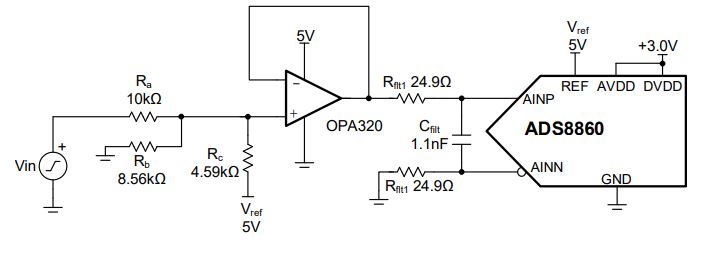

In the above design, I've to use ADS8900B instead of ADS8860.

In the datasheet of ADS8900B, it is specified that it can work as a single-ended as well as fully differential ADC.

OPA320 is a single-ended amplifier (non-differential amplifier).

But nowhere in the datasheet of ADS8900B, it is specified how to drive the ADC with a single-ended operational amplifier.
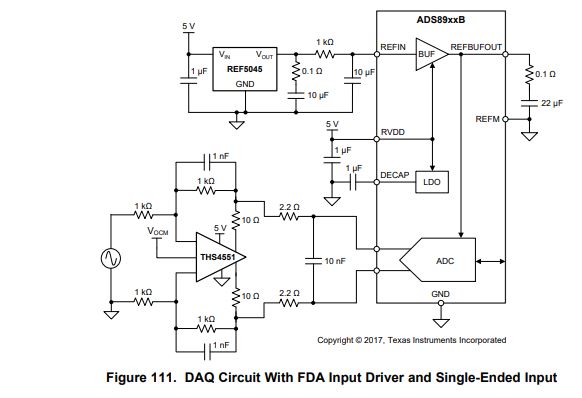
If I need to use ADC as a single-ended ADC, what should be the state of AINM Pin?

My Vin is in the range of +/-4VPP.

  • Hi Shibin,

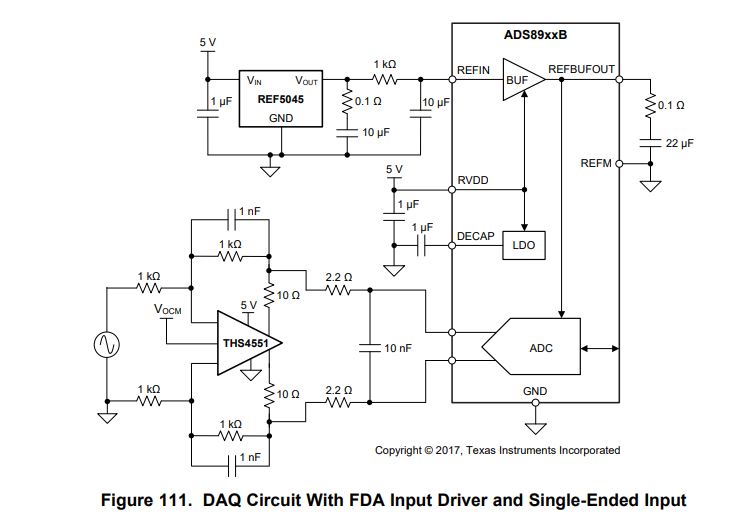
    The ADS8900B requires differential inputs.  This device can be used in systems with single ended signal chains, but the final voltage must then be converted to differential to drive the ADC inputs.  Figure 111 above, using the THS4551, is a good way to do this.  

    You can also use 2 operational amplifiers to drive the inputs.  Take a look at this Analog Engineer's circuit that uses 2 OPA320's.

    https://www.ti.com/lit/an/sbaa265/sbaa265.pdf

    The OPA320 is not quite fast enough to settle to 20b when sampling at 1MSPS.  For 1MSPS, 20b performance, the below circuit provides more details on how to use the THS4551 in this application.

    https://www.ti.com/lit/an/sbaa246a/sbaa246a.pdf

    Regards,
    Keith Nicholas
    Precision ADC Applications

  • Hi Keith,

    Thank you for your reply.
    So I should use two op-amps like OPA320 or a single differential amplifier like THS4551.

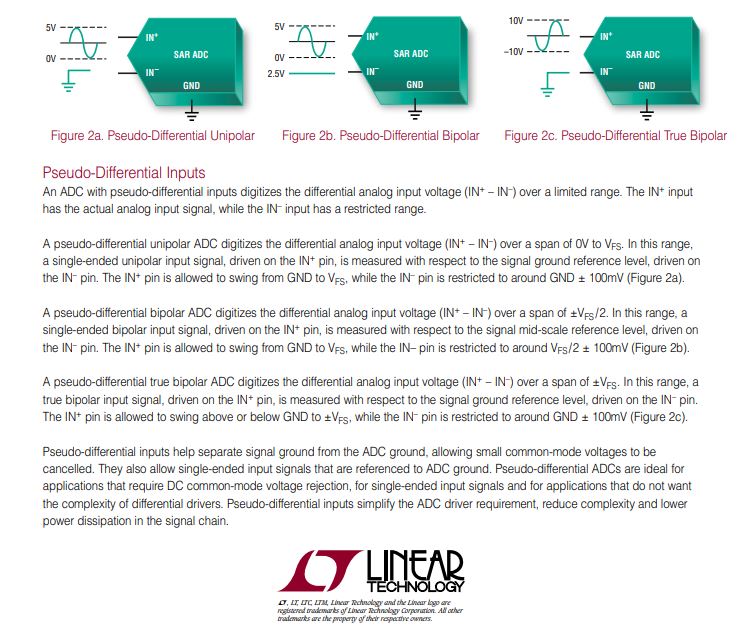
    Can I connect the AINM pin directly to the ground so that it is working as a Pseudo-differential true bipolar mode and fed my +/-4VPP signal to the AINP pin like 

  • Hi Shibin,

    The ADS8900B requires that the input common mode voltage (average of the two inputs) equal Vref/2+/-100mV over the full differential input range.  Because of this requirement, you can not connect the AINM input to ground, or some other DC reference voltage.  This limitation on the inputs is referred to as a fully differential input.

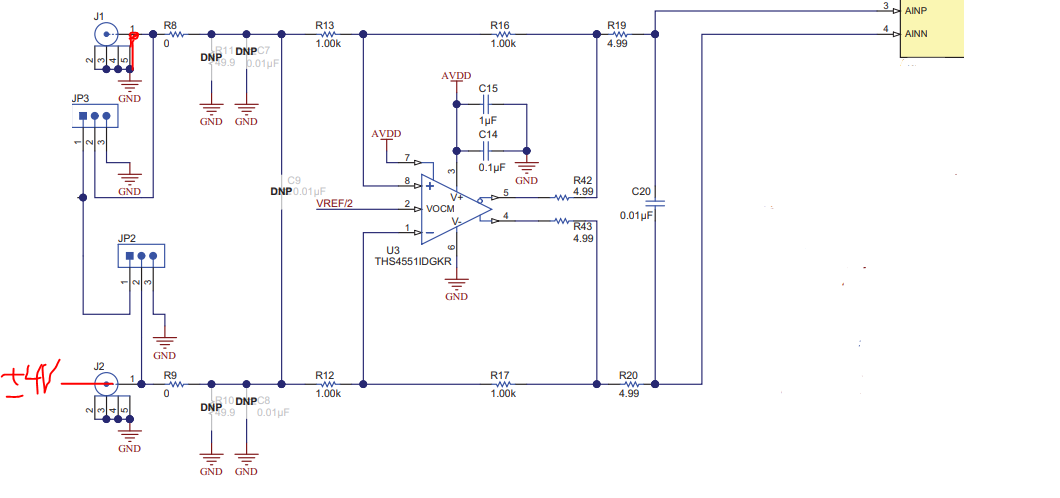
    If you have a +/-4V single ended input voltage (bipolar), the THS4551 will then be the best part to convert this input to the proper levels on the ADC inputs.

    If you can use an 18b device, the ADS8881 has 'true differential' inputs.  In this case, you can connect the AINM input to ground, or some other DC reference voltage, and still meet full datasheet performance.

    Please take a look at this TI Precision Labs that discusses these different input limitations for more details.

    https://training.ti.com/ti-precision-labs-adcs-sar-adc-input-types?context=1139103-1128659

    Regards,
    Keith

  • Hi Keith,
    Thank you for your reply.
    After some discussions with my teammates, we are planning to switch to a THS4541 differential amplifier.
    DVDD pin of the ADC is fed with 3.3V and the RVDD pin is fed with 5V as mentioned in the datasheet.
    Do I really need the reference generator for the +/-4VPP signal? 

    Also, what should be the voltage at the Vocm pin of the FDA? I think I need to fix it to a 2V from a voltage divider form the reference generator.
    Awaiting your reply

  • Hello Shibin,

    The ADS8900B includes a reference buffer, but still requires an external reference.  In this case, the REF50xx is an excellent choice.  Since your input is +/-4V, you can use the REF5040 (4.096V) to take advantage of the full dynamic range.

    The Vocm should be set the input common mode voltage required by the ADS8900B, which is Vref/2.  If using the REF5045 (4.5V), then Vocm=2.25V.  If using REF5040 (4.096V), then Vocm=2.048V.  You can generate this voltage by using a resistor divider off of Vref.

    For more details on the input amplifier, take a look at the ADS8881EVMV2 user's guide.  This is a different ADC (18b), but the input amplifier circuit with the same values will work with the ADS8900B.

    Regards,
    Keith