This thread has been locked.

If you have a related question, please click the "Ask a related question" button in the top right corner. The newly created question will be automatically linked to this question.

ADS127L01EVM: Is it possible reading "32 bit SPI data output" from the ADC to MCU - TM4C1294XL

Part Number: ADS127L01EVM
Other Parts Discussed in Thread: LMK00804

Dear Sirs,

With the board I used ADS127L01EVM, I am measuring the analog differential voltage signal from a gyro. I want to send my digital data to another MCU (TM4C1294XL), but the receiving side has a 16-bit RX FIFO. Therefore, it can not read 32-bit SPI data from the ADS127L01EVM.

While converting 24 bit analog Gyro data to digital data, I want to send it countinously to a proper MCU for filtering or some math operations.  MCU will process and send the data by using CAN or another communication channel.

,

Measured signals on oscilloscope screen where the signal designations are as follows:

Pink: DOUT
Yellow: CLK
Blue: FSYNC
Mode: Frame-sync master mode
WB2 , OSR 256

ADS127L01EVM works fine but the SPI output is 32 bit. My MCU has max. of 16 bit RX FIFO.

We opened a question with the Other microcontrollers forum. I have confirmed that the two cards are incompatible.

Would you have any recommended MCUs compatible to work with ADS127L01EVM to recieve 32-bit data from the ADC we are currently using?


Do you recommend a compatible MCU for ADS127L01EVM ? Because the ADC has 32 bit SPI transaction.
You may advice me to use another ADC board compatible with my TM4C1294XL.

Regards,

Riza

  • Hello Riza,

    The ADS127L01EVM uses the TM4C1294NCPDTI3R MCU to acquire the 32b data using SPI mode (FORMAT pin connected to GND.)

    SPI mode requires the following connections:

    /CS - Chip Select

    SCLK - Serial Clock

    DIN - Data IN, from Host to ADC

    DOUT - Data OUT, from ADC to Host.

    DRDY - Data Ready

    Is there a reason you do not want to use SPI?  If not, then this would be the recommended solution using the TM4C1294 MCU family.

    Regards,
    Keith Nicholas
    Precision ADC Applications

  • Hello Keith Nicholas,

    First of all, thank you for answering.

    The reason for selecting Frame-Sync Mode: I couldn't find an appropriate clock connection between two boards as you can read from the following details.
    I did not noticed the constraint in the datasheet of ADC board about SPI communication with TM4C1294XL is only possible with Freescale SPI Mode. It is not possible with Frame-Sync Mode.

    While reading the pdf (ADS127L01EVM Hardware) of ADSL127L01EVM. The section about clock inputs caught my attention.


    The system clock of both cards (TM4C1294XL & ADS127L01EVM) must be same because of harmonics. Isn't it? ADS127L01EVM has the external CLK input & output pins (JP6-CLKSEL), but I couldn't find MCU's external clock input pin on the TM4C1294XL. I also couldn't find a clock output pin on the TM4C1294XL in order to feed the external clock input of ADS127L01EVM.
    So I chose the Frame-Sync Master Mode that can work on its own without a need for external clock signal.

    In the TM4C1294XL, example program "spi_master.c" is being run. I can not change SYSCLK because I can not see the signals on oscilloscope. I don't have a SYSCLK pin to measure.

    Would you please, give me the information about;
    1- The clock signal hardware connection between two boards.
    2- Clock settings will be applied in example program for TM4C1294XL.

    Regards,
    Riza

  • Hello Riza,

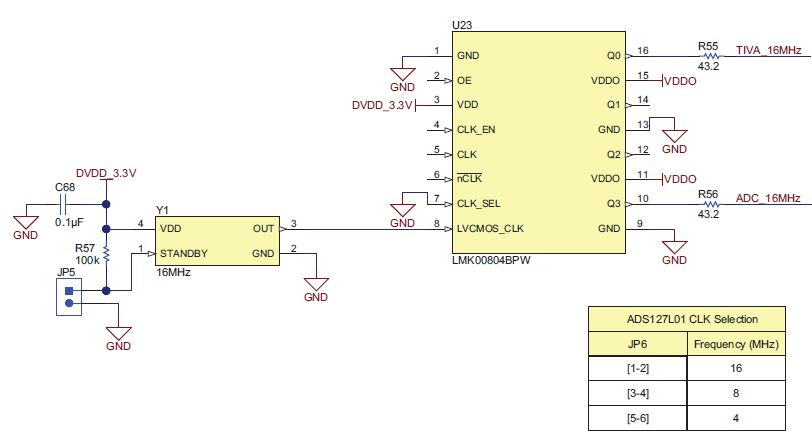
    The microcontroller clock input comes from the LMK00804 clock divider (U23) on the ADC side of the EVM (net: TIVA_16MHz). After the level-translators, this becomes "TIVA_OSC0" and connects to pin 88 of the MCU. We had to derive the ADC and MCU clocks from one clock source to remove any clock intermodulation artifacts from the ADC spectrum.

    Best regards,