This thread has been locked.

If you have a related question, please click the "Ask a related question" button in the top right corner. The newly created question will be automatically linked to this question.

DLPLCR4500EVM: Can the DLP4500EVM meet the conditions of making a 3D hologram?

Part Number: DLPLCR4500EVM
Other Parts Discussed in Thread: DLPC350

Hi,

We are trying to make a 3D hologram using this previous study

https://vgl.ict.usc.edu/Research/3DDisplay/3DDisplay_USCICT_SIGGRAPH2007.pdf

Will the DLPlight crafter 4500 meet the quota of the P.2-3 High-speed Projector?

IF not, is there any product that will meet the conditions?

Thank you,

Ryo

  • Hi Ryo,

    Welcome to the E2E forums with your questions. 

    My initial concern with the DLPlight crafter 4500 is the amount of image storage. This is from the user guide while the article you sent me mentioned they are displaying 288 images per rotation.

    https://www.ti.com/lit/pdf/dlpu011

    I will need to look into this issue further and check internally. Thank you for your patience. 

    The article also mentions a system is available from Polaris Road Inc., have you tried reaching out to them?

    Regards,

    Alex Chan

  • Dear Alexander Chan

    Thank you for your reply.
    In terms of the memory problem, if we use the video mode and mini HDMI, can that solve the problem?
    And another question that we want to ask is: can the DLPlight Crafter 4500 manipulate 24 images in 1-bit and control it?
    As for “Polaris Road Inc.”, we could not find any sort of information about it. The article is written several years ago, so it may have been already been out of business.

    Regards
    Ryo

  • Hi Ryo,

    Yes if you use hdmi to send data using 24-bit RGB interface, you do not need to store images from flash memory where there is limitations in storage. 

    Please see the user guide: https://www.ti.com/lit/pdf/dlpu011

    Section 3.2.2 goes over operating modes.

    Looking at the operating modes from section 3.2.2, I do not see support in video mode for 1 bit data input but the pattern sequence modes do. 

    Please also note that the DLPC350 in video mode will apply video processing functions. If you prefer not to have those, ensure you are using pattern sequence mode which bypasses any processing functions. 

    https://www.ti.com/lit/gpn/dlpc350

    Thanks,

    Alex Chan

  • Hello Alexander Chan,
    According to the explanation in user guide 3.1, it says that pattern sequence mode displays images from 1-bit bitmap images stored in flash memory. Is it possible to store more than 64 images in flash memory if we use 1-bit images?

    In addition, we want to know whether can the 24-bit RGB data be displayed as 24 black-and-white images by setting the sequence setting in the GUI.

    Thanks,

    Ryo

  • Hello User,

    Please allow the team some time to look into your questions.

    Regards,

    John

  • Hi Ryo,

    Unfortunately there is a limit of 64 images.

    For your second question, for pattern sequence mode where you generate a pattern such as in the video here https://www.youtube.com/watch?v=RxgmGkNsqvk , you can only do the following colors so there is no black option. 

    For video mode you will not be setting up or creating these patterns if you don't need that level of specification. Video mode you would have control from the host of what information is being sent so you can provide black and white content if you desire.

    Regards,

    Alex Chan

  • Hello again Chan,

    By using options like red and green,
    Is it possible to display one picture of 24-bit image to 24 pictures of 1-bit image?

    Thanks,
    Ryo

  • Hello Ryo,

    For clarification, you are hoping to divide a incoming 24-bit image into 24 captures of 1-bit images through the DLPC? Or would this be divided up into the 24 bit images before being sent into the DLPC?

    Regards,

    Austin

  • Hi Austin.
    Thanks for your message.
    We want to try using the LightCrafter with the former option. Is it possible to divide an incoming 24-bit image into 24 captures of 1-bit images through the DLPC?

    Thanks,
    Ryo

  • Hello Ryo,

    This should be possible. Please refer to Section 3.3.1.1 of the EVM User's Guide.

    Kind regards,

    Austin

  • Hello
    In 3.3.1.1, it says that one flash image corresponds to 24 1-bit images. If I take this as it is, is it possible to output up to 64*24=1536 1-bit images from 64 flash images?
    Thanks,
    Ryo

  • Hello Ryo,

    Let me double check this and get back to you.

    Thanks,

    Alex Chan

  • Hi Ryo,

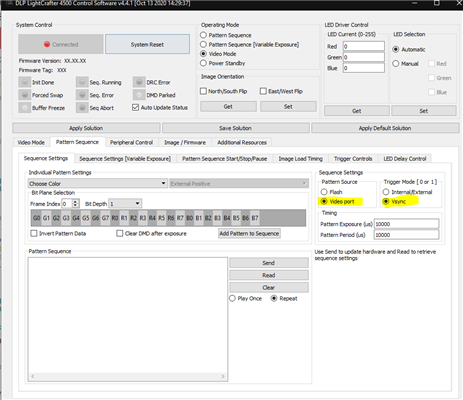
    As ALex has pointed out you can not use video mode. But it is possible to use video port in pattern sequence mode. You need to select the source as video port instead of flash image. With these settings you need not store images in flash and can send them via HDMI reducing the flash limitation and also latency(reading images from flash adds latency).

    Hence for your use use I recommend using either pattern sequence mode and can define 1-bit depth pattern sequences. This ensures the input 24-bit data to 24 1bit depth frames as defined.

    Regards,

    Akhil