This thread has been locked.

If you have a related question, please click the "Ask a related question" button in the top right corner. The newly created question will be automatically linked to this question.

ISO5852S: soft-turn off (STO)

Part Number: ISO5852S

Hi, team,

Could you please give me your advice for soft turn off (STO) in ISO5852S?

1. The STO protect IGBT or FETs from getting damage by over current. Is it correct?

2. If #1 is yes, how to detect the over current condition in FETs (or IGBT)?
The V(drain - source) should be increased in FETs (or IGBT) once over current condition is happened. Then Over voltage condition at V(drain) should be required. I guess UVLO2 is for the protection of  ISO5852s device from over current condition in OUTH and OUTL.

Regards,
Nagata.

  • Hi Nagata,

    Thanks for your interest in our part, my name is Mamadou DIallo, I will help address your concerns.

    1. Yes you're correct, the STO is a standard safety feature preventing permanent damage to the IGBT.

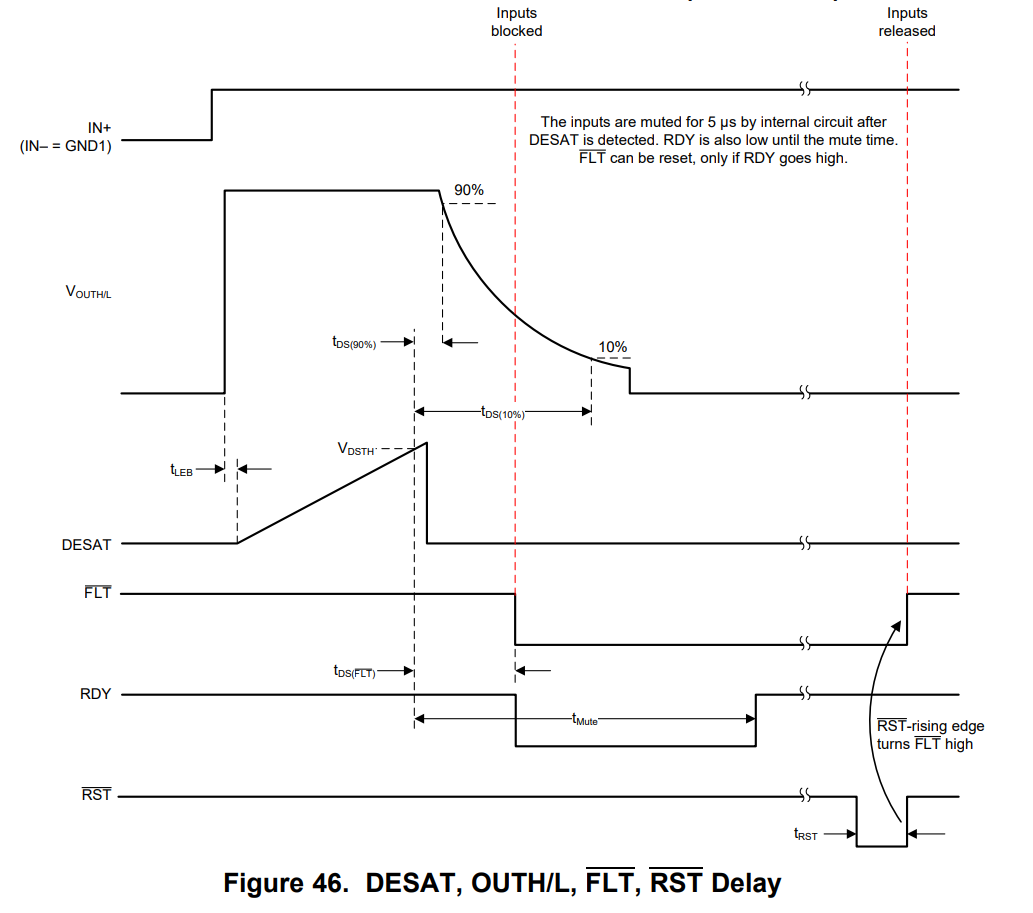
    2. This detection is done by constantly monitoring the the Vce voltage of the IGBT through the DESAT pin of the driver. When DESAT is recognized by the driver(whenever Vdesat > Vds,thresh), STO is initiated by disabling OUTH/L.

    The image below best captures this process.

    I am not sure I understand this statement "The V(drain - source) should be increased in FETs (or IGBT) once over current condition is happened. Then Over voltage condition at V(drain) should be required" but Vds would increase due to overcurrent through the IGBT and UVLO turns off the IGBT when supply voltage is not enough. 

    Sections 2.1.5 through 2.1.7 from the copied link below further describe this process in further details.

    www.ti.com/.../tiduc70a.pdf

    If this answered your question, please press the green button or reach out to us for further clarification. 

    Thanks. 

    Regards, 

    -Mamadou