This thread has been locked.

If you have a related question, please click the "Ask a related question" button in the top right corner. The newly created question will be automatically linked to this question.

Linux/DS90UB949-Q1: -Linux driver requirement

Part Number: DS90UB949-Q1
Other Parts Discussed in Thread: ALP

Tool/software: Linux

Hello, TI community:

I get a DS90UB949 and DS90UB948 which I want to integrate them to a automotive infotainment display prototype.

I use the Beaglebone black with HDMI as the display source to the DS90UB949. Now I need to a DS90UB949 & DS90UB948 linux driver for the device initialze when system power-up. (I have touch device at the DS90UB948 side)...

Could someone please guide me how to gain these two devices linux driver?

Thanks,

foxlin0314@gmail.com

  • Hi,
    The link between UB948 and UB948 can work automatically with hardware pin setting, you can refer to d/s on the mode_sel setting. also you can use TI's ALP tool with GUI to configure this link. in most cases, the link between UB949 and UB948 can run automatically without the register setting. in some cases, you can use registers, such as reset, I2C access, etc. So sorry we have no Linux driver for you.

    best regards,
    Steven
  • Hi TI Community:

    First of all, very thanks for yor rapidly reply my question. Following are my understanding of the TI's SerDes, if I have any incorrect, please correct me:

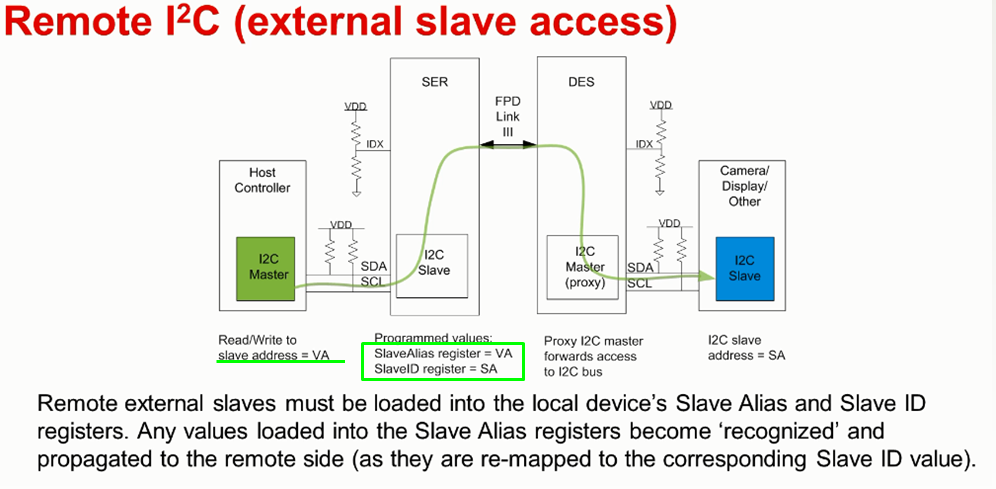
    1. Roughly, TI SerDes mainly have two I2C processing mechanism, one is the "paired device access, Fig-1" & the other is "external slave access Fig2."

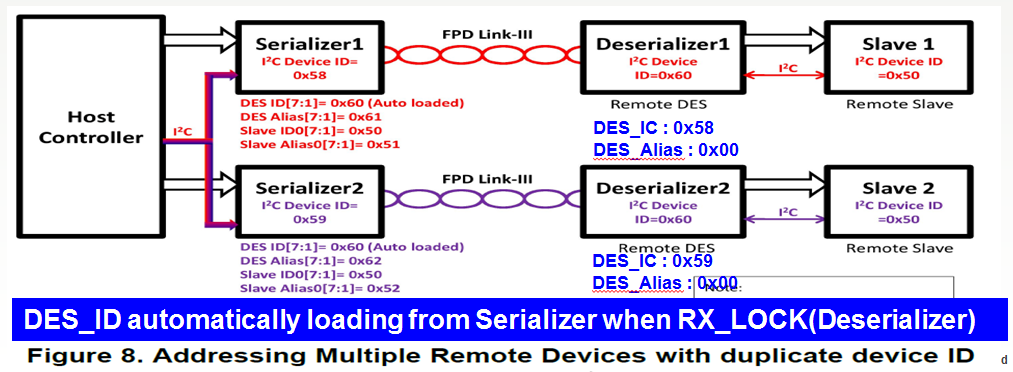
    2. In paired device access, the DES_ID will be loaded from de-serializer when RX_Locked. (Please see Fig-3)

    3. Like as Fig3 illustration, if you just want to access De-serializer that's definitely don't need to config register between Serializer and De-Serializer and we can easily access serializer and de-serialize through master I2C interface by HOST.

    4. But If I have slave device (touch panel) attached at the De-serializer, I have to config SlaveID and SlaveAlias of Serializer side.....Am I right? If this is right, the intialize driver still don't need?

    Above that my understanding of TI's SerDes if I have any misconcepton please let me know.

    Have a good day.

    Fox.

    Fig-1: SerDes I2C paired device

    Fig-2 : External slave access

    Fig-3 : Master I2C attached Serializer

  • Fox,
    yes, you are right, please see below comments.
    1. Roughly, TI SerDes mainly have two I2C processing mechanism, one is the "paired device access, Fig-1" & the other is "external slave access Fig2."
    --> yes, can access remote paired part (ser or deser), and the attached slave I2C port (such as touch controller).

    2. In paired device access, the DES_ID will be loaded from de-serializer when RX_Locked. (Please see Fig-3)
    --> yes, automatically by FPD-Link after it is stable.

    3. Like as Fig3 illustration, if you just want to access De-serializer that's definitely don't need to config register between Serializer and De-Serializer and we can easily access serializer and de-serialize through master I2C interface by HOST.
    --> you need configure the deser's I2C alias address, or else you don't the two attached deser in figure3. also you need enable pass-through.

    4. But If I have slave device (touch panel) attached at the De-serializer, I have to config SlaveID and SlaveAlias of Serializer side.....Am I right? If this is right, the intialize driver still don't need?
    -> you need set: a. pass through; b. deser's alias address; c. slaveID and slaveAlias attached to the deser. if you need visit the touch controller, it is certain that the reg. should be configured, and TI has some reg. setting referencei in d/s or EVM board.

    best regards,
    Steven
  • For,
    sorry, we have no driver to you, but if you want to enable the I2C channel in the link, you can have below settings in Serializer side:
    1. I2C pass-through enable
    2. set DES_Alias name
    3. set remote slave I2C address in reg. Slave_ID[n] and its corresponding Slave_Alias[n], n can be 0, 1, 2,...
    then you can visit the remote slave I2C device through serializer. the app. note on i2c access is attached, which is available for all FPD-Link parts. thanks.
    www.ti.com/.../snla222.pdf


    best regards,
    Steven
  • Dear Junqiang Shi :
    Thanks for your explanation, if just config some register by I2C, I think I can handle it by myself.
    Thanks you.