This thread has been locked.

If you have a related question, please click the "Ask a related question" button in the top right corner. The newly created question will be automatically linked to this question.

TPS65987DDJ: TPS65987 as a 20V Sink

Part Number: TPS65987DDJ
Other Parts Discussed in Thread: TPS65987

We are using the TPS65987 as a UFP Sink.

Is there a way to configure the TPS65987 so that the power path (VBUS to PP_HV1) is only enabled when 20V @3A is available from the source side (smart battery etc)? I have been experimenting with the TPS65987EVK board, and we don't want 5V to be output if the 20V option is not available. We would like either 20V or 0V to be the output. Is that configuration possible? I am using the Configuration Utility to configure the eval board.

  • Hi Del,

    Unfortunately, you cannot accept only a 20V contract. As defined by the PD spec, you must first have a 5V contract, and then transition to a higher PDO such as 20V.

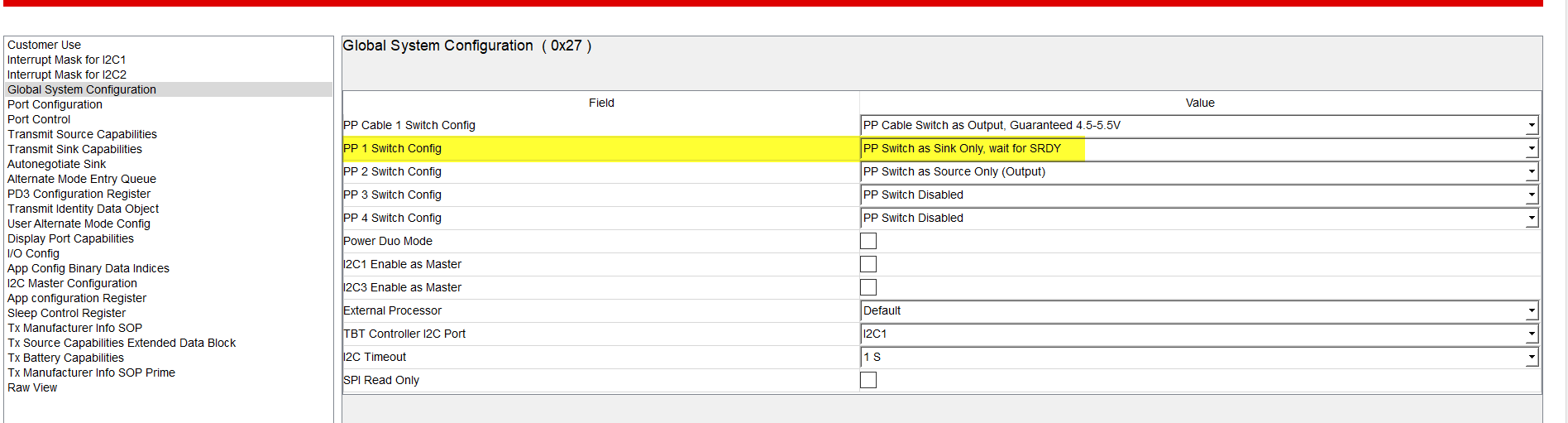
    However, if you have some type of embedded controller on your system, you can control when the internal power path is enabled and passing through a voltage from VBUS to PPHV. You can configure your system where you only enable this path when 20V/3A is being supplied. This is done by changing the power path option for the sink path to 'wait for SRDY'.

    However, this will require quite a bit of setup. You will need to use the IRQ registers (0x14 - 0x18) to determine when a device has been connected, and then read specific debug registers to determine the capabilities of the source connect. I would recommend reading registers 0x30 and 0x34. All of the registers and their corresponding values can be referenced in the host interface technical reference manual 

    https://www.ti.com/lit/pdf/slvubh2 

    Once you've determined that the charger connected is capable of supporting the 20V/3A, then your EC can send the 4cc command SRDY which is also outlined within the host interface technical reference manual 


    If you do not have an EC or some type of controller to communicate to our device via I2C, then unfortunately you cannot meet this requirement 

    Hope this helps answer your question