This thread has been locked.

If you have a related question, please click the "Ask a related question" button in the top right corner. The newly created question will be automatically linked to this question.

ISO1212: Question on: ISO1212 TINA-TI Transient Reference Design (Rev. A) sllm391a.tsc

Part Number: ISO1212
Other Parts Discussed in Thread: TINA-TI

Question on: ISO1212 TINA-TI Transient Reference Design (Rev. A) sllm391a.tsc

 I am trying to understand better the modeling of the ISO1212 in order to verify some adjustments for my application (*) following Figure 29 found in SLLSEY7F – April 2020. My primary reason for this modeling is to 1) ensure the maximum input values are note exceeded, and 2) calculate the voltage that a bipolar-TVS diode needs to be.
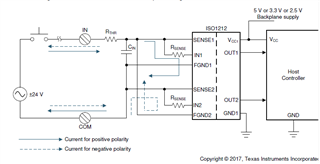
I was unable to get the above circuit to run in TINA-TI and from my search here, I read that the PSPICE model required the FGND1 and FGND2 pins to be grounded. So, I was going to model just the single channel with of AC input, and extrapolate

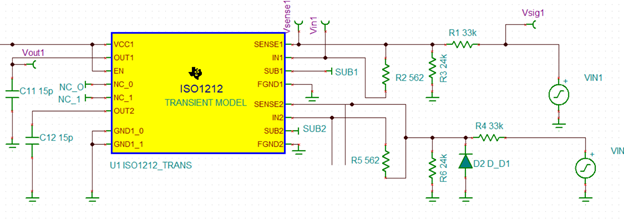
However, I am unable to figure out the role of D1 D_D1 and D2 D_D1 in the model. If I remove it, it appears the voltage present at the In/Sense pins exceed the maximum ratings due to an offset; even with the recommended values for Rthr/Rshunt/Rsense. However, I do not see reference to it elsewhere in any of the various application notes, etc.

Here I am modeling a 110 Vrms ( 170Vpeak ) with the recommended resistor values where I added some voltage test points.  Vin1 and Vsense exceeds the -60V maximum. Is this just an artifact of the model?


 Additional Question: Would the Rthr and Rshunt values remain the same when configured for a bipolar input such as in Figure 29?


(*) The system will need to detect 60 Hz AC at 120 VRMS on both polarities to achieve the required time response. Additionally, there will be several isolated/floating DC voltages which may be connected in either polarity, e.g. 0 to +125 VDC, or 0 to – 125VDC. The source of all these signals is from various relays and will be in an electrically noisy environment. The input side grounds will not be connected to the local/measurement ground. I plan on using the recommendations found in slla483.pdf, etc with respect to surge immunity, EFT, ESD as well as using some filtering.

---

Much appreciated,

Keith

  • Hi Keith,

    Thanks for reaching out and for your interest in ISO1212.

    Regarding TINA-TI and PSpice simulations, please allow us to run the simulations and come back to you if we see similar behaviours as what you have observed. Meanwhile, I would recommend you to use the ISO121x Threshold Calculator that's included in the technical documentation section of ISO1212 product page, I have also copied the link below. This spreadsheet calculator allows to you choose the resistor values to meet the required thresholds.

    ISO121x Threshold Calculator for 9V to 300V DC and AC Voltage Detection

    I would also recommend you to refer to the below document that talks about designing for 110V and AC input detection.

    How to Design Isolated Comparators for ±48V, 110V and 240V DC and AC Detection (Rev. A)

    Additional Question: Would the Rthr and Rshunt values remain the same when configured for a bipolar input such as in Figure 29?

    Yes, the calculations remain the same and hence the values even for bipolar input designs.

    I plan on using the recommendations found in slla483.pdf, etc with respect to surge immunity, EFT, ESD as well as using some filtering.

    Yes, this document should stand as a good reference backed with test results for designing for Surge immunity. Thanks.


    Regards,
    Koteshwar Rao

  • Hi Keith,

    We have run the simulations without the D1 and D2 diodes and observed similar behaviour as what you have seen. I found out that the ISO1212 TINA model doesn't have the internal reverse blocking diode considered into its modelling. Due to the reason, you see that negative input voltage is not blocked when the external diodes are removed. Hence, it is necessary to use  the external D1 and D2 diodes and consider them to be part of ISO1212 modelling and not as external components for simulating the device.

    I hope this addresses the concern you had on your observations, thanks.


    Regards,
    Koteshwar Rao