This thread has been locked.

If you have a related question, please click the "Ask a related question" button in the top right corner. The newly created question will be automatically linked to this question.

ISO7740: ISO7740 Replacement for Optocouplers in IO Circuit

Part Number: ISO7740
Other Parts Discussed in Thread: ISO7240C, ISOM8610, ISOM8110, ISOM8710, ISOM8711

Hello,

I am redesigning an older IO circuit board that currently uses optocouplers for galvanic isolation. I am planning to replace them with the ISO7740 digital isolator.

I would like to know if the ISO7740 is a suitable replacement for this application and if additional protection devices are required between the ISO7740 and the external connector.

The operating conditions and a brief schematic overview of the system are as follows:

  • External Equipment: The connected external equipment cannot be changed. Its voltage levels may be 5V TTL, 3.3V LVTTL, or 3.3V LVCMOS.
  • Connection Cable: The connection uses an unshielded, non-twisted cable with a maximum length of approximately 3 meters.
  • Environment: The new circuit will be placed near motor controllers.
  • Signal Frequency: The maximum signal frequency is approximately 10 kHz.
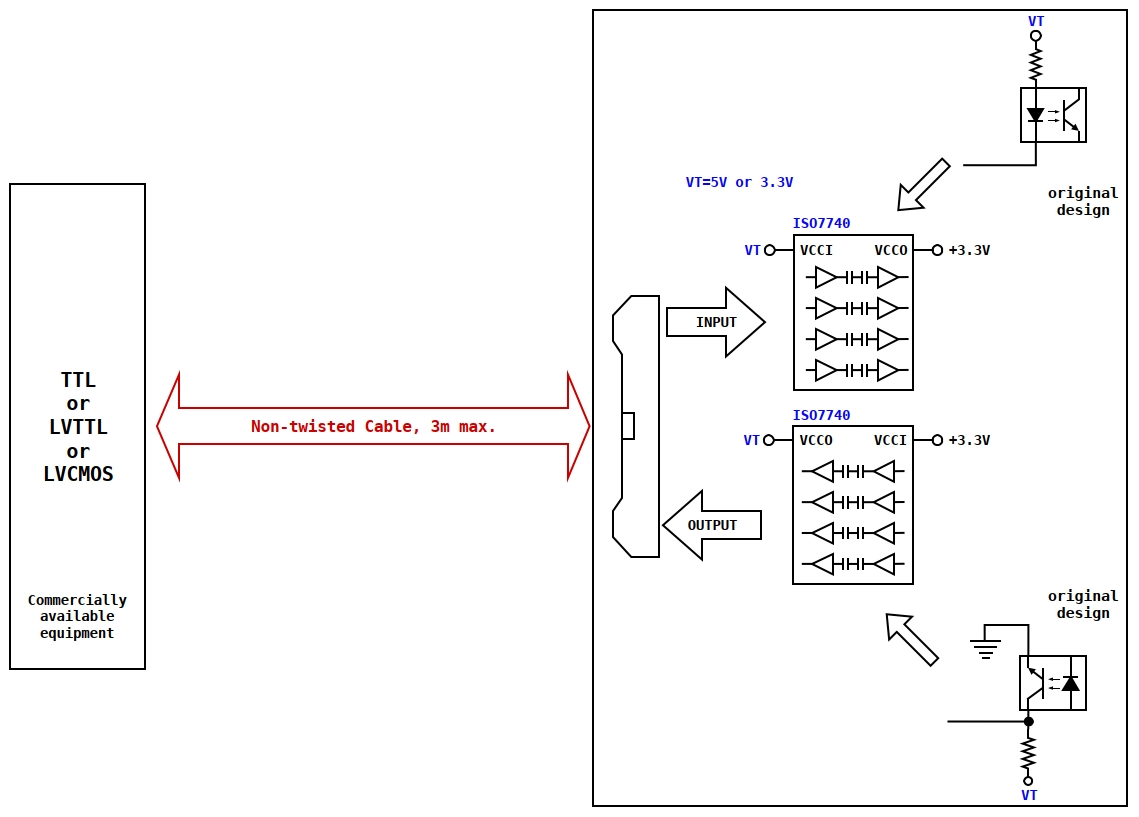
Any advice or recommendations regarding the suitability of the ISO7740 and the need for external protection components (e.g., TVS diodes, filtering) would be greatly appreciated.

Thank you!

  • Hi Wei,

    Thanks for reaching out and providing the details. Please find my inputs below:

    1. Output pins of Digital Isolators like ISO7740 are not capable of driving longs cables such as in this system. Hence directly using ISO7740 as a replacement without changing the system is not suitable in this case.
    2. ISO7740 is CMOS based input and output device:
      1. TTL-to-CMOS interaction is tricky because TTL's guaranteed high-output voltage (2.4V)) is often too low for a CMOS input's high-level threshold, which can cause unreliable communication. While CMOS can often drive TTL, a TTL-to-CMOS interface usually requires a level shifter, a pull-up resistor, or a CMOS buffer to ensure the voltage is high enough for the CMOS device to register a valid logic high. 
      2. ISO7240C is a TTL input digital isolator - but this also has the limitation of long wire communication.
    3. You can consider using our Opto-Emulator family of devices, the ISOM8110, ISOM8710(CMOS Output)/ISOM8711(Open Drain) and ISOM8610(SSR) based on your system requirements - Opto-emulators | TI.com

    If you have any further queries related to opto-emulators, I request you to start a new thread for the right experts to guide you.

    Regards
    Varun